Insights
AI and the future of your people - how to design your org structure for an AI world
In this week's Kowalah Wednesday Webinar, we focused on the big question as AI technology advances: "what does this mean for the people that work in your organisation?"
In this article, I'll pull out five images to guide your thinking.
Teams with AI produce better quality solutions
In a recent study Procter and Gamble (the CPG company) brought 776 of their colleagues to work on real-world tasks.
Some worked as individuals, some worked in teams, some were given ChatGPT, and some were not.
The real-world solutions that they came up with were blind-scored by a team of Procter and Gamble executives and rated according to their perceived quality.
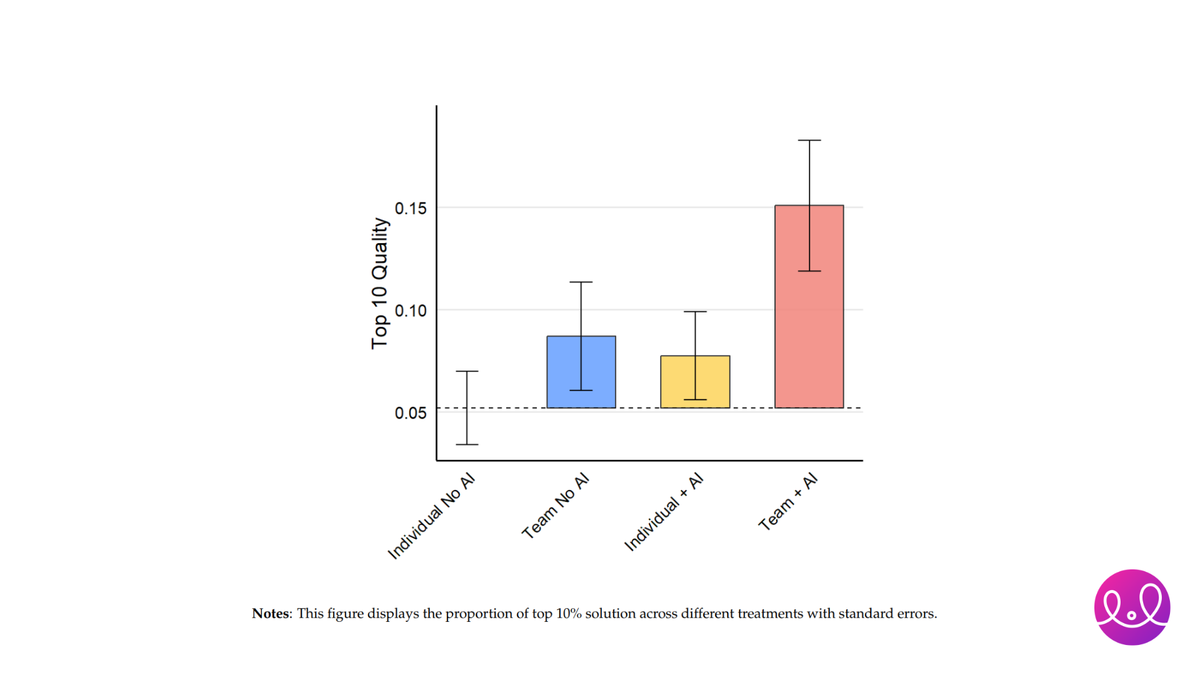
This chart shows the percentage of each cohort's solutions that made it into the top 10% of these quality solutions.
You can see that a team with AI produces by far the highest standard of quality.
What this means: even as AI improves, it is the diverse experiences and perspectives of our teams combined with AI that drives the best business outcome - we need people working together with AI.
From pyramids to pentagons
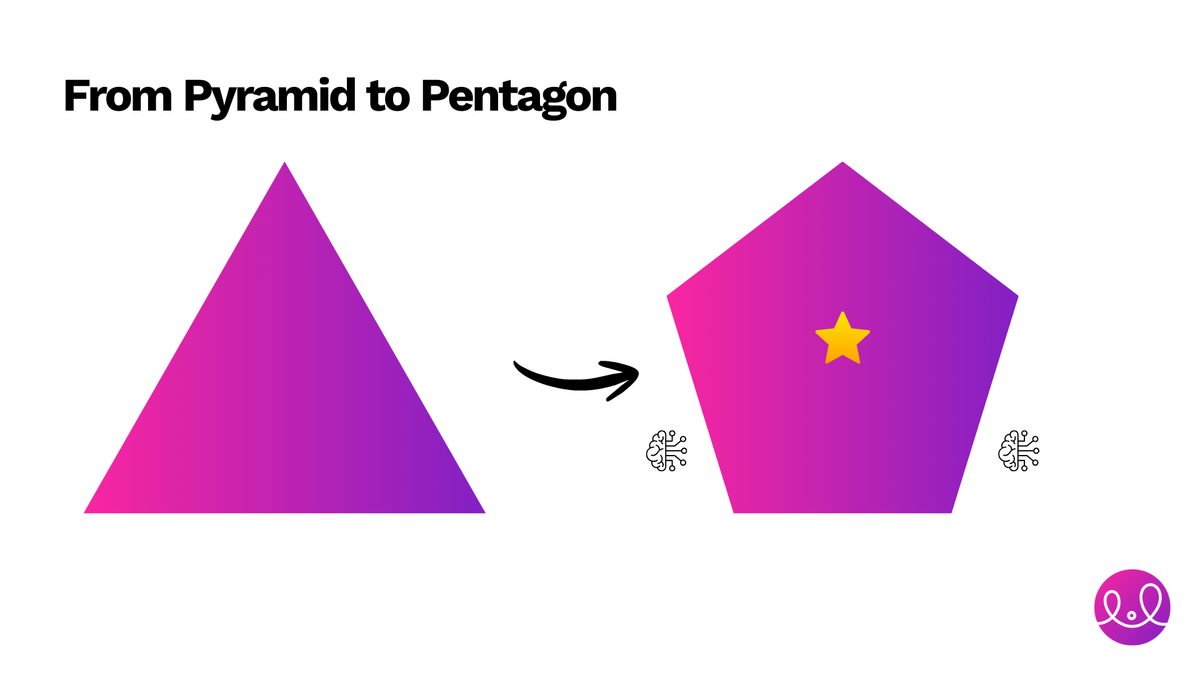
Regardless of industry, historically, you could describe a company org structure as a pyramid.
- CEO at the top
- VPs below.
- Managers below them
- Individual contributors below them
Companies hire into the base of the pyramid and over time graduate high performers up to the senior levels.
Yet so many of the roles at the bottom of the pyramid include titles like administrator, assistant, associate, analyst, and these types of roles are ripe for being replaced by AI.
We see the future org chart looking more like a pentagon, where AI-enabled high performers at the middle of the organization are using AI tools to complement themselves instead of delegating work to junior team members.
This provides a new challenge to senior leaders.
If there is no base of the pyramid, where do these high-performing individuals come from?
What this means: people leaders need to consider how to accelerate the development of their existing team members up into this high-performing middle.
As an AI-enabled organization, consider how to attract talent into the middle of the organization because of their AI-native focus
Your job is just a skill
I saw this post on X recently where someone said their new put-down was that your job is just a skill waiting to be written.
I hope it was a tongue-in-cheek post, but the point is real. Jobs have existed to take information from one place to another, to analyse information, to send communications. These are all skills waiting to be written.
[A skill is a prompt, a way of doing something that originated in Claude but is now available in ChatGPT.]
What this means: each of us, from the intern to the CEO, needs to take a strong look at the work that we're doing and ask if this applies to ourselves.
Even if our entire job is not a skill waiting to be written, what parts of our job are skills, and how can that improve our effectiveness if we off-load it?
AI is coming for (some) jobs
Anthropic published this chart a couple of weeks ago.
The blue shows the theoretical capability of AI to perform a specific job role. You'll see the top right: roles in business, finance, computing, even architecture and engineering are almost at human levels of capability
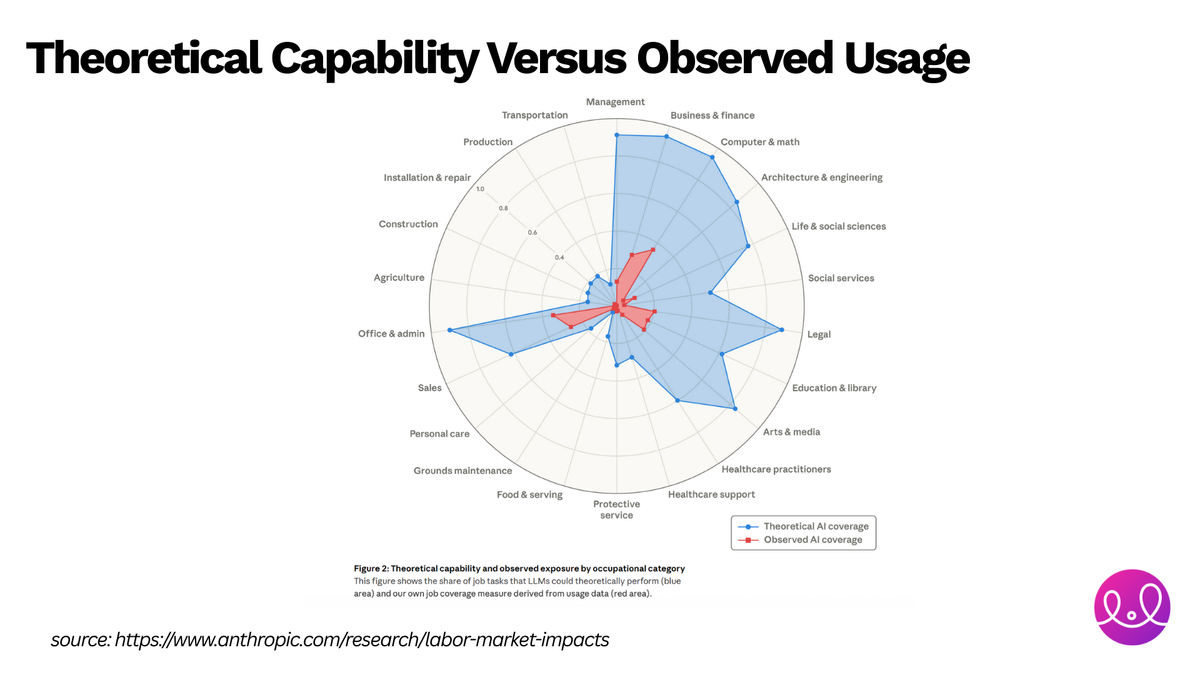
The red shows Anthropic's analysis of how their platform is being used to deliver work in these categories.
You can see there is a lot of potential, but as soon as companies and teams figure out how to use the theoretical capability, we should expect a rapid reconfiguration of what our workforce looks like as more work is handled by agents and less by humans
What this means: as a parent, I look at this chart and think about the guidance that I'd be giving to my children about where human work is still going to be valuable.
Prepare for the K-shaped economy
I found this chart on X recently, where the poster, Miles Deutscher, talks about the K-shaped economy.
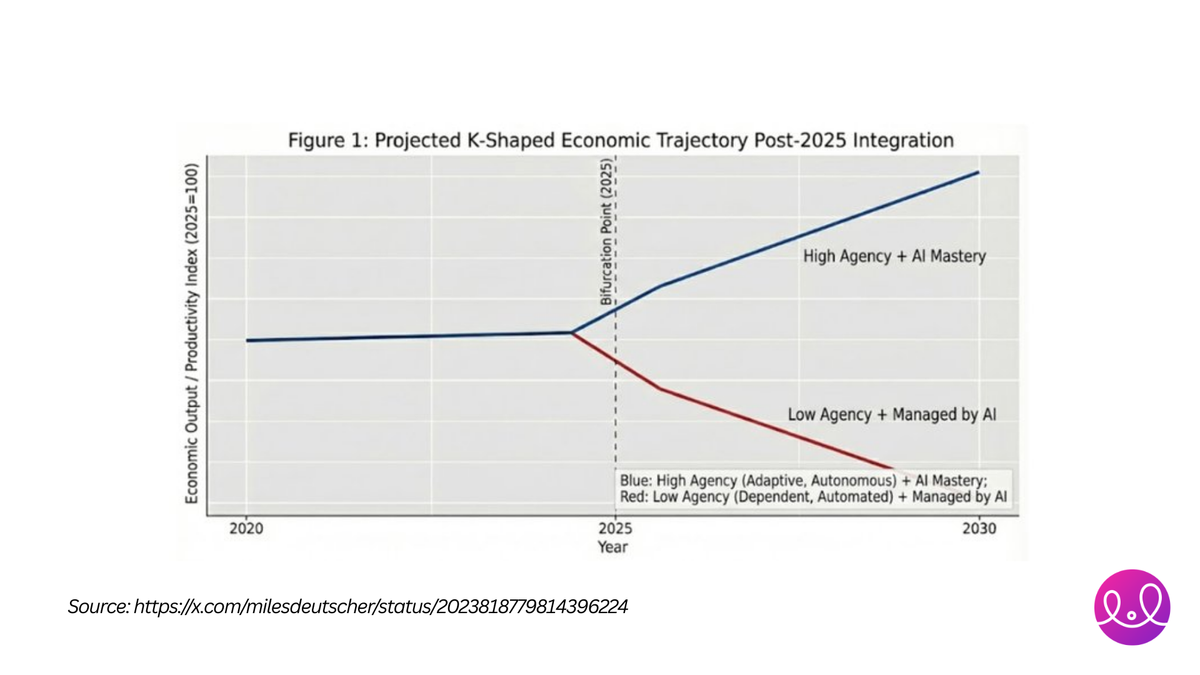
As individuals, as teams, as companies, we are at a fork in the road and we have a decision to make:
We can take the red path and refuse to accept what is going on in the world of AI. "We will not use agents to do the work. We will type code ourselves, we will negotiate contracts ourselves, we will write proposals ourselves"
Or we can take the blue path and have high agency, where we choose to use AI to teach us, to coach us, to mentor us, to do so much of our work through skills and agents.
What this means: Miles makes the point that we can either have high agency and be the one that is mastering AI, or we can have low agency and be the one that is being managed by AI - which do you choose?
Hiring the employee of the future
Building on Miles' K-shaped economy, Companies need to fill up their employee base with AI-native employees
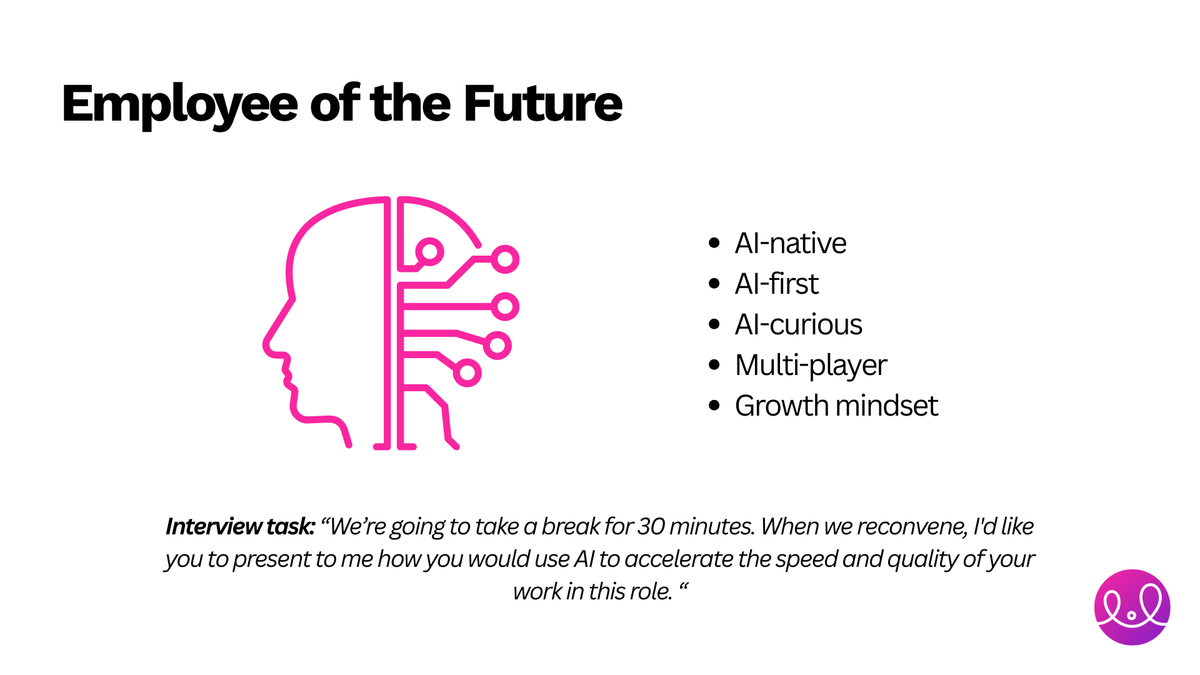
These are employees that
- introduce AI at the very start of dealing with the business challenge, not as a last resort
- are playing with AI tools in their personal time because it excites them, not because it's part of their job
- use AI in combination with their colleagues up on a screen in shared projects, not as a dirty little secret in solo mode
What this means: uncover these future employees, these future stars, with this interview task. During in-person interviews, give them this task:
“We’re going to take a break for 30 minutes. When we reconvene, I'd like you to present to me how you would use AI to accelerate the speed and quality of your work in this role. “
When you come back into the room, you'll very quickly work out who has got AI embedded in the way they think, and those that are frantically asking ChatGPT what to do in the same way they'd ask Google.
Go Deeper:
If you enjoyed these slides and want to watch the full webinar, including live demos of how people teams can put Claude to work to share policies to support goal setting or to have your first Talent Manager agent conducting interviews on your website, watch the YouTube video here.
Enjoyed this?
Weekly insights for executives navigating enterprise AI. A five-minute read.