Insights
Event follow-up, torn down: where event leads go cold, and how to redesign the process
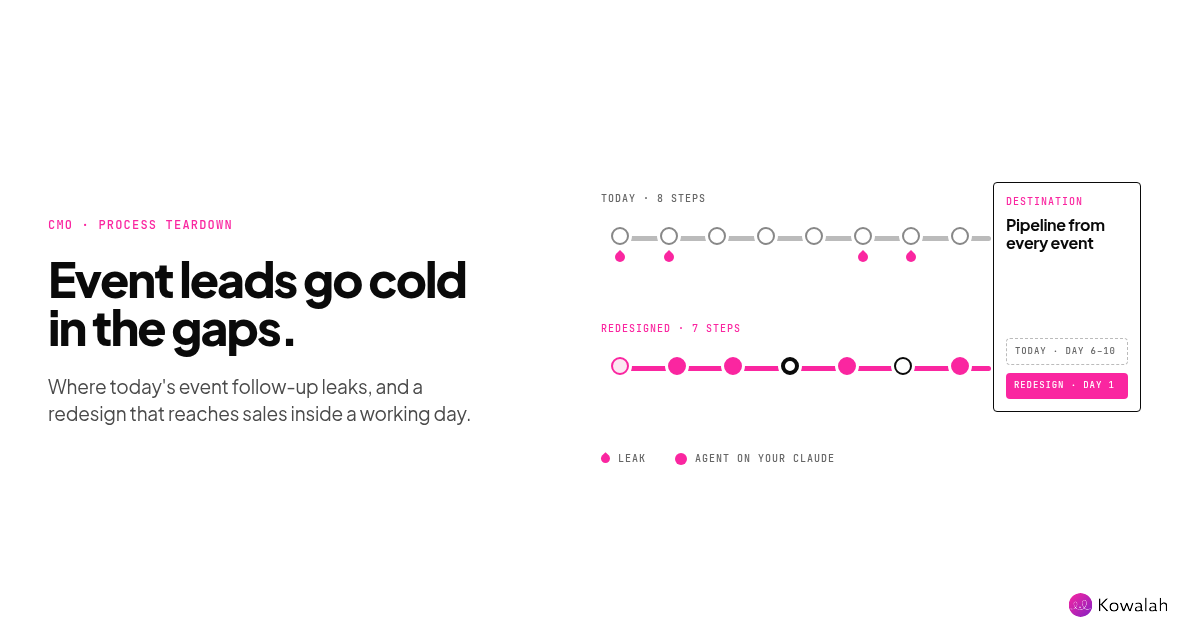
Event follow-up is the work between the badge scan and the first sales conversation. A common version runs to eight manual steps, five people and six to ten days, so warm event leads go cold before sales calls them. The fix isn't a faster email. It's a redesigned process: an agent on your own Claude runs the routine steps the evening of the event, and your team makes the judgement calls.
This is a process teardown: one revenue process, before and after. The numbers are illustrative, built on a two-day trade show with about 400 badge scans. They are not a client result.
The goal: pipeline from every event
Why it matters: events are one of the biggest lines in the marketing budget, and the board asks what each one returned. Forrester's Q1 2024 State of B2B Events Survey found that demonstrating ROI was the number one priority for event teams. In Bizzabo's 2025 State of Events survey of more than 1,500 organisers and attendees, 70% of organisers reported difficulty demonstrating ROI for in-person B2B conferences, summits and conventions in 2024.
The goal is the pipeline, and in time the revenue, each event produces. In Emily Kramer's four revenue levers (MKT1), follow-up sits on the efficiency lever: more pipeline from leads you have already paid for.
The KPI that moves it is time to first follow-up: the hours from the end of the event to the first personal touch for each attendee. Two companions keep it honest:
- Share of attendees followed up within one working day
- Event lead to meeting rate, read 30 days after the event
The same process runs after your own customer events, such as a user conference or a community meet-up. There the follow-up is about adoption and expansion rather than a first meeting, so the goal is keeping customers as well as finding them.
Today's process, on the APQC map
We map processes on the APQC Process Classification Framework, the cross-industry standard the Kowalah Platform uses. Event follow-up crosses two of its process groups:
- 3.3.4 Develop and manage promotional activities: running the event and evaluating its performance (3.3.4.5 and 3.3.4.6)
- 3.5.1 Manage leads/opportunities: receiving, qualifying and routing the leads (3.5.1.2 and 3.5.1.3)
The seam between those two groups is where the time goes. Marketing owns the first, sales owns the second, and the list sits in between. Here is a common version, after the illustrative trade show:
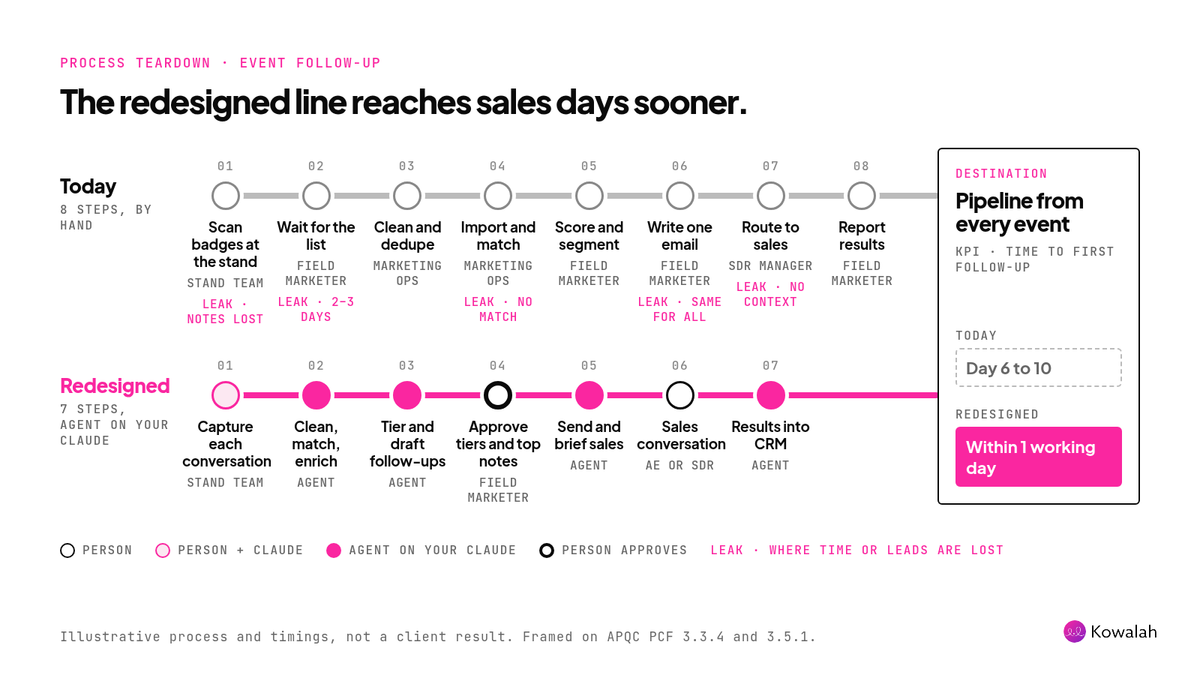
- Scan badges at the stand (stand team, day 0). Notes go into phones or onto the backs of business cards.
- Wait for the organiser's lead list (field marketer, days 1 to 3).
- Clean and dedupe the list (marketing ops, about 3 hours).
- Import into the CRM and match to accounts (marketing ops, about 3 hours).
- Score and segment (field marketer, about 2 hours).
- Write one follow-up email for everyone (field marketer, about 2 hours, day 6).
- Route warm leads to sales (SDR manager, days 6 to 8).
- Report the event's results (field marketer, about 4 hours, weeks later).
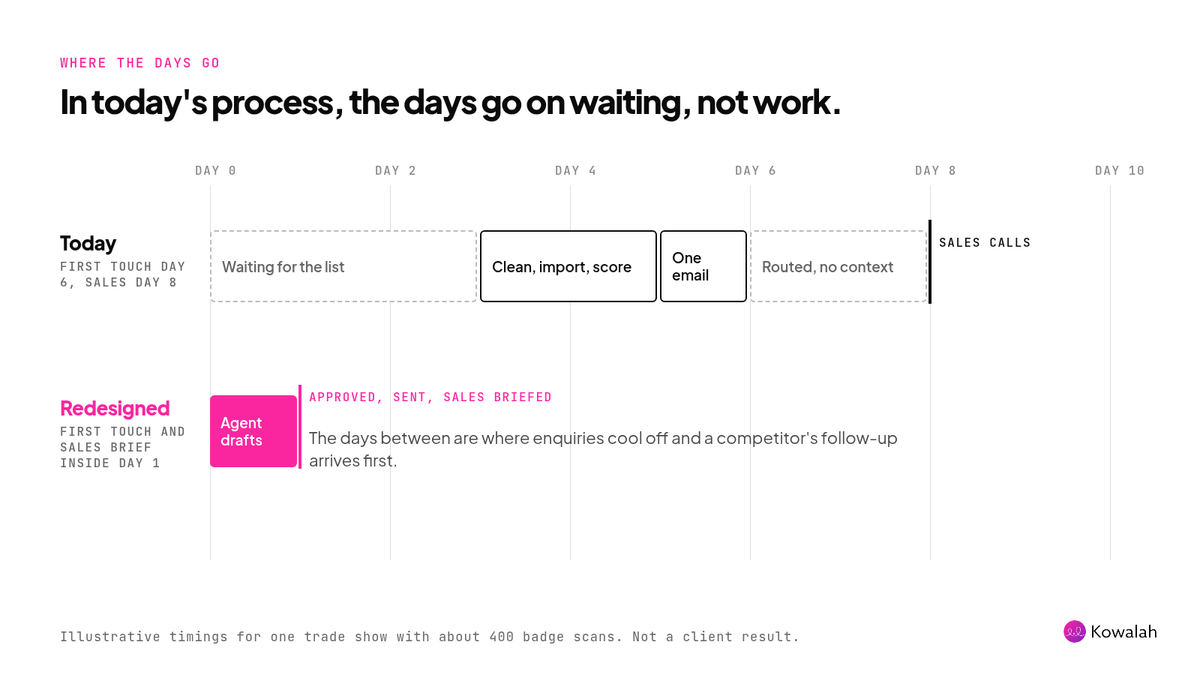
That's about 14 hours of people's time, and six to ten days before the first sales conversation.
Where it leaks
The conversation never reaches the CRM. The best signal from an event is what was said at the stand. If the notes stay on a phone, or the event platform never talks to the CRM, every attendee looks the same. Forrester's Q1 2024 State of B2B Events Survey found that only 21% of enterprises had fully integrated their event platform into their tech stack.
The list waits. The days go on waiting for an export and for a free afternoon in marketing ops, not on work. In a 2024 test of 1,000 B2B software companies, only 365 replied to a demo request, at an average of 1 day, 5 hours and 17 minutes. Event leads have a longer path to the CRM than a web form, so they are unlikely to be faster. They cool off while a competitor's follow-up lands first.
Everyone gets the same email. One message for 400 people ignores the 40 conversations that mattered. A generic note that lands a week later is easy to ignore.
Sales gets a name, not a reason. A lead routed without context gets the same priority as a cold list, and the rep has to redo the research before calling.
And the event report lands weeks later, so next year's keep, change or drop decision rests on badge counts.
A note on a famous number. "80% of trade show leads are never followed up" is quoted everywhere and credited to CEIR. CEIR says it isn't from its research, and the citation trail leads to a small 2010 exhibitor survey. You don't need it: the leaks above show up in your own CRM.
The redesigned process
The redesign starts from the goal, not the tools. Each step gets the cheapest thing that does it well: a person, a skill in Claude, or an agent. Here, an event follow-up agent we build on your own Claude account takes the routine steps, and your team keeps the judgement calls.
- Capture each conversation (stand team, with Claude). After each conversation, staff record a short voice note or a few words. Claude turns it into structured notes against the badge.
- Clean, match and enrich (agent). The evening of the event, the agent dedupes the list, matches each attendee to an account in your CRM, and adds what you already know: open opportunities, customer status, past events.
- Tier attendees and draft follow-ups (agent). It tiers every attendee against your ideal customer profile and the stand notes, and drafts a follow-up for each one that refers to what they talked about.
- Approve the tiers and the top messages (field marketer). The person who ran the event checks the tiers and edits the top-tier messages. Nothing goes out under your brand without that approval.
- Send and brief sales (agent). Approved messages go out. Warm leads land with the owning rep, with a short brief: who they are, what they asked and the suggested next step.
- Sales conversation (account executive or SDR). Unchanged, except it now starts with context.
- Results into the CRM (agent). Campaign membership, touches and meetings are recorded as they happen, so the event report builds itself.
Eight steps become seven. Four run on the agent, one is a person working with Claude, and two stay with people by design: the approval and the conversation.
| Today | Redesigned | |
|---|---|---|
| Time to first follow-up | Day 6 to 10 | Within 1 working day |
| What each attendee gets | One email for everyone | A message about their conversation |
| What sales gets | A name and a score | A brief and a suggested next step |
| People's time per event | About 14 hours | About 4 hours, mostly approvals |
| The event report | Weeks later, by hand | Builds as touches are logged |
What the agent needs: a connection to your CRM (HubSpot or Salesforce), the lead export from your event platform or the organiser, your tiering rules, and your brand voice. It runs on your own Claude and Anthropic account, so you own it and see what it costs each day. It starts read-only, and people approve what's sent.
The KPI to watch, and how to measure it
Baseline first. Before the next event, pull four numbers from the CRM for your last two or three events:
- Median hours from the end of the event to the first logged touch per attendee
- Share of attendees touched within one working day
- Event lead to meeting rate at 30 days
- Pipeline created within 90 days, per pound of event cost
Then compare. Run the next event on the redesigned process and read the same four numbers at the same points. Record the baseline and each reading against the goal, so the leadership team sees the KPI move, not a list of tasks.
Watch quality as well as speed. Read a sample of 20 messages from each event and track reply rates and unsubscribes. A faster bad email isn't the goal.
Where to start
Pick your next event with a date in the diary. Baseline the last one this week, using the free Event Follow-up Audit. Then decide which steps get an agent first. Start with steps 2 and 3, where the waiting is.
We're a UK Anthropic Implementation Specialist. We work with CMOs to redesign processes like this one against the KPI they move, then build the agents with your team on your own Claude account. A first step can be an Agent Pilot: one agent on one bottleneck, measured against a baseline.
Talk it through first
Book a free 45-minute planning session. Bring your next event and last event's numbers, and leave with the redesigned process and the KPI to watch. Book a planning session, or see how we work with CMOs.
Enjoyed this?
Weekly insights for executives navigating enterprise AI. A five-minute read.