Insights
How we Architect our Anthropic Managed Agents
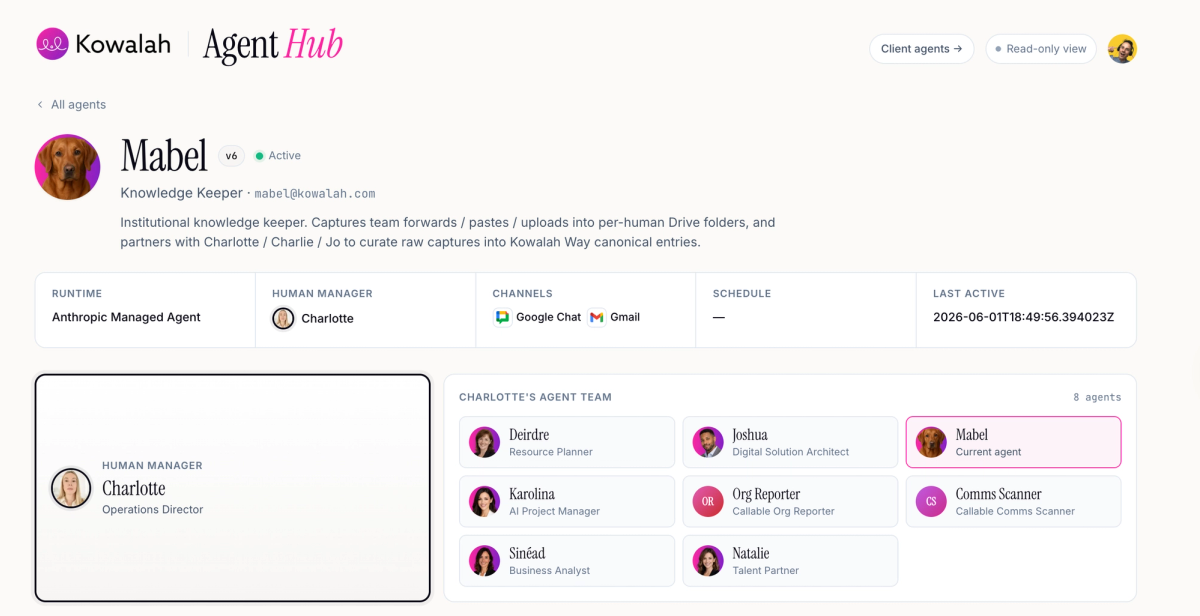
We give our agents human names and personalities.
- Karolina is our project manager
- Brian is our AE
- Deirdre is our resourcing manager
- Mark is our CFO
- And the list goes on…
We get asked two questions:
- Should you have just one company agent, or multiple like we do?
- What’s the benefit of giving them a human persona as opposed to “lead qualification agent”?
One agent or multiple
You have a trade off - one agent across the whole company is easier to manage and to raise awareness for.
Shopify’s agent is called River, Block’s agent is called Goose - every employee knows how to find them and how to use them.
But a generalist agent by its nature is not a specialist in a single area - whilst it can be provided with specific skills, its system prompt and personality needs to be general to cover an employee asking about the product roadmap, and another asking about the paternity policy.
At Kowalah we have one generalist agent - Mabel. She is the curator of all company information, she interacts with our human team (and other agents) to gather experiences, lessons learned, useful podcasts, funny anecdotes, ways of working (others refer to these agents as the “Company Brain”).
Our team can speak to Mabel via Google Chat (you may use Slack or Teams), or via Email and she has a general remit to support everyone in the team with general topics.
The other end of spectrum is to create multiple agents with specialisms.
- Each agent benefits from its own system prompt (defining its purpose, its personality and how it should interact).
- Each agent can be assigned its own skills to provide its specialist talents - Brian knows how to qualify deals and update HubSpot. Karolina knows how to review Granola project meetings and update our project management platform.
- Each agent can be assigned its own tools, and permissions in those tools - Brian (the AE) has access to HubSpot. Mark (the CFO) also has access to Xero our accounting system to be able to build cashflow forecasts off pipeline and actual invoice data.
- Each agent can build its own memories based on its work and the humans and other agents that engage with it.
Our experience is that just as you hire specialists into a sales, marketing or finance team, building specialist agents that develop domain knowledge and only work with a subset of your team (in addition to Mabel, the company brain) provides a much higher quality of work.
Human persona or process name?
This leads to the second question - why bother giving Brian, Krista, Claire, Joshua human personas?
Why not just call them demand gen agent and solution architecture agent?
We think about it in three stages:
- Building the agent
- Working with the agent
- Coaching the agent
Building the agent
When we start designing an agent we find it far easier to think of a human we have worked with in the past that has done that job.
We know what they did, we know who interacted with them, we know what systems they needed access to, and we know what outputs they provided.
Building Karolina the project manager agent was as easy as remembering the human Karolina I worked with and having Claude (using our agent builder skill) to develop a 9 page agent definition - our version of a job description and onboarding guide.
Secondly, once you’ve designed what your agent needs to do, setting up a ‘human persona’ in your Google or Microsoft workspace is simple.
We use Google, so we create them as a Google Workspace user in an agent-specific Organisational Unit.
They get email, calendar, GChat, Drive. We set them up with their own Shared Drive (so that any docs they create are immediately available to our human and agent team).
We use ChatGPT Image Gen to create an avatar for them which brings them to life.
(all our agents have a human avatar apart from Mabel - who is a fox red labrador!)
Working with the agent
To start with you experience the same issues as new humans starting at your company.
Who is Emily? What does Emily do? What is Emily good at? Wouldn’t it be easier if each human new starter just introduced themselves as “lead qualification human?”
But as with humans as you start working with people you understand who they are, what they are good at, when you would go to Brian’s desk, versus Karolina’s.
This is what we are experiencing in our team. Our GTM team know who Brian and Krista are and when and how to work with them.
Our delivery team are all over Karolina.
And as a leader - I spend a lot of time with McMahon (our CRO), Claire (our COO) and Mark (our CFO).
I love hearing from our team “I was chatting with Krista earlier and she was helping me plan our webinar series…”
Once you know who they are and what they are great at - it is actually way simpler than having a list of ‘processes’ to decide what to pick up and use.
Coaching the agents
I refer to Managed Agents as “self-improving software” - the more that you speak to them, the more that you work with them, the more they improve.
Each agent manages its own Google Drive folder, where they lay down documents that they create, context about the work that they’re doing, and trackers based on their monthly objectives. In addition, they run their own memory stores where they architect and write their own memories into the Anthropic platform.
Each agent is able to use this improving context and experience in each future chat - it is self-improving just as a human is the longer they are at your company. Both of these work independently but are extremely steerable.
“Hey Brian, can you remember that we follow the MEDDPICC approach to deal qualification? The most important of these is identifying the pain that the client is facing”
“Hey Krista, I listened to a great podcast today all about AEO and helping get your company surfaced in AI results. Here is the link to the transcript. Can you read it and store the framework as a doc in your Google Drive”
On a regular schedule, when we decide if an agent has enough memories that could actually be turned into a unique skill to help them to do a certain task or process in the future, we’ll build another skill to add to the agent’s capabilities.
This coaching is happening at scale across our team, with each agent having one human manager who is responsible for developing them.
(that’s develop as in career not as in code!)
Where to start - 1:1:1
If you’re just getting started, my advice would be to start with 1:1:1
- One agent
- One channel
- One data source
One agent: your version of Mabel, a company-wide generalist agent that every member of your team can access. This way everyone learns the potential of managed agents.
One channel: pick the place where your team congregate to get work done. That may be Slack, it may be Teams, it may be Google Chat - make it easy to find and work with your agent.
One data source: your generalist agent will definitely want multiple data sources in time, but it’s easy to get carried away and before you know it you’re buried in complexity, integrations, permissions and data integrity. So pick one. It could be your HR platform, it could be Sharepoint, it could be a policy directory.
Pick one data source, give your one agent access to it, allow people to speak to it through the one channel.
Through this experience you will learn a lot and the ideas for specialist agents will flow!
I hope this helps you get started, and I look forward to hearing all about your Mabel and how she’s helping as a valued member of the team.
Enjoyed this?
Weekly insights for executives navigating enterprise AI. A five-minute read.