Insights
Should you hire a GTM engineer? What the role does, what it costs, and what to decide first
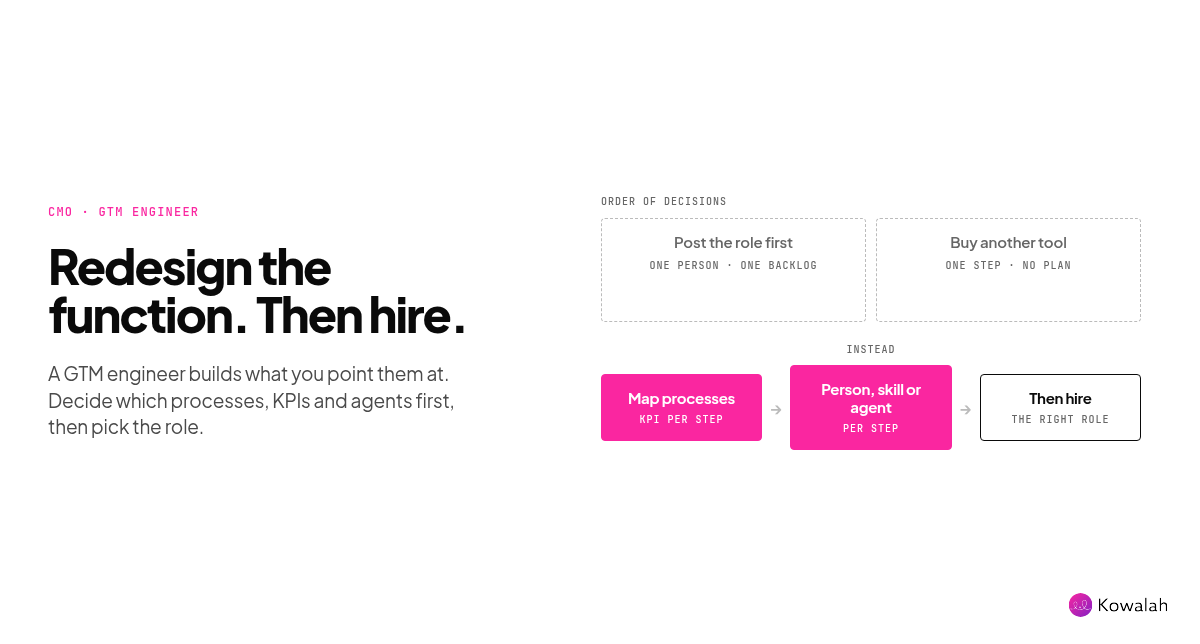
A GTM engineer builds the systems behind how you find, win and keep customers: data, routing, automation and, now, AI agents. In the UK the role's median advertised base is about £70,000. Before you post it, decide which processes move your number and which steps need a person, a skill or an agent. Then you'll know what role to hire.
That's the short answer. Below is what the role does, what it costs, a sample job description, and the decision to make first.
What is a GTM engineer?
"GTM engineer" is short for go-to-market engineer. Clay, the data tool company, says it coined the term in 2023. It defines the role as someone who builds automated revenue systems using AI, data enrichment and workflow automation, and reports that about 100 GTM engineer job listings go live every month.
In practice a GTM engineer sits between marketing, sales and RevOps. They:
- Route and enrich inbound leads so the right person replies fast
- Build research and outbound workflows for target accounts
- Update the CRM from calls and emails so reps don't have to
- Wire up attribution, reporting and buying signals
- Build and maintain AI agents and the tools reps use every day
The best ones measure themselves on revenue outcomes, not tickets closed. Clay says its own GTM engineers were measured last quarter on pipeline created, stage-one-to-stage-two conversion and quota capacity per seller.
How much does a GTM engineer cost in the UK?
The role is new, so the data is thin. Two checks, as of November 2026:
- The GTM Engineer Search salary index puts the UK median base at £70,000, across 23 job postings in the last year.
- A London GTM engineer role advertised on RevOps Careers in October 2026 offered £70,000 to £90,000 plus equity.
Add employer National Insurance, pension, recruiter fees and the months it takes to recruit and serve notice. The bigger cost is what the person is pointed at in their first six months.
What a GTM engineer job description includes
Here's a sample you can adapt. Write yours after the redesign, so the list reflects the work you found.
- Purpose: build and run the systems that help marketing and sales hit the revenue target with the team we have.
- Owns: lead routing and enrichment, the CRM data model, workflow automation, and the agents and skills the team uses.
- Measured on: the KPIs named in the plan, such as speed to lead, meetings booked, pipeline created or conversion between stages.
- Works with: marketing ops, RevOps, sales leadership, and IT and security for anything that touches customer data.
- Skills: CRM administration, APIs and webhooks, SQL or Python, prompt and agent design, and a commercial instinct for what moves pipeline.
- First 90 days: take over the processes already mapped, keep the agents running, and improve one KPI from its baseline.
Should you hire a GTM engineer? The two routes compared
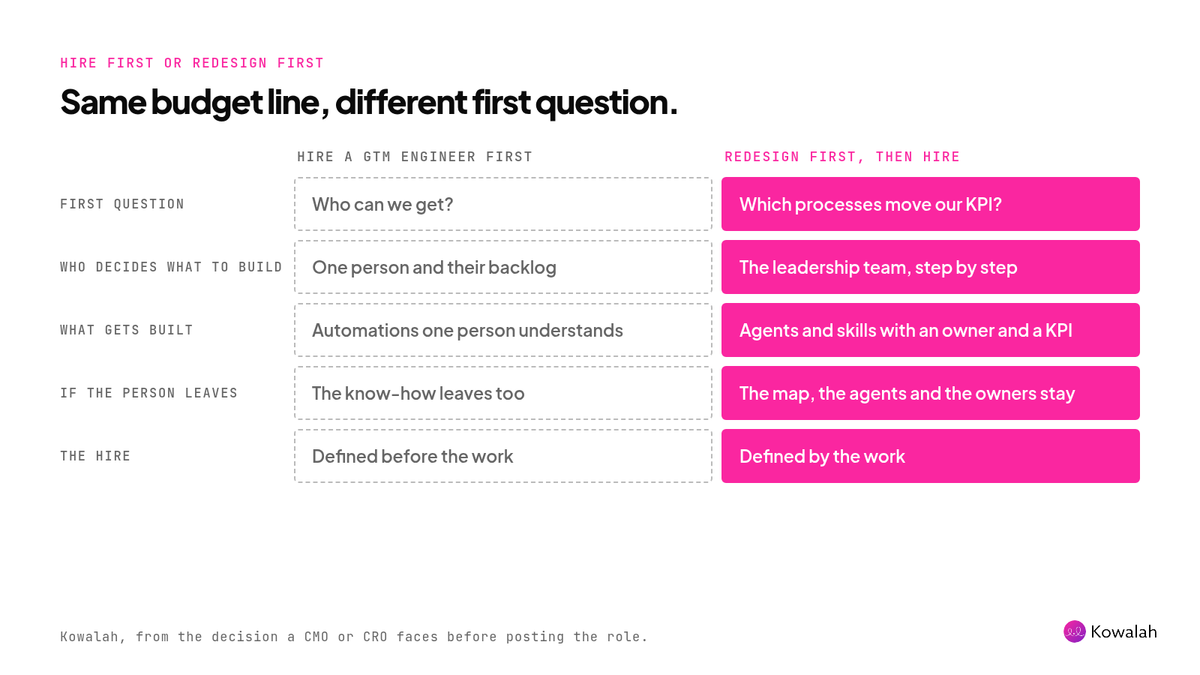
The question isn't whether GTM engineers are good. The ones we meet are. It's what you ask them to do on day one.
| Hire a GTM engineer first | Redesign the function first, then hire | |
|---|---|---|
| Starting question | Who can we get, and when can they start? | Which processes move our KPI, and what does each step need? |
| Who sets the priorities | The new hire, working through a request backlog | The CMO or CRO and the leadership team, ranked by KPI |
| What gets built | Automations and agents one person understands | Agents and skills, each with an owner and a KPI |
| How the team changes | Little; automations are bolted on | Each step is redesigned and the team is trained to run it |
| If the person leaves | The know-how leaves with them | The process map, agents and owners stay |
| How the hire is defined | Before anyone knows the work | By the work the redesign found |
| Best when | The processes are already mapped and you need someone to run and extend them | You know the target but not yet which steps need a person, a skill or an agent |
Route 1: hire first
You write a job description, recruit, and give the new hire a backlog. The backlog comes from whoever shouts loudest: the events team wants follow-up fixed, sales wants better lead routing, the CEO wants to know what ChatGPT says about you.
One capable person works through it. They build automations that work. Then three things happen.
- The order is set by requests, not by the number. Nobody ranked the processes by the KPI they move.
- The knowledge sits in one head. The workflows run in tools and scripts only that person fully understands.
- The team doesn't change. Marketing and sales keep working the same way, with automations bolted on.
When that person leaves, you hire again and start from their notes.
Route 2: redesign the function first, then hire
You start from the target. Which processes move it, step by step, and which KPI does each step change? Then you tag each step: does it need a person, a skill (a reusable set of instructions the team runs in Claude), or an agent that does the work and hands it to a person to approve?
Now the role writes itself. If over half the work is agent and skill work, you build those first and train the team to run them. If the gap is judgement and relationships, you hire for that. If it's systems and data plumbing, a GTM engineer or a RevOps hire fits, and you know exactly what they're taking over.
The questions leaders ask us
These come up in conversations with marketing and sales leaders weighing the hire.
Should we hire a junior builder to find things to automate, or a senior engineer? Map the processes first. A junior builder without a map automates what's visible, not what moves the number. A senior engineer without a map spends their first quarter making it.
What will the hire use as their system of record, and how will we measure them? Decide both before the hire starts. Name the KPI for each process and record a baseline, so their work is judged on the number, not on the number of automations.
How do we stop 60 people building the same assistant? Agree the shared skills and agents centrally, give each one an owner, and publish them to the team. A single hire can't police that alone.
How to decide in an afternoon
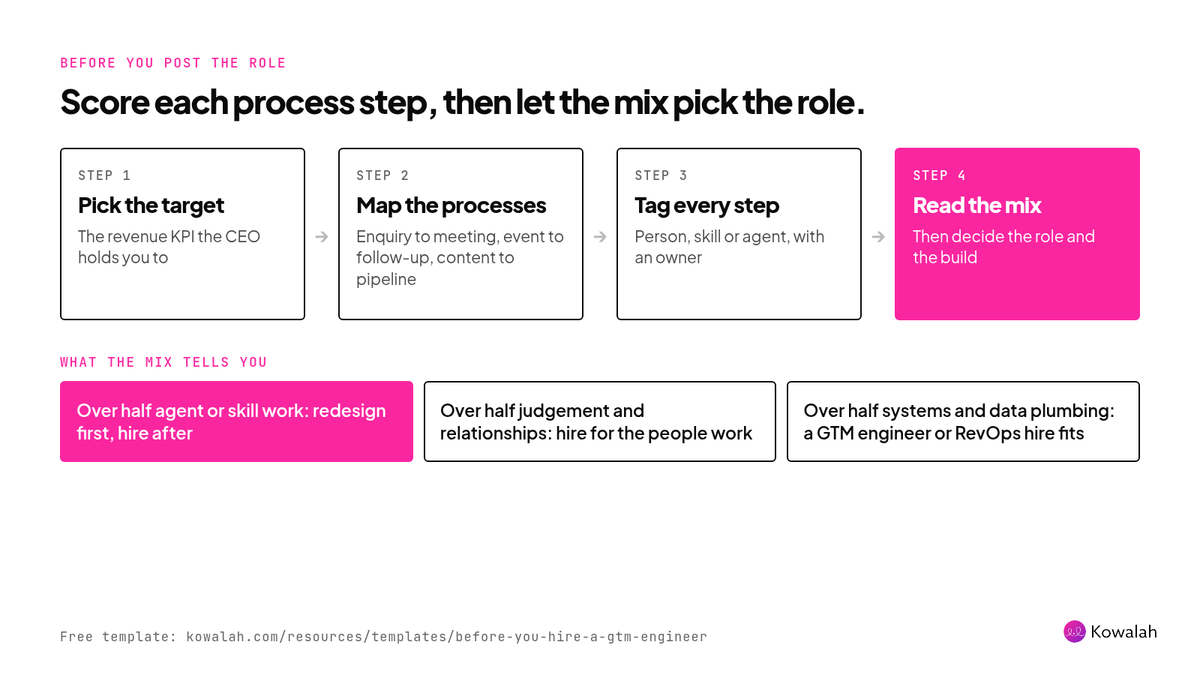
- Pick the target. The revenue KPI the CEO holds you to: new pipeline, net revenue retention, or both.
- Map the processes that move it. Enquiry to meeting, event to follow-up, content to pipeline, renewal to expansion.
- Tag every step as person, skill or agent, and give each an owner.
- Read the mix. It tells you whether to redesign first, hire now, or both.
Our free Before you hire a GTM engineer checklist walks through these steps and scores the result. If you want the full version, our AI marketing plan template turns the map into a plan your CEO will read.
Where Kowalah fits
We're a UK Anthropic Implementation Specialist. We work with CMOs and CROs to redesign the function before the hire: we map the processes to your KPIs, then build the agents and skills with your team on your own Claude account, so you own them and see what each one costs.
That work can take the form of an AI marketing or sales plan or an Agent Pilot on one bottleneck, measured against a baseline. If you still need a GTM engineer afterwards, you'll hire one with a clear brief and a running system to take over.
Talk it through first
Book a free 45-minute planning session. Bring your number and the role you're about to post. You'll leave with the processes to change first and a view on what the hire should own. Book a planning session, or see how we work with CMOs.
Enjoyed this?
Weekly insights for executives navigating enterprise AI. A five-minute read.