Insights
How to build an AI sales playbook your reps will actually use (free template)
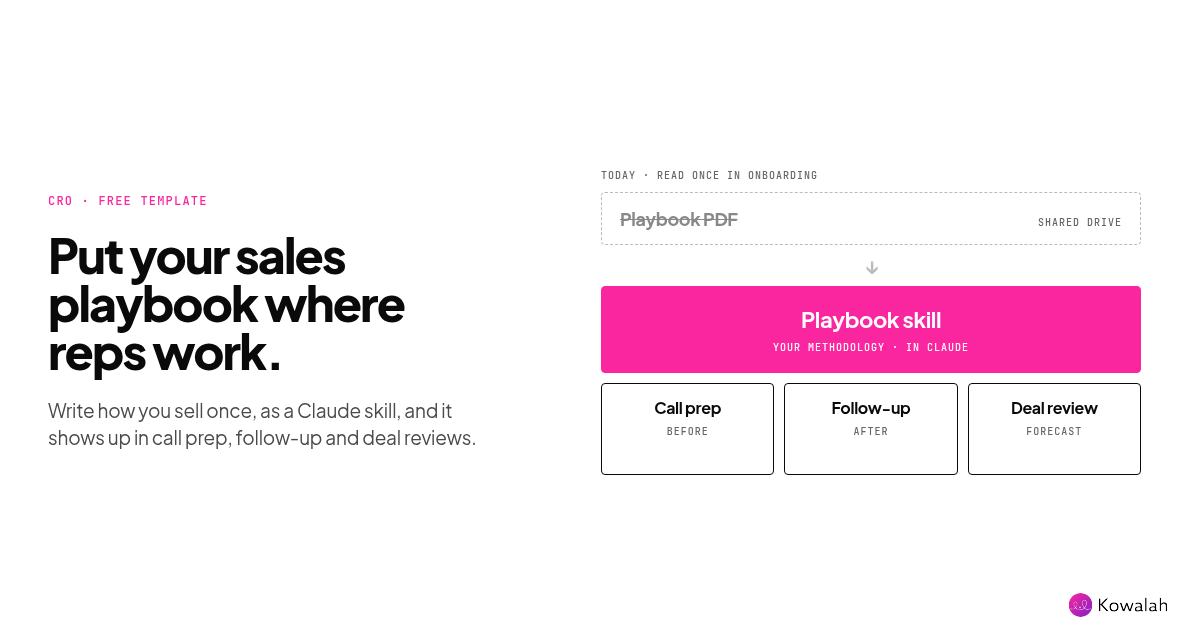
Most sales playbooks are read once, in onboarding, and then sit in a shared drive. An AI sales playbook works differently: you write how your team sells once, as a Claude skill, and it shows up where reps already work: call prep, the follow-up and the deal review. Here's how to build one in seven steps, with a free AI sales playbook template to fill in as you go.
This guide is for CROs, VPs of Sales and Heads of RevOps at B2B tech companies of 200 to 1,000 people whose bookings target went up while the team didn't.
Why the PDF playbook doesn't get used
Reps don't lack the will. They lack the time. Salesforce's State of Sales, 7th edition, a survey of 4,050 sales professionals, found reps spend 60% of their week on work other than selling. Training alone takes 11%.
The same report shows why the guide on the shared drive isn't the answer. 52% of reps say traditional enablement, such as courses and guides, doesn't give them the skills they need. 46% rarely get feedback on their sales conversations, and 40% say their manager's lack of time is an obstacle.
So the problem isn't the content of your playbook. It's where it lives. As one sales leader put it to us: even a perfect process fails if people don't follow it. An AI sales playbook puts the process inside the work, so following it is the easy option.
Step 1: Start from the number and the KPI
Write one line first: the bookings target, the date, the number of reps carrying it, and the gap. Then pick the KPI the playbook has to move. For most teams it's one of three:
- Win rate, if deals enter the forecast that shouldn't.
- Sales cycle length, if deals stall between stages.
- Rep ramp time, if new hires take two quarters to sell like your best people.
Take a baseline for that KPI now. Without it, you can't show the CFO the playbook made a difference.
Step 2: Write down how you sell today
Most of your playbook already exists. It's in your best reps' heads, your win and loss notes and your call recordings. Write down four things:
- Who you sell to: your ideal customer, the disqualifiers, and the people on a typical buying committee.
- Why they buy: three value points, each with proof you're allowed to use.
- How deals move: each stage, with exit criteria the buyer meets, not activities the rep completes. "Pain and budget confirmed by the economic buyer" beats "demo done".
- How you qualify: your framework, such as MEDDPICC, with what good evidence looks like for each element.
Do this with two of your best reps and your RevOps lead. One team we spoke to found that tacit knowledge stayed with sellers, so when someone left, their pipeline knowledge left with them. Writing it down is the first fix, whether or not you add AI.
Step 3: Write one play per selling moment
A play is a short page for one moment in a deal: inbound follow-up, discovery, the first demo, bringing in the finance buyer, the proposal, negotiation and renewal. Each one answers the same seven questions.
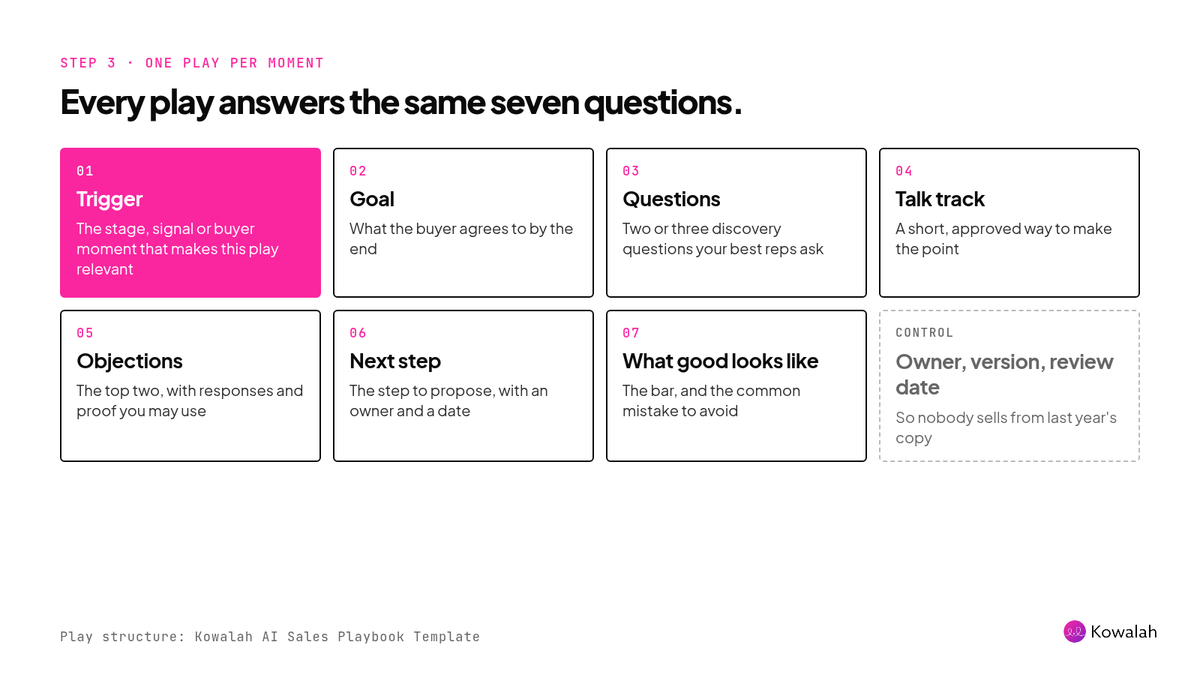
Keep each play to a page. If it takes longer to read than the call it prepares for, nobody will read it.
You won't write all of them at once. Score each play on impact, confidence and ease from 1 to 10, multiply, and write the top three first. Start where deals leak, at the stage with the lowest conversion.
Step 4: Turn the playbook into a Claude skill
A skill is a folder of instructions that Claude loads when a task matches it. Each one has a SKILL.md file with a name and a short description, which Claude reads to decide when to use it, plus any reference files it needs. Anthropic's guide to creating custom skills explains the format.
Your playbook becomes one skill: the instructions say how your team sells, and the reference files hold the plays, the stage definitions, the qualification checklist and the approved objection responses. On Team and Enterprise plans, an owner can provision the skill to everyone in the organisation, so every rep gets the same version and updates reach everyone at once.
This is also where the generic tools fit. Anthropic's own sales plugin for Claude has 36 skills, from call prep and call summaries to deal reviews and forecasts, and it reads your CRM's own stages and fields. What it can't know is how your team sells. Your playbook skill supplies that.
Step 5: Put it in the moments reps already work
Don't ask reps to open the playbook. Bring it to three moments they can't skip:
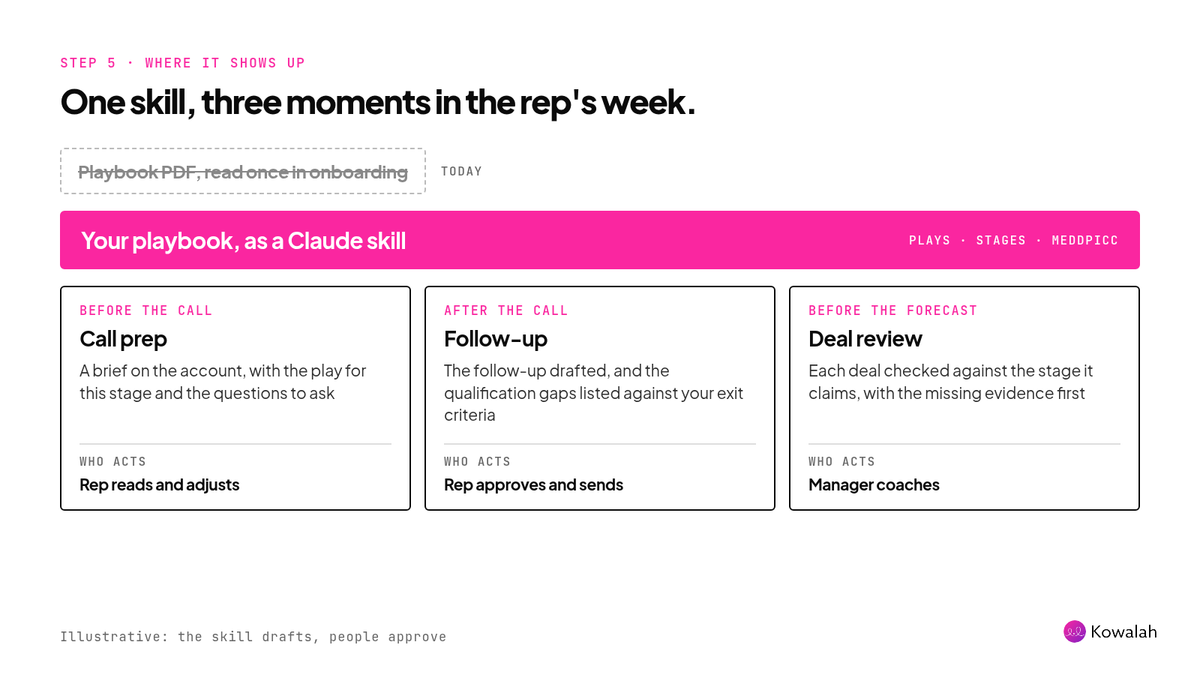
- Before the call: Claude prepares a brief on the account, with the play for this stage and the questions your best reps would ask.
- After the call: Claude drafts the follow-up and lists the qualification gaps against your exit criteria. The rep edits and sends.
- Before the forecast call: each deal is checked against the stage it claims to be in, with the missing evidence listed first, so the manager coaches on gaps rather than asking what happened.
That third moment is where the playbook starts to move forecast accuracy as well as win rate. It also helps with the gap the Salesforce survey found: managers without the time to coach every deal.
Step 6: Set the rules before reps trust it
Reps lose faith fast. One revenue team told us that one or two poor recommendations would be enough for people to stop using a tool. Another objection we hear often: "I'd never let an agent update our CRM." Both are answered by rules written into the skill:
- Use approved sources only, and flag any claim without one rather than inventing it.
- Send anything about pricing, discounts or contract terms to a person.
- Start with drafts. The rep approves what goes to a buyer.
- For CRM changes, add evidence-based notes rather than overwrite fields, never delete or merge records, and ask when unsure.
Start read-only and widen what Claude can do as the team sees it get things right.
Step 7: Measure it and keep it alive
Give the playbook an owner, a version number and a review date, so nobody sells from last year's copy. Each month, compare the KPI with your baseline, read the win and loss notes, and change the plays that aren't working. Log what changed and why.
Track two leading indicators alongside the KPI: the share of calls with a follow-up sent the same day, and the share of forecast deals with complete qualification evidence. They move first, so they tell you early whether reps are using it.
Use the free template
The AI Sales Playbook Template follows these seven steps: the number and the KPI, who you sell to, why they buy, stages with exit criteria, a MEDDPICC evidence checklist, ICE scoring for which plays to write first, a one-page play, objections and competitors, the rules for Claude, a SKILL.md outline, measures and a change log. It's free and ungated: copy the page or open the Google Docs version.
Where Kowalah fits
On our page for CROs, this is the sales playbook skill: we turn your sales methodology and messaging into a Claude skill every rep uses, connected to your CRM and call recorder. It runs on your own Claude account, so you own it.
If you'd like help deciding where to start, bring your bookings target to a free 45-minute working session. We'll map it to your processes and team, and you'll leave with a one-page plan: the first three processes to change, the agents and skills for each, and how your team changes. Bring your number. Leave with a plan.
Frequently asked questions
What is an AI sales playbook?
Your sales methodology, plays and messaging written so Claude can apply them in the work reps already do: call prep, follow-ups and deal reviews. It's the same playbook, used in every deal rather than read once.
What should a sales playbook include?
Who you sell to, why they buy, your stages with buyer-based exit criteria, how you qualify, one play per selling moment, objections and competitors, and the KPI it's meant to move, with an owner and a review date.
Do we need Claude Enterprise to build one?
No. You can write the playbook with the template whichever AI you use. Skills work on paid Claude plans, and on Team and Enterprise an owner can provision one skill to the whole team.
Will reps feel watched?
Not if the skill serves the rep first. Start with the brief before the call and the follow-up drafted after it. Deal reviews come once reps trust what it writes.
How long does it take to build?
Most of the time goes on steps 2 and 3, writing down how you sell. Start with your three highest-scoring plays rather than the full playbook.
Enjoyed this?
Weekly insights for executives navigating enterprise AI. A five-minute read.