Insights
AI SDR tool vs inbound agent vs hiring a BDR: which closes the gap?
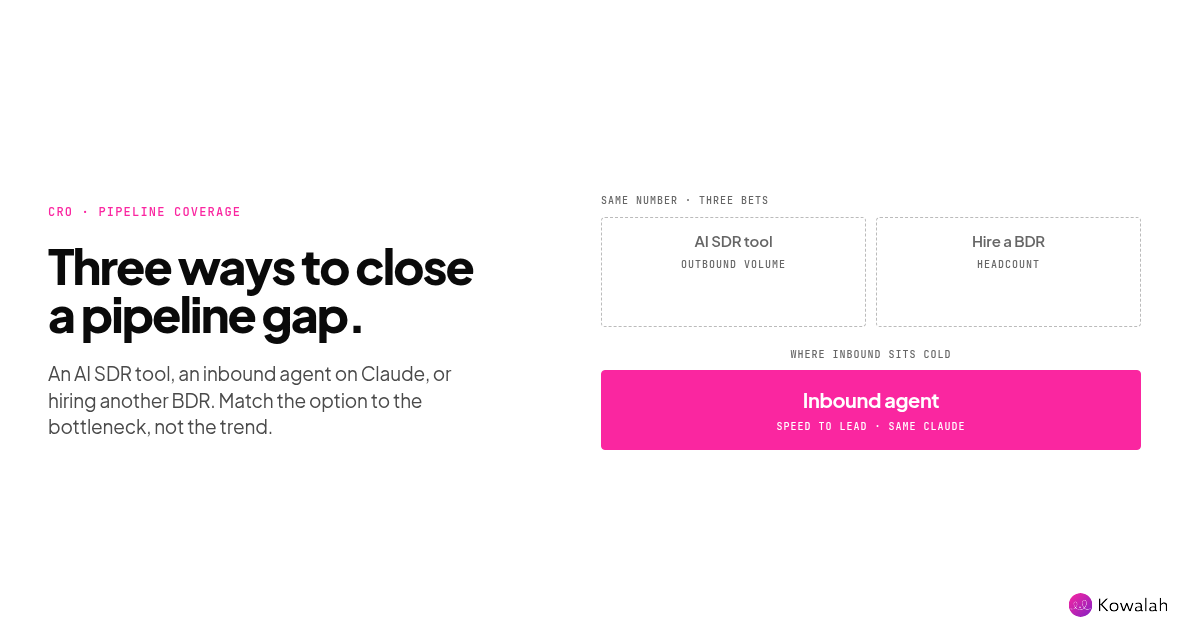
Your bookings target went up. The CFO will not approve three more BDRs. So you are staring at three options that all claim to close the gap: buy an AI SDR tool, hire another BDR, or put an inbound agent on the Claude you already pay for.
This is for CROs, VPs of Sales and Heads of RevOps at 200 to 1,000-person B2B tech firms who need more pipeline coverage without growing headcount, and who keep being sold volume as if it were revenue.
The vendor pitch collapses three different jobs into one seat. Outbound volume, inbound speed and live judgement are not the same problem. Buying the wrong one leaves the number untouched and burns a quarter.
The choice most CROs are being sold
An Emporia Research survey for SlateCX, fielded in September and October 2025 among 103 marketing and sales leaders, found that 79% of organisations have adopted or plan to adopt AI SDRs, but only 5% find them highly effective. Ninety per cent described them as limited, poorly integrated or overly aggressive. That is the backdrop for every vendor demo you sit through this quarter.
Meanwhile Salesforce's seventh State of Sales report says reps still spend 60% of an average workweek on work that is not selling. The pressure to buy something that scales is real. The risk is buying the wrong bottleneck.
In recent conversations with revenue leaders, the same questions keep coming up. How fast must an inbound reply land? Which routing stays with a human? Should the first Claude pilot be inbound or outbound? The answer starts with naming the gap, not picking a tool.
The three options, side by side
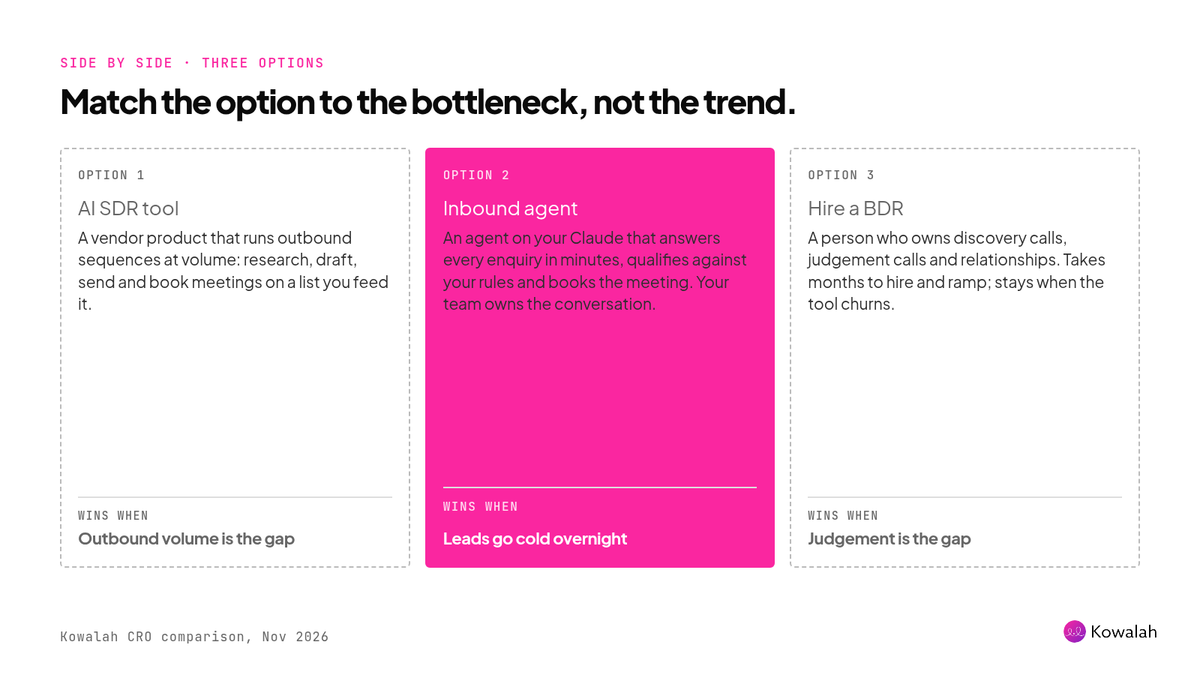
| AI SDR tool | Inbound agent on Claude | Hire a BDR | |
|---|---|---|---|
| What it is | A vendor product that runs outbound sequences at volume | An agent that answers, qualifies and books inbound on your Claude | A person who owns discovery calls and judgement |
| Primary KPI | Meetings booked from outbound | Speed to lead; inbound pipeline coverage | Qualified conversations and ramp |
| Time to first result | Days to weeks once lists and messaging are ready | Weeks once qualification rules and connectors are set | Three to six months to hire and ramp |
| What it cannot do | Judgement on complex deals; protect your domain reputation alone | Create outbound volume from a cold list | Reply in minutes every evening and weekend |
| Main risk | Volume without quality; deliverability damage | Brand risk if the agent sends the wrong reply | Cost grows with output; knowledge leaves with the person |
| Best when | You have a defined ICP, warm list, and outbound volume is the gap | Enquiries go cold overnight and inbound is documented | Deals need live judgement, objections and buying committees |
When an AI SDR tool is the right bet
Buy an AI SDR tool when outbound volume on a defined list is genuinely the constraint. The tool wins at research, enrichment, first-draft messaging and routine follow-up that a human reviews. It loses when the work depends on reading the room, navigating a buying committee or disqualifying a prospect on a live call.
- Defined ICP. You have thousands of similar accounts and a rules-bound message.
- Warm list. You have existing contacts that have engaged, purchased or attended events previously
- Volume gap. Your bottleneck is coverage and reply volume, not conversation quality.
- Human review. Someone on the team will review replies, stop sequences and own exceptions.
Treat meetings booked as a leading indicator, not the score. Measure held meetings, opportunities accepted by AEs, and cost per qualified opportunity. If those diverge, the tool is generating calendar noise.
When hiring a BDR is the right bet
Hire when the unresolved work needs accountable seller time: judgement, objections, multi-threaded deals and relationships. A BDR still wins where trust and live conversation move the number.
- Complex motion. Long cycles, buying committees and phone-led selling.
- Coaching capacity. You can name the manager, the ramp plan and the handoff rules before the offer goes out.
- Process ready. Your current process can absorb another person without creating more operational mess.
Hiring is the familiar budget line. It is also the slowest path to a working quarter. If the CFO has frozen headcount, the case has to be made against the next hire you do not need, not as a soft preference for tools.
When an inbound agent is the right bet
Start with inbound when the leads you already earn go cold before sales sees them. Enquiries that arrive after five sit until morning. Event follow-ups land days late. The agent reads every enquiry, researches the company, replies within minutes against your qualification rules, and books the meeting. Your team owns the conversation.
That matches what we hear in the field. Revenue teams often pick inbound before outbound for a first Claude pilot because inbound is documented and rule-based. Outbound stays messier and needs more experimentation. Harbor BD, writing from a year of outbound deployments, made the same practical point: inbound is where AI earns its seat, while cold outbound into executive buyers still depends on human judgement.
- Speed to lead. Overnight and weekend enquiries are going cold.
- Documented criteria. You can write qualification rules a skill can follow.
- Ownership. You want the agent on your own Claude and CRM, with drafts the team can approve.
Agents should start read-only. The team decides what gets sent. That answers the brand-risk anxiety without freezing the project.
How to decide in one leadership meeting
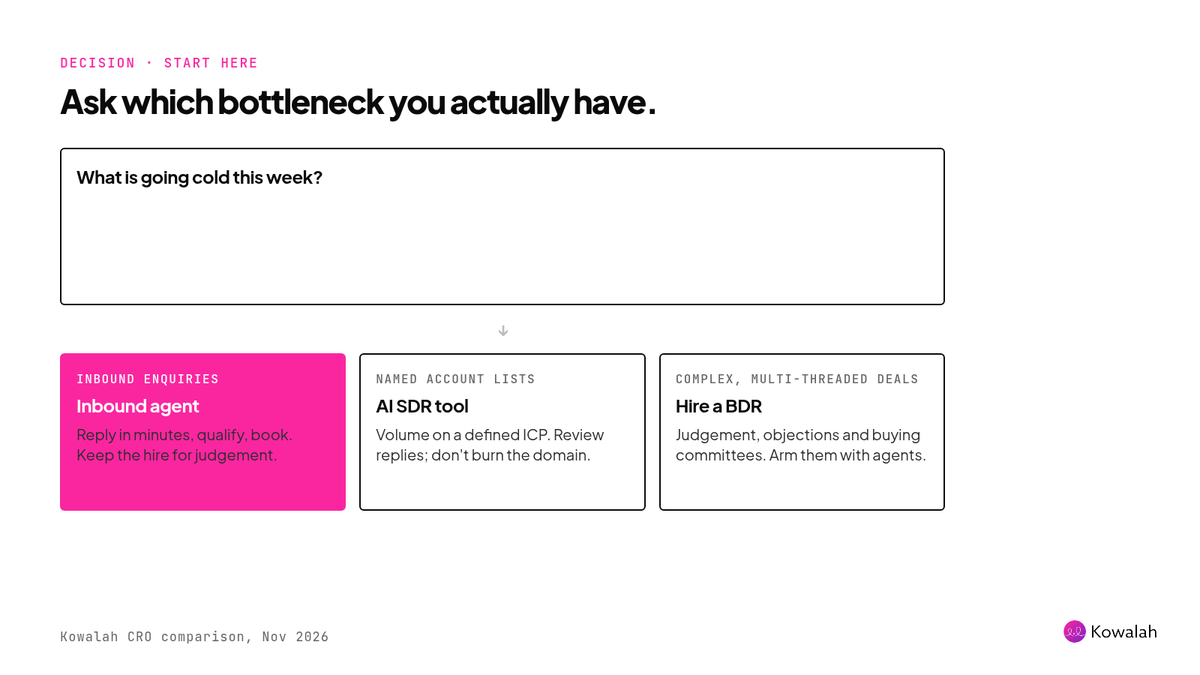
- Identify the bottleneck. What went cold last week: inbound enquiries, named-account outbound, or complex deals that needed judgement?
- Pick the metric. For each option, write the KPI you will put in front of the board in 90 days. Meetings booked alone is not enough.
- Fund it. What would you stop spending to fund it: an agency, a tool seat, or the next hire?
- Identify the owner. Who owns exceptions: RevOps, a sales manager, or the hire? If nobody owns them, do not buy volume.
- Prove it. Run a 90-day split on one segment before you replace a motion. Compare held meetings, opportunities and downstream conversion.
Write the answer on one page before you renew a tool or open a req. If you cannot identify the bottleneck in a sentence, pause the purchase. Volume without an owner is how domains get burned and AE calendars fill with meetings nobody wanted.
What a hybrid team looks like
Hybrid is fine. Many teams keep a lean BDR bench for judgement and complex accounts, put an inbound agent on every form and event follow-up, and use an AI SDR tool only on a tightly defined outbound segment with reply review. The mistake is pretending one seat replaces the other three jobs.
A free decision scorecard
Use the AI SDR vs inbound agent vs hiring a BDR scorecard to score each option against your bottleneck, KPI, time to first result and owner. Fill it in the room. Leave with a one-page call.
Where Kowalah fits
Kowalah is a UK Anthropic Implementation Specialist. For CROs we build AI-native sales teams on Claude: the inbound BDR agent for speed to lead, sales operations agents for same-day follow-up, and skills for deal coaching and proposals. Agents run on your Claude account. You own them.
Bring your number. Leave with a plan.
Frequently asked questions
Should we buy an AI SDR tool?
If outbound volume on a defined ICP is your gap, an AI SDR tool can add volume. Start one step earlier: which accounts to go after, what to say, and what happens to the replies, so the volume turns into pipeline. Keep human review on replies.
Is an inbound agent the same as an AI SDR?
No. An AI SDR tool is usually built for outbound sequences. An inbound agent answers people who already reached out, qualifies them against your rules and books the meeting. Different bottleneck, different risk.
Will an agent email prospects on its own?
Only what you agree up front. Follow-ups and proposals should start as drafts the rep approves. Inbound replies stay inside the qualification and tone rules you set.
Do we need Claude Enterprise to start?
We build on Claude by default, on the client's own Anthropic account. If your company already uses another AI stack, we start from what you have where that is the better fit.
What happens in the 45-minute session?
We take your bookings target and walk through your processes and team. You leave with a one-page plan: the first three processes to change, the agents and skills for each, and how your team changes.
Enjoyed this?
Weekly insights for executives navigating enterprise AI. A five-minute read.