Insights
AI search visibility is just SEO with a new name: 6 myths
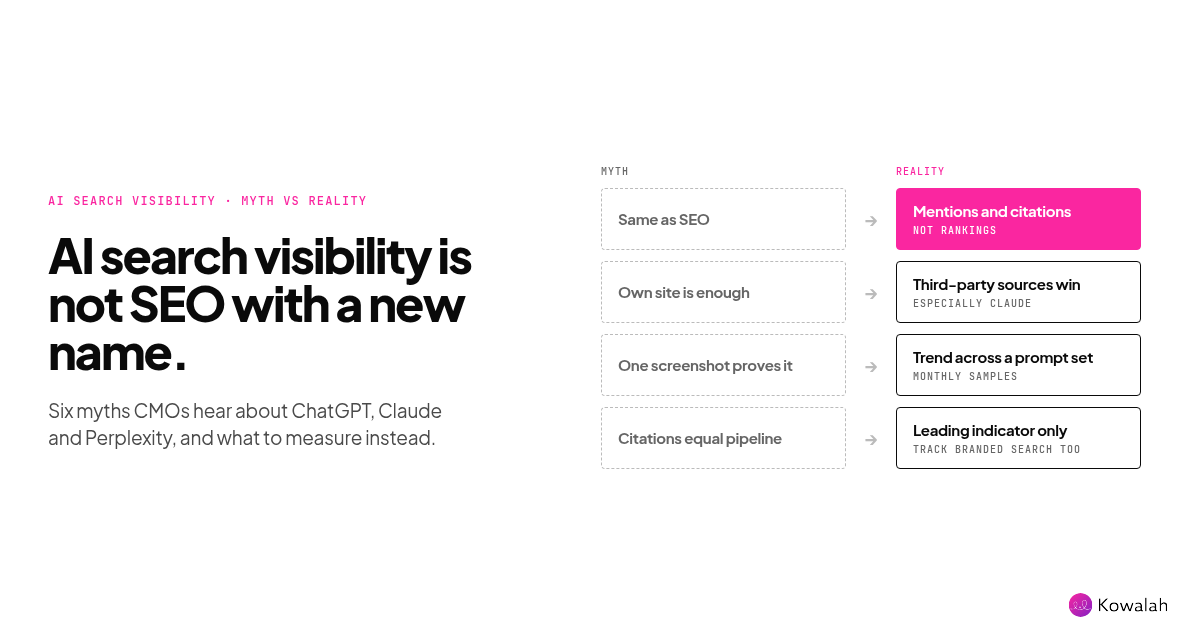
CMOs keep hearing that AI search visibility is "just SEO with a new name". It isn't. Buyers ask ChatGPT, Claude and Perplexity who to shortlist before they ever hit your site, and the signals those engines use are not the same as page-one rankings. Here are six myths, what is actually true, and what to measure instead.
This is for CMOs, VPs and Heads of Marketing at B2B tech companies of 200 to 1,000 people whose organic traffic is falling while buyers ask AI assistants about their category.
Why this keeps coming up
Gartner's 2026 CMO Spend Survey found marketing budgets effectively flat at 7.8% of company revenue, while CMOs put 15.3% of that budget into AI. Seventy percent say becoming an AI leader is a critical goal for 2026, yet only 30% report mature AI readiness. The same pressure shows up in discovery: Gartner notes B2B buyers are ahead of consumers on using AI tools to identify suppliers, and that answer engines create more zero-click experiences. If your dashboard still only reports organic sessions and keyword rankings, you are measuring last year's channel.
HubSpot's answer engine visibility playbook puts the distinction cleanly: SEO asks where you rank; AI search visibility asks whether you are named, cited and framed the way you would want a prospect to hear you.
Myth 1: AI search visibility is just SEO with a new name
Reality: they share foundations, and they measure different things. SEO still rewards relevance, crawlability and links. Answer engines reward clarity, entity consistency and, increasingly, what third parties say about you. You can rank on page one for a head term and still be absent from ChatGPT's answer to a near-identical buying question.
Treat AEO as an extension of SEO, not a rebrand. Keep the SEO work. Add a second scoreboard for how assistants describe you.
Ahrefs' analysis of mention types across hundreds of millions of AI prompts found Reddit mentions correlating most strongly with AI brand visibility, with press and general webpage mentions close behind. That does not mean you abandon your site. It means a CMO who only funds on-site content is funding half the system answer engines actually read. See Ahrefs on mention types and AI visibility.
Myth 2: Publishing more on our own site will fix what Claude says about us
Reality: owned content helps, and for Claude it is rarely enough on its own. Independent citation research summarised by Omnia found only about 6.7% of Claude citations pointed at a brand's own domain in the sample they tracked, with the rest coming from editorial and independent sources. HubSpot's playbook makes the same point in broader terms: off-site mentions, reviews and community coverage carry more weight for answer engines than they did for classic SEO.
So keep publishing clear, current category and use-case pages. Also plan earned coverage, review listings and expert commentary on the domains each engine already cites in your category. For Claude in particular, that third-party footprint is the bottleneck.
Myth 3: One ChatGPT screenshot tells us where we stand
Reality: models are non-deterministic. The same prompt can name you on Monday and skip you on Tuesday. A single screenshot feels decisive and is not.
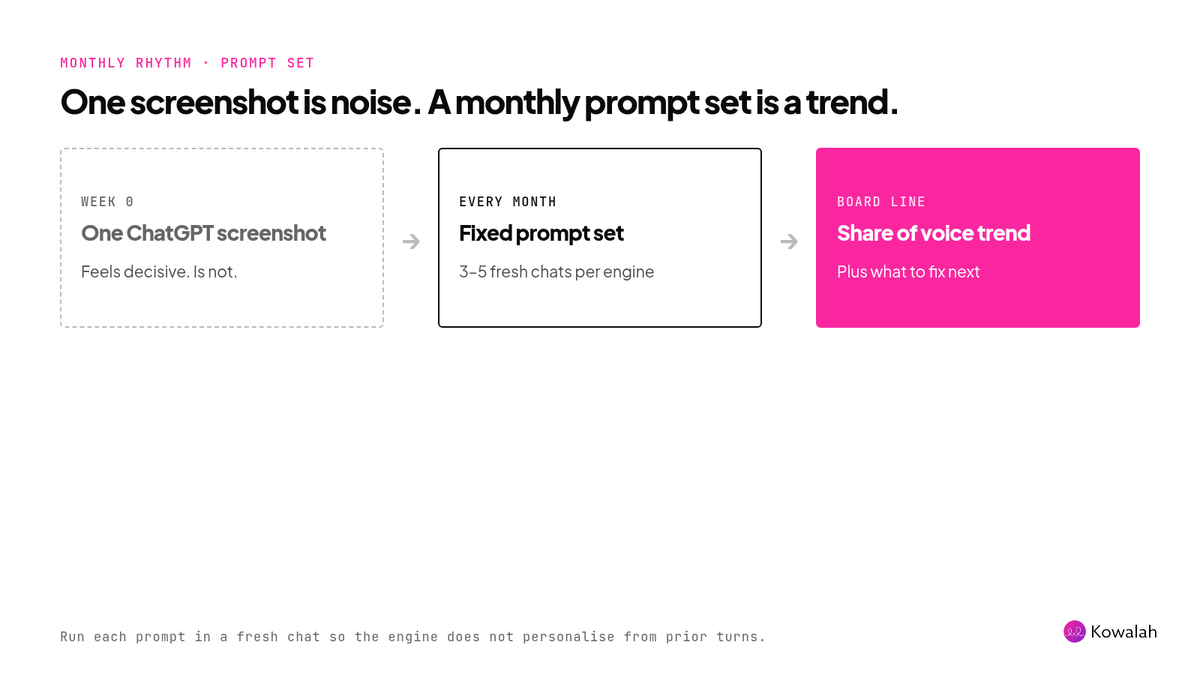
Build a fixed prompt set of the buying questions that matter to your pipeline. Run each prompt three to five times in a fresh chat on ChatGPT, Claude and Perplexity. Log the result monthly. The board-ready line is the trend in share of voice, not one lucky answer.
Myth 4: Mentions and citations are the same thing
Reality: a citation means the engine used a page as a source. A mention means your brand was named in the answer. They can move independently. Tracking data reported by Ansvisor in autumn 2026 showed vendors with thousands of citations and almost no mentions, and the reverse. You need both columns.
Add sentiment as a third column. Being named as "legacy" or for the wrong use case can suppress a conversation even when you appear.
Myth 5: If citations go up, pipeline will follow automatically
Reality: AI search visibility is a leading indicator, not proof of revenue. HubSpot's ROI guidance splits the funnel into visibility, engagement and revenue, with delays between each layer. Citations can move in weeks. Branded search and direct traffic often follow later. Pipeline influence shows up later still, and much of it arrives as unattributed or "direct" because the buyer never clicked a citation link.
So report share of voice next to branded search volume and self-reported "how did you hear about us" answers. Do not promise the board that a 10-point citation lift equals next quarter's bookings.
Myth 6: We need a new tool stack before we can start
Reality: tools help at scale. You can start this month with a spreadsheet, a fixed prompt set and a monthly cadence. Pick the questions your buyers actually ask. Sample ChatGPT, Claude and Perplexity. Log mentions, citations, sentiment and competitors named. After two or three months you will know whether a paid tracker is worth the seat, and which prompts to fix first.
Technical hygiene still matters: make sure AI crawlers can reach the pages you care about, keep entity names consistent across your site and profiles, and refresh the pages that answer buying questions. Files such as llms.txt are optional experiments, not a silver bullet. Evidence that they move citations is thin.
Granola notes from recent marketing and revenue conversations keep returning to the same gap: teams want an idea pipeline and an audit rhythm for AI answers, not another tool catalogue. The myth that stops them is believing they need a perfect stack before they look. Looking first is cheaper, and it tells you which three prompts lose you to a competitor every month.
What to measure instead
Replace "are we ranking?" as the only discovery KPI with four signals, logged against the same prompt set every month:
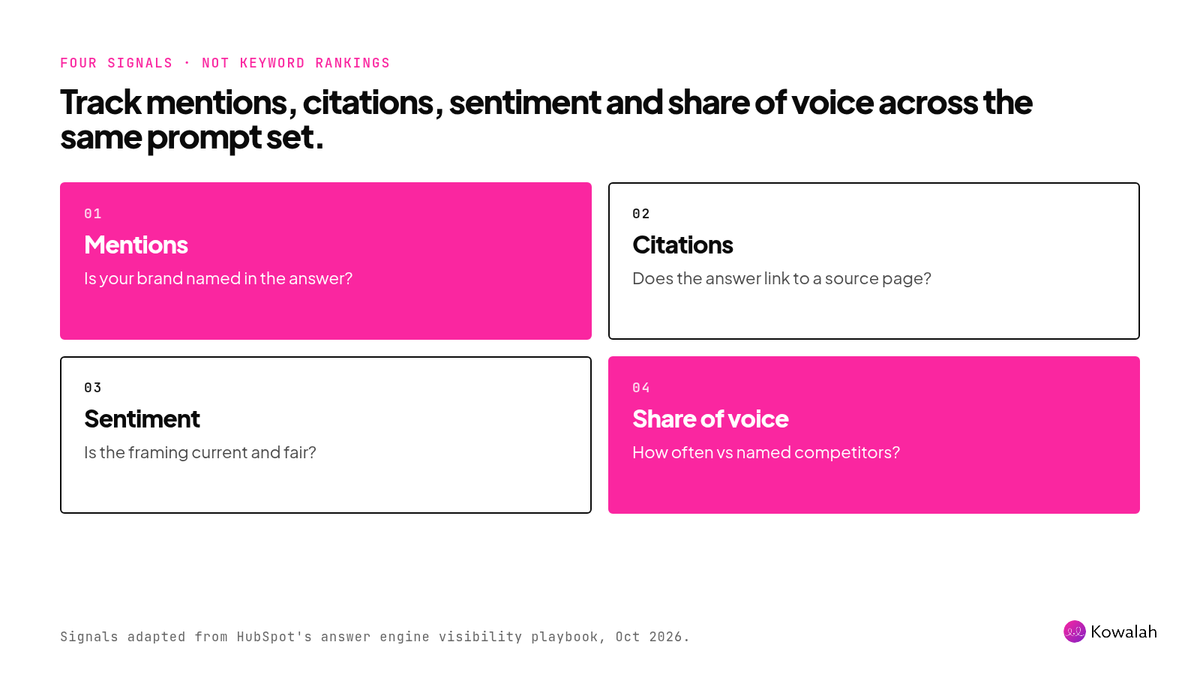
- Mentions: is your brand named in the answer?
- Citations: does the answer link to a source, owned or third-party?
- Sentiment: is the framing current, accurate and fair?
- Share of voice: how often do you appear versus a named competitor set?
Put the trend on one slide for the board, with the two or three prompts you will fix next. That is a discovery metric your CEO can act on when organic sessions keep falling.
Where Kowalah fits
On our page for CMOs, AI search visibility sits inside channel planning and attribution. The AI search visibility skill checks how Claude, ChatGPT and Perplexity describe and cite your brand, and tells you which pages to fix first. It runs on the Claude your team already uses.
If you want help turning a prompt set into a one-page plan against your pipeline number, bring that number to a free 45-minute working session. Bring your number. Leave with a plan.
Frequently asked questions
Is AI search visibility the same as AEO?
Almost. AI search visibility is the outcome: how often and how accurately you appear in AI answers. Answer engine optimisation (AEO) is the practice of improving that outcome. SEO remains the foundation; AEO adds mention, citation and framing work on top.
Which AI engines should a CMO track first?
Start with the ones your buyers use: usually ChatGPT, then Claude and Perplexity. Add Gemini if your buyers live in Google's ecosystem. Two or three engines, tracked monthly, beat seven engines tracked once.
How long before AI search visibility affects pipeline?
Visibility can move in weeks. Engagement signals such as branded search often lag by a month or two. Treat pipeline influence as a multi-month correlation, confirmed with self-reported attribution, not a same-week KPI.
Do we stop doing SEO?
No. Clear structure, fresh facts and crawlable pages help both channels. You stop treating organic click volume as the only proof that discovery is healthy.
Enjoyed this?
Weekly insights for executives navigating enterprise AI. A five-minute read.