Insights
Choosing a Claude implementation partner in the UK (2026 guide)
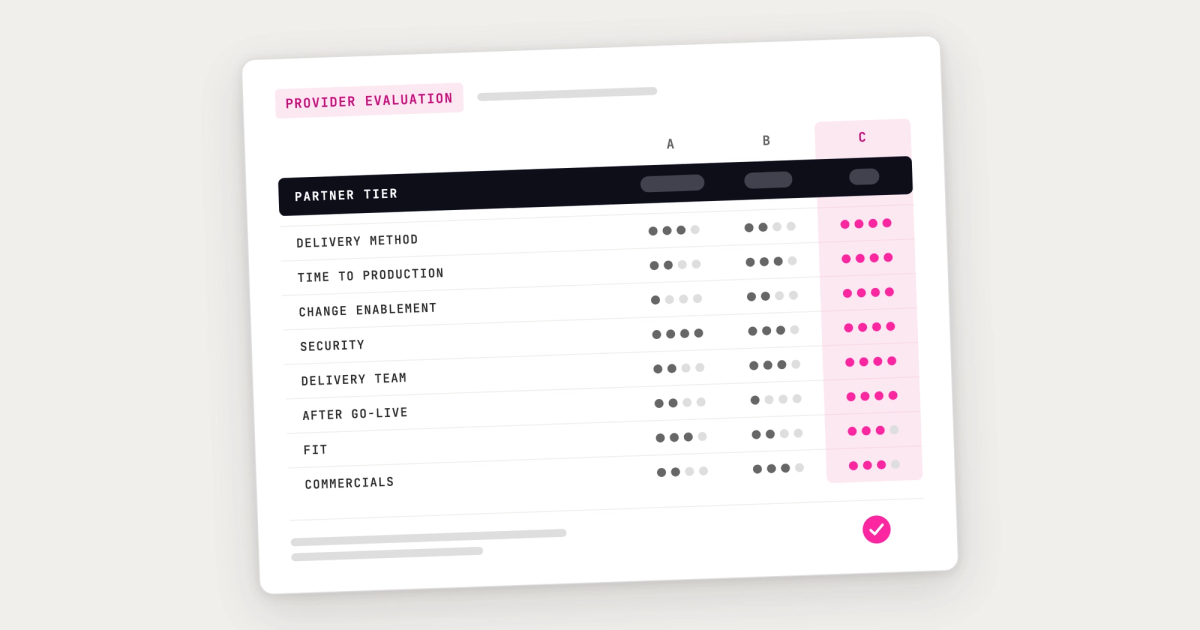
You have signed Claude Enterprise, or you are about to. The next decision is who implements it. Search for help and you meet four kinds of provider, a partner programme with three tiers, and a long list of firms describing themselves in the same words. This guide sets out how to tell them apart and what to ask each one, so the choice holds up at your 12-month board review.
We are Kowalah, a UK Anthropic Implementation Specialist, so we are one of the options. We have written this to be useful whoever you choose. Everything below is correct as of September 2026.
The short answer
- Check the partner directory. Anthropic lists the firms in its Claude Partner Network, with their tier, in a public services partner directory.
- Read the tier as evidence, not a guarantee. A tier measures the size of a firm's Claude practice and its deployed customers. It does not measure how that firm will run your programme.
- Choose on what the tier leaves out: a delivery method you can report to the board, change enablement that gets the tools used, how the provider works after go-live, and references from organisations like yours.
What Anthropic's partner programme tells you
Anthropic runs the Claude Partner Network. In June 2026 it added a Services Track for consulting and implementation firms, with three tiers:
| Tier | Anthropic's published requirements |
|---|---|
| Select | At least 10 active certified individuals, at least 2 joint customers deployed in production in the last 12 months, and at least 1 public customer story |
| Preferred | At least 100 active certified individuals, at least 15 deployed joint customers, and at least 3 public customer stories |
| Global Premier | At least 1,000 active certified individuals, at least 100 deployed joint customers across three or more regions, at least 15 public customer stories, and a joint business plan with named executive sponsors |
Anthropic reviews tiers on 1 January and 1 July, with an extra review on 1 October 2026 in the programme's first year.
What a tier shows: the number of people a firm has certified on Claude, its joint customers in production, and the customer stories it has published. It is Anthropic's view of the depth of a firm's Claude practice.
What a tier does not show: how the firm runs a programme, whether its people have delivered in your sector, how it handles change and adoption, or who you will work with each week. Those are the questions that decide whether your rollout succeeds, so they belong in your evaluation alongside the tier.
The four kinds of provider
Global consultancies
Firms such as Accenture, Deloitte and KPMG run Claude practices inside wider AI and transformation businesses. They bring scale across countries, existing relationships with your business, and breadth beyond AI. Ask who will staff the work day to day, how quickly the team can start, and how change enablement is resourced.
Specialist Claude consultancies
Smaller firms focused on Claude, a mix of partner-network members and independents. They bring depth on Claude, senior people on delivery and speed to a first result. Ask about their capacity to run an organisation-wide programme, the method behind it, and what happens after go-live.
Cloud provider routes
If you run Claude through Amazon Bedrock, Google Cloud or Microsoft Foundry, the cloud provider and its partners can set up infrastructure and regional data residency. Ask who owns the business outcome, because infrastructure set-up and programme delivery are different jobs.
Building in-house
Your own team keeps ownership and knowledge inside the business. Ask whether your engineers have capacity alongside their product and core systems work, and who brings the method for a rollout across every function.
A CIO's evaluation checklist
| What to assess | What good looks like | Evidence to ask for |
|---|---|---|
| Delivery method | Phases with named deliverables and decision points, reportable like any other IT programme | A sample plan and status report from a live engagement |
| Time to first production use | A first agent or workflow live in weeks, scoped to a measurable business outcome | Dates from brief to live on recent projects |
| Change enablement | Named people and a plan for adoption: champions, training, communications and measurement | How adoption was measured on a past engagement, and the result |
| Security and compliance | A security checkpoint before any build, working inside your existing Microsoft 365 or Azure estate | Their approach to data residency, DPIAs and connector permissions |
| Delivery team | Senior practitioners doing the work, the same people from proposal to go-live | Names and backgrounds of the delivery team |
| After go-live | A clear model for support, new use cases and expansion | The contract structure and service levels for year two |
| Fit | Experience with organisations of your size, sector and regulation | Two references you can call |
| Commercials | A fixed-scope first phase before a larger commitment | How the first phase is priced and what it produces |
12 questions to ask any provider
- Are you in Anthropic's Claude Partner Network, and at which tier? How do your people keep their Claude skills current?
- Which Claude deployments do you have in production today, and can we speak to two of those customers?
- Walk us through your delivery method. What are the phases, and what do we receive at the end of each?
- How long did it take from brief to the first agent in production on your last three projects?
- Who from your team will do the work, and will they stay through go-live?
- How do you handle security review, data residency and connector permissions before you build?
- How do you work inside Microsoft 365, and alongside Copilot if we already use it?
- What is your approach to adoption, and how do you measure it?
- How will we report progress to our board?
- What happens after go-live? Who supports the agents, and how are new use cases found and delivered?
- What do we own at the end: the agents, the skills, the prompts and the documentation?
- What does the first phase cost, and what decision will it let us make?
What to probe further
- A proposal that starts with licences or tools rather than the business outcomes you need
- No named deliverables until the end of the project
- Training offered as the whole adoption plan
- A delivery team you have not met before you sign
How to run the selection
Give each shortlisted provider the same brief: one business outcome, one team and one data source. Compare the plans they return against the checklist above, and call their references. Then fund a fixed-scope first phase with the provider whose plan you would defend to your board.
Where Kowalah fits
Kowalah is a UK Anthropic Implementation Specialist, and we are in the application process for Anthropic's Claude Partner Network. We work with CIOs at UK organisations of 1,000 to 10,000 employees who have committed to Claude Enterprise, across four pillars: Strategy & Advisory, Design & Build, Change Enablement and Managed Services. See Claude implementation for UK enterprises for how a programme runs.
Every engagement starts with a Vision Map Workshop, which produces a roadmap and proposal in five working days. Delivery follows The Kowalah Way, a phase-gated method with named deliverables at every stage. If you would like to compare us against the checklist above, book a conversation.
Frequently asked questions
Does a Claude implementation provider need to be an official Anthropic partner?
No. Any provider can implement Claude Enterprise. Partner status shows Anthropic's assessment of a firm's Claude practice, so weigh it alongside the provider's method, team and references.
Where can I check a provider's partner tier?
In Anthropic's public services partner directory. If a provider claims a tier, the directory should show it.
How long does a Claude Enterprise rollout take?
A first agent or workflow can be live in six to eight weeks when it is scoped to one measurable outcome. An organisation-wide rollout is then phased function by function.
Should one provider handle strategy, build and adoption?
One provider across strategy, build, change and support removes the hand-offs between firms, which is where programmes lose time. If you split the work, agree in writing who owns the business outcome.
Enjoyed this?
Weekly insights for executives navigating enterprise AI. A five-minute read.