Insights
How to pick the right processes to reinvent with AI
The highest impact decision you can make as you lead your company into an AI future is where to focus.
The last couple of years have seen mass experimentation - "lets give our people Copilot, Gemini, ChatGPT or Claude, train them, and see what happens."
Not a lot is the answer.
The companies that are seeing the greatest impact are being very targeted about where to apply AI and how to re-imagine their processes for the new world.
My top book recommendation for CEOs right now is Rewired (2nd edition). It is written by the team at McKinsey for a CEO (not a CIO) and describes how AI is a business strategy, not a technology strategy.
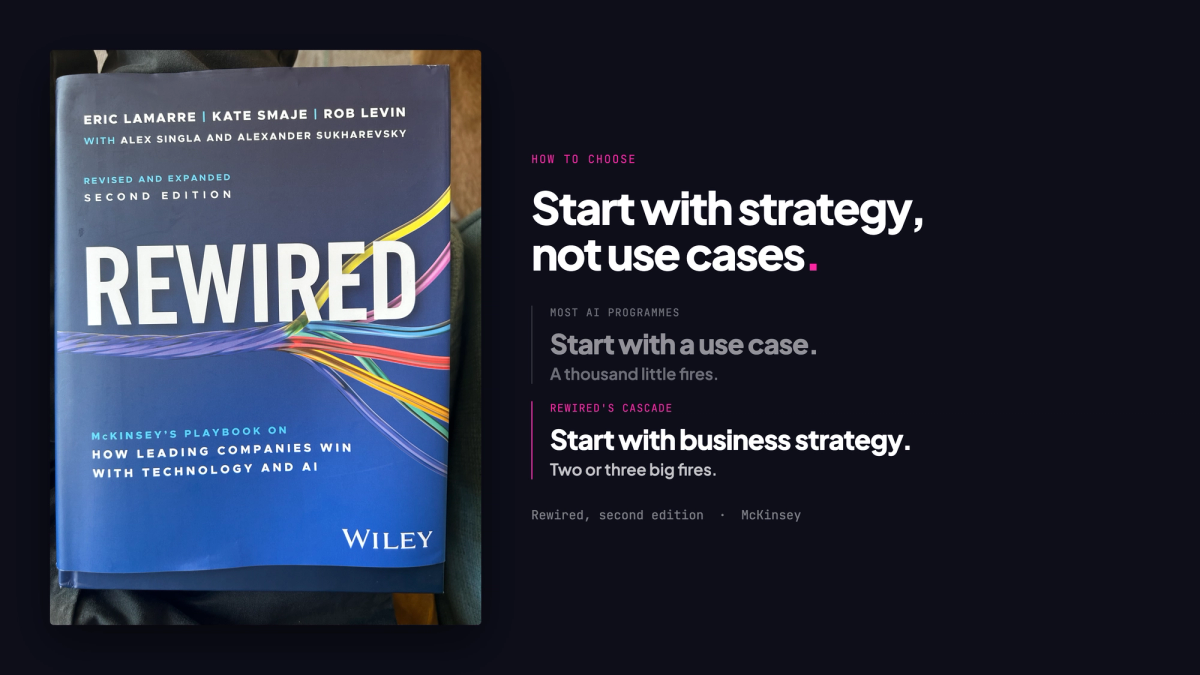
I recommend you buy the book (in hardback so you can see and annotate the images) and in this article I'll walk you through how you'll select the highest value processes (or domains as the authors refer to them).
Value drivers
In your industry there will be two or three drivers of value to any organisation in that industry - in insurance that might be risk calculation, in retail it might be your supply chain, in professional services it might be utilisation.
You don't get to define these - but knowing them informs the next step of the process.
Business strategy
Knowing these value drivers you'll define your business strategy (we are big fans of the Playing to Win framework, from A.G. Lafley and Roger Martin's book of the same name - where your business strategy will be built around your where to play and how to win choices).
- Where to play- which markets and segments of the value chain will be play in
- How to win- what can we uniquely bring to ensure we win on our chosen fields of play
As you think about your business strategy over the coming years the arrival of AI may influence or add additional where to play and how to win combinations.
Importantly - you don't have an AI strategy - you have a business strategy enabled by AI
Goals
Having defined your business strategy you will define your goals - you may call these OKRs (Objectives and Key Results), you may call them KPIs or metrics.
I ask CEOs which numbers go on the first couple of slides of their board meeting deck.
There will be a handful of numbers that you review at the very top of the business to track your progress against your business strategy - those are the numbers we mean.
Domains
In Rewired the authors use the word "domains" to refer to an area of a business. You might call them end-to-end processes, you might call them value chains, you might call them customer journeys.
A company is built on 15-20 top level domains, and we want to hone in on the 2-3 that most impact your goals.
How do you uncover your domains?
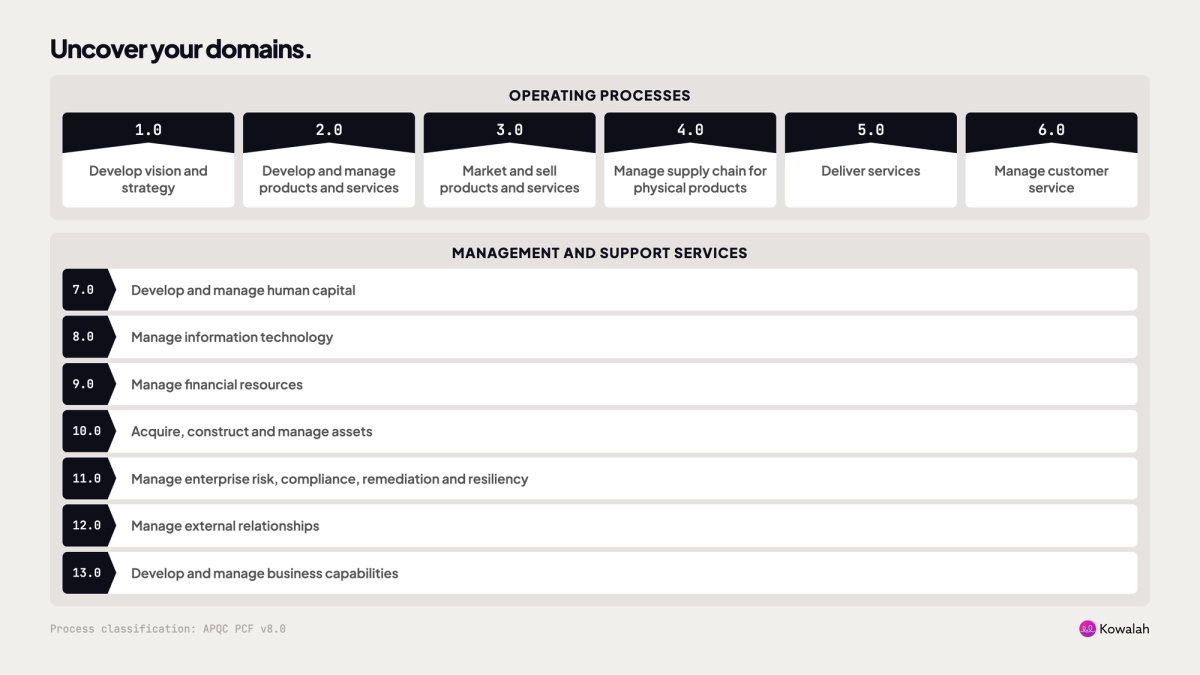
We like APQC and their Process Classification Framework (PCF). PCF is an open source reference for processes across any company (with sub classifications for individual industries including banking and automotive)
The framework lists six top level operating processes (from developing your vision & strategy, through to managing customer service), and seven management and support processes (including HR, IT, finance, and risk).
I'm confident it is those first six that drive value and will link to the numbers on your board deck.
You want to manage the management and support processes well, and there are efficiencies to be made - but the game changing, industry defining opportunities are in your operating processes.
Value levers
Having picked the 2-3 domains where you can have the biggest impact, you should look at the leverage points in those domains - you can think of a value lever as a Key Performance Indicator, a metric, a number, that you track at the top level of that domain or process.
Let me pick marketing and sales as a domain.
- Average deal size ($)
- Close ratio (%)
- Sales cycle length (time)
These would be three value levers that determine the output of that process.
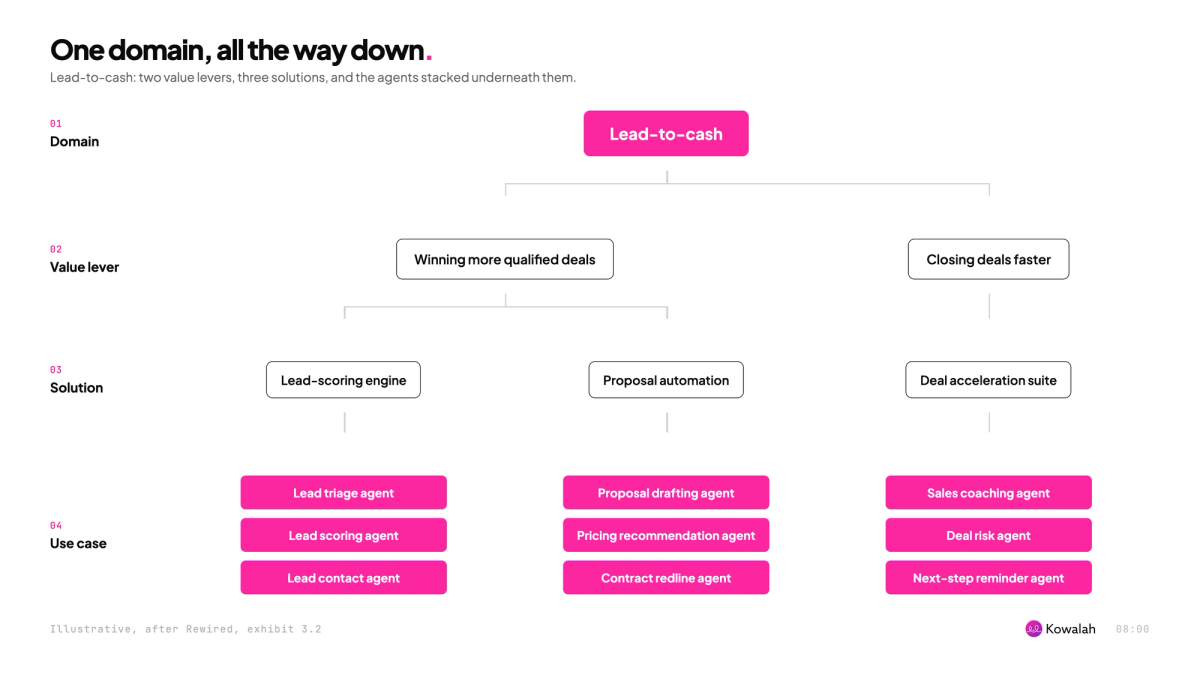
If we sell into bigger deals, we win more of them, and we win them more quickly, we are going to transform the direction of this business.
For any value lever we want to know what the current metric is, and what our target will be.
Solutions
Now we can consider a number of solutions that can support these value levers - and here is where you want to involve the people that work in that process today.
Lets expand on our marketing and sales domain - you need to understand from the people closest to the campaigns, the prospects, the partners, the process to uncover ideas that could improve these metrics.
- A lead scoring engine to ensure we focus on the right opportunities
- A proposal automation platform to ensure consistent proposals
- A deal acceleration system to remove downtime in sales cycles
Use cases
And now we drop to the lowest level - individual use cases that would bring that solution to life.
For our lead scoring engine that could include:
- A lead triage agent
- A lead scoring agent
- A lead contact agent
As the authors of Rewired describe - by focusing on multiple use cases strung together in a single solution in a single domain, you earn three big benefits over scattered use cases across the business.
- Each agent likely uses the same data sources so you gain efficiencies of plugging it in once
- Each agent likely passes its output onto another agent in the process meaning they get compounding benefits
- Each agent is likely used by or interacts with the same group of humans meaning your change enablement can be more focused and effective.
Go Deeper
To get started on this journey - I'd recommend buying Rewired (2nd edition) and spending a weekend reading and thinking about your own business's domains.
Use the PCF framework to help determine which domains or processes are the most impactful to the numbers on your board deck.
The Kowalah Plugin has the PCF built in, so you can map your domains, processes and potential solutions in Claude, and score the opportunities you find.
Our free AI use case prioritisation framework turns this article into worksheets you can work through with your leadership team, from board goals to a scored backlog.
Enjoyed this?
Weekly insights for executives navigating enterprise AI. A five-minute read.