Insights
Personal Claude vs Claude Enterprise: why locked-down rollouts lose to free accounts
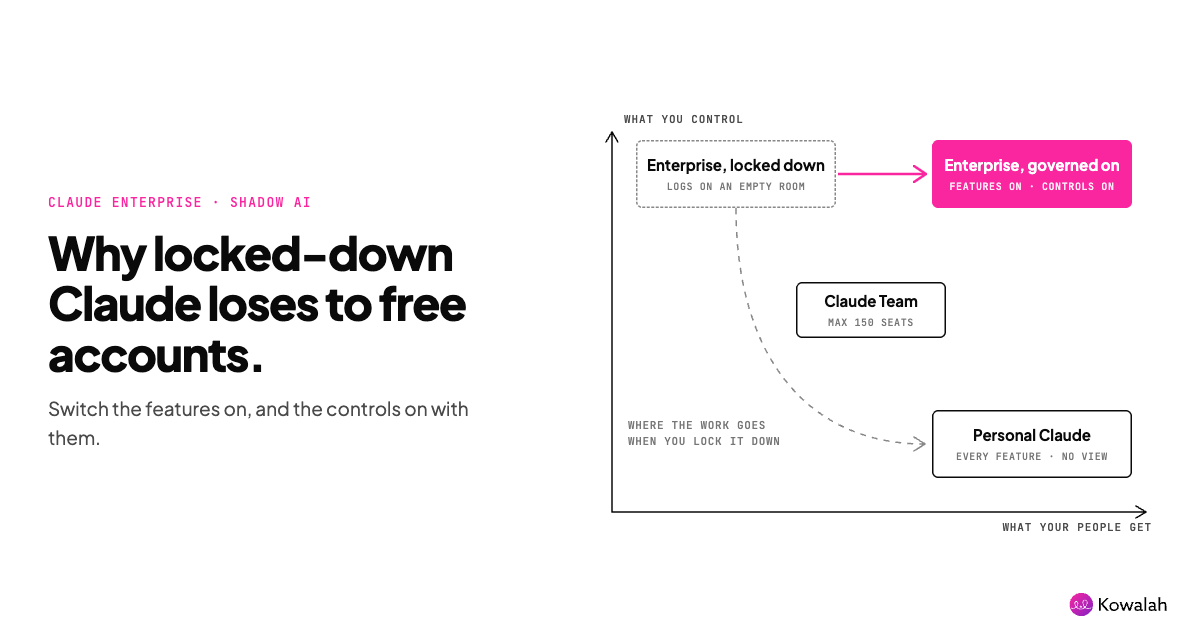
If your company's Claude has memory, connectors and the newest features switched off, your people's personal accounts now do more than the tool you pay for. They'll use those instead, under terms you don't control and in places you can't see. More lockdown won't fix it. Claude Enterprise with the features on, and its controls on with them, will.
This comparison is for CEOs, CIOs and AI Ops leads at UK organisations of 1,000 to 10,000 people who own a Claude rollout. To find your own gaps, copy the free Claude Feature Gap Audit. It's ungated, with a Google Doc version.
Why it matters now
Three announcements this week widened the gap, in both directions.
- Auto mode by default. On 22 October, Anthropic said auto mode will roll out next week as the default for new sessions in most Claude apps on Pro, Max and Team. Instead of asking people to approve each action, an automated check lets safe actions go ahead and blocks risky ones. Enterprise admins will get an email before it becomes the default for their organisations.
- Claude Duet. On 21 October, Anthropic opened a research preview of Claude Duet, an app where Claude works as a proactive agent. It's for US Pro and Max subscribers only, by waitlist.
- Inference hooks. On 20 October, inference hooks came out of beta for Claude Enterprise. They send every governed prompt to your own security server for an allow or deny verdict before the model runs.
Earlier this month, Claude Docs, Slides and Design left beta on every plan, including Free. Personal plans get new capabilities first. Enterprise gets controls nobody else has. A locked-down rollout takes the worst of both.
What we're hearing
This week's client conversations, anonymised, said the same thing three ways:
- A professional services firm's Enterprise instance had memory, artifacts, connectors and Claude Code switched off. Teams were falling back to personal accounts.
- A data security vendor described teams opening their own Claude Team accounts after central IT locked Claude down.
- A software company asked how to fold several Claude accounts, including a separate Team account, into one governed Enterprise organisation.
Head to head: personal Claude, Team and Enterprise
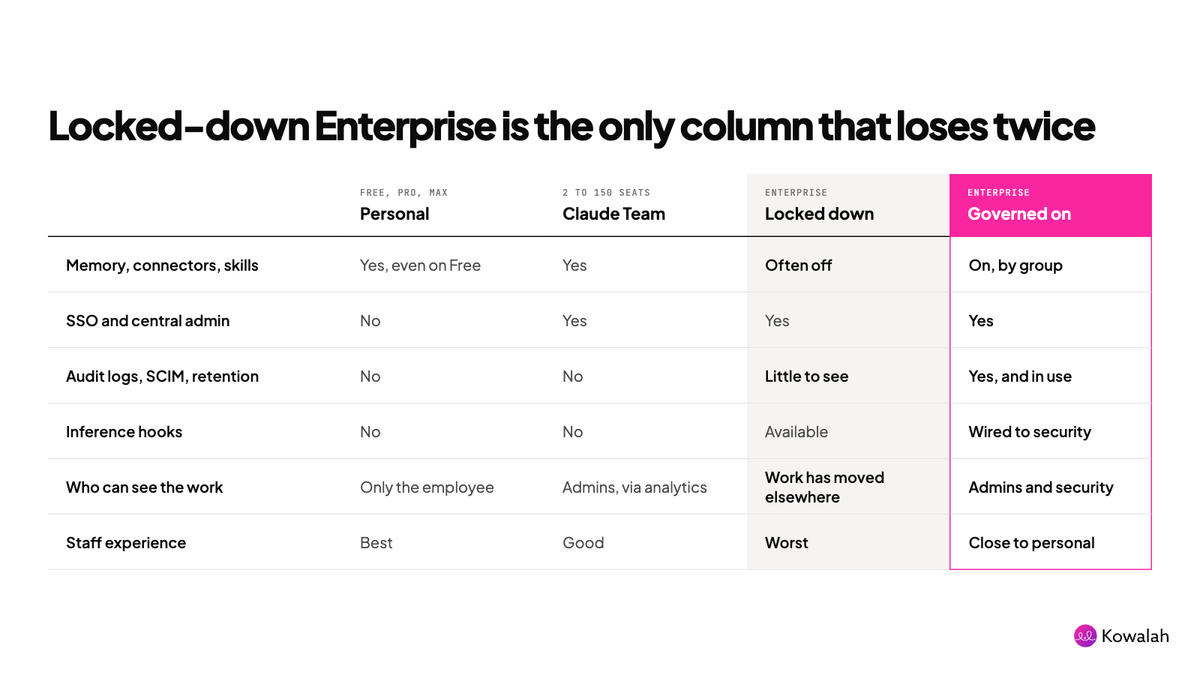
The table compares what your people get with what you control. "Locked down" means Enterprise with most capabilities switched off. "Governed on" means Enterprise with capabilities on and its controls in use.
| Personal (Free, Pro, Max) | Claude Team | Enterprise, locked down | Enterprise, governed on | |
|---|---|---|---|---|
| Who pays | The employee, or nobody on Free | The company, 2 to 150 seats | The company: a seat fee plus usage at API rates | The same |
| Memory, connectors, skills, Docs, Slides and Design | Yes, even on Free | Yes | Often off | On, by group |
| Auto mode as the default | Rolling out next week on Pro and Max | Rolling out next week | Opt-in for now; admins emailed first | Your decision, made on purpose |
| Chats used to train models | The employee's choice | Not by default | Not by default | Not by default |
| SSO and central admin | No | Yes | Yes | Yes |
| Audit logs, Compliance API, custom retention, SCIM | No | No | Available, but little to see | Yes, and in use |
| Inference hooks (your own allow or deny check) | No | No | Available | Connected to your security tools |
| Who can see the work | Only the employee | Admins, through usage analytics | Admins, but the work has moved elsewhere | Admins and security |
| Staff experience | Best | Good | Worst | Close to personal |
Sources: Claude plans and pricing, Anthropic's consumer terms update and the auto mode announcement.
What the table says
- Locked-down Enterprise is the only column that loses twice. It does less than a free account, and its audit logs watch an empty room.
- Personal accounts aren't malicious. They're invisible. Under consumer terms, the employee decides whether their chats help train models. If they say yes, Anthropic can keep that data for up to five years. You get no admin view, no audit log and no way to keep the work when they leave.
- Team is a real option, but not at your size. It tops out at 150 seats and has no audit logs, Compliance API, SCIM or inference hooks. A Team account opened by a frustrated department is shadow AI with a company card.
Why blocking won't close the gap
Claude gives you two blocking tools, and both are worth using. Once you verify your domain, "Restrict organization creation" stops anyone creating new Claude accounts on it, on Team or Enterprise (Anthropic's SSO guide). On Enterprise only, domain claiming moves existing Free, Pro and Max accounts on your domain into your organisation, with a 30-day window. It can't be reversed.
Neither touches a personal account on a personal email address. You can block the domain. You can't block the habit. The lasting fix is to make the company's Claude the better one.
How to get to "governed on"
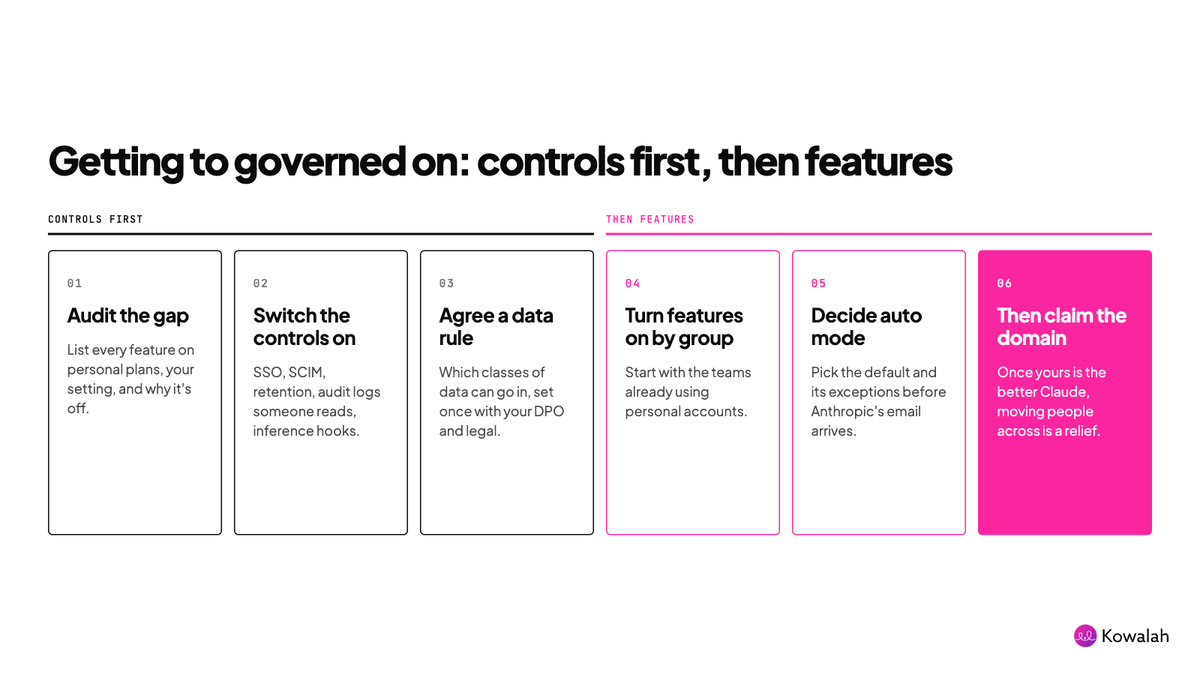
- Audit the gap. List every capability on personal plans, your current setting, why it's off and what would make it safe to switch on. That's what the free audit is for.
- Switch the controls on before the features. Enforce SSO, set up SCIM or JIT provisioning, set retention, make sure someone reads the audit logs, and connect inference hooks to your data loss prevention or AI security tool. Only Owners and Primary Owners can configure hooks, and they aren't available through Amazon Bedrock or Google Cloud (docs).
- Replace case-by-case approvals with a data rule. If every client file needs its own approval, people go round it. Agree with your DPO and legal team which classes of data can go into your Enterprise organisation, and on what conditions.
- Turn features on by group. Start with the teams already using personal accounts. They'll tell you what they need, and their move back is your best evidence.
- Decide auto mode before the email arrives. In Anthropic's Claude Code study of 1,053 paid testers, people caught 13.6% of planted dangerous commands; auto mode caught 89%. Anthropic still recommends reviewing high-stakes production changes yourself. Choose your default and its exceptions on purpose. Our guide to setting approvals by risk helps.
- Then claim the domain. Once the company's Claude is the better one, moving people across is a relief rather than a fight.
Keep it current with a monthly release review. Every new default is another chance for the gap to reopen.
Which option is right?
- Personal accounts: fine for learning in your own time on your own material. Not for company or client data.
- Claude Team: a smaller organisation, or a single team under 150 seats, that can live without audit logs, SCIM and inference hooks.
- Claude Enterprise, governed on: the default for organisations of 1,000 to 10,000 people. See what changes at 150 seats.
- Claude Enterprise, locked down: a holding pattern for a few weeks at most, never a destination.
Where Kowalah fits
Kowalah is a UK Anthropic Implementation Specialist. We help CIOs and AI Ops leads get Claude Enterprise to "governed on": the controls, the data rule and a feature plan your teams will actually use. You can record your AI estate, the systems and AI assets in use, on Kowalah's free plan. If you'd like a second pair of eyes on your settings, book a conversation.
Common questions
Is Claude Pro safe for work data?
Pro is a consumer plan. The user decides whether their chats help train models, and the company has no admin view, audit log or say over retention. Treat it as unsuitable for company or client data.
What does Claude Enterprise have that Team doesn't?
SCIM, audit logs, the Compliance API, custom data retention, role-based access, domain claiming and inference hooks. Claude Security's continuous scanning is also in public beta for Enterprise customers.
Can we stop staff using personal Claude accounts?
Partly. You can stop new accounts on your domain and, on Enterprise, claim existing ones. You can't see or stop accounts on personal email addresses. Make the company's Claude better, and say clearly what's allowed.
Will auto mode switch on in our Enterprise organisation automatically?
Not without warning. Anthropic says Enterprise admins will get an email before auto mode becomes their default. In Claude Code, admins can pin a default mode or turn auto mode off in managed settings.
Get the audit
Copy the free Claude Feature Gap Audit. List each capability, your setting, the shadow-use signals and the condition for switching it on, then score what to enable first.
Enjoyed this?
Weekly insights for executives navigating enterprise AI. A five-minute read.