Insights
Which AI work still needs a human sign-off? Set approvals by risk
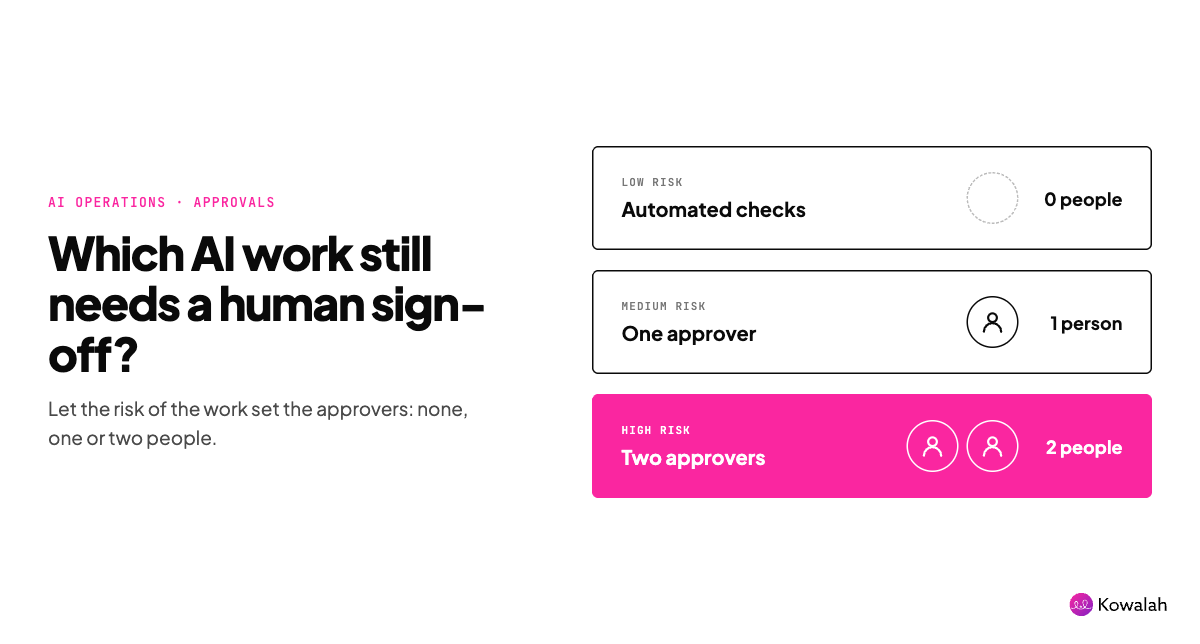
Putting a person on every piece of AI output feels safe. It isn't. It builds a queue, and the people in that queue start rubber-stamping. Anthropic's Claude Code team has just shown a better model: the risk of the work sets how many people approve it. None, one or two.
This guide is for the AI Ops lead, CIO or COO at a UK organisation of 1,000 to 10,000 people who has to decide where people stay in the loop as agents take on more work. It translates Anthropic's approach from code to business workflows, with a fictional worked example. To set your own tiers, copy the free AI human approval matrix. It's ungated, with a Google Doc version.
What Anthropic published
On 15 October, the Claude Code team published how it does code review. Claude writes about 90% of Claude Code's own code. From June to September, merged pull requests more than doubled while the share that had to be reverted fell by more than 40%.
The team didn't remove review. It moved most of the reading to machines, saved people's attention for the calls machines are bad at, and made mistakes fast to undo.
The heart of it is a short table:
- Low risk (docs, copy, internal-only features, additive changes behind a flag): no human approval once automated review and security checks are green.
- Medium risk (ordinary product changes, and sensitive areas such as caching or system prompts): one person.
- High risk (the riskiest code, plus a small set of paths that always need two people): two people.
Three rules sit around it. A classifier sets the tier from the change, not from who wrote it. An agent's approval never counts as a person's. And whoever prompted the agent is on the hook for what it produced.
Two caveats. These are Anthropic's own internal figures for one engineering team, and your claims team isn't a codebase. But the pressure is the same one Anthropic described two days earlier, when it said changes merged to its monorepo went from about 2,500 a day in May to more than 30,000 in September, leaving it bottlenecked by infrastructure "built for human scale". Agents in finance, HR and customer service will hit the same wall: people's attention.
Why "a human checks everything" fails
A blanket sign-off has three problems.
- It becomes the bottleneck. An agent can draft 200 replies before lunch. A team leader can't read them all properly, so either the work waits or the reading stops.
- It turns into a rubber stamp. In a conversation this week, someone called it the "meat proxy" problem: people passing AI output along without really reading it. A sign-off nobody reads is worse than none, because it looks like control.
- It checks the wrong thing. Anthropic's team calls "did a human read the code?" an imprecise proxy for the real question: what could go wrong with this change, and which check is the right one to catch it?
UK law draws a similar line. Under the Data (Use and Access) Act 2025, a decision is solely automated when there's no "meaningful human involvement". The ICO's guidance says mere human involvement doesn't necessarily count as meaningful review. A rubber stamp may not protect you where it matters most.
There's a people issue too. In some organisations, approving things is how a manager's seniority shows. Redesign the approval and you redesign their job. The process owners who lead that change, rather than defend the queue, are the ones who'll run the next version of their function. Make it worth their while: credit the redesign to them in your steering group update.
Translate the tiers to business work
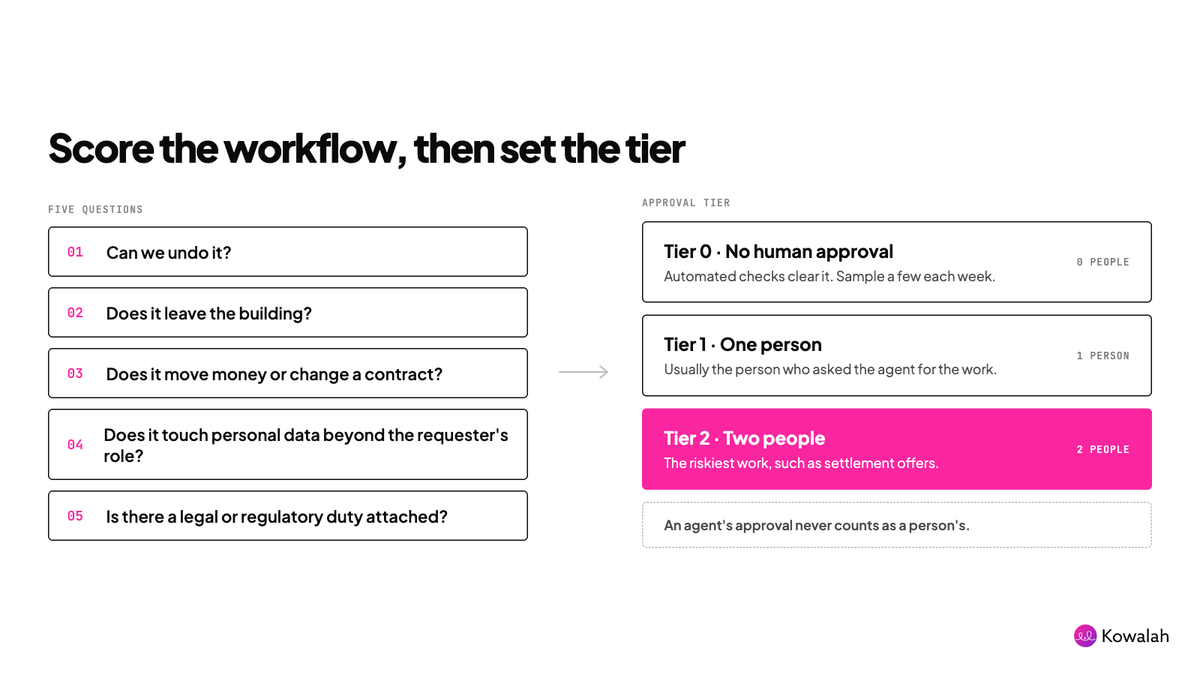
Swap code for workflows and the model carries over. Score each workflow on five questions. Can we undo it? Does it leave the building? Does it move money or change a contract? Does it touch personal data beyond the requester's role? Is there a legal or regulatory duty attached? Then set the tier.
| Tier | Typical work | Human approvals | Before a person looks |
|---|---|---|---|
| 0: Low | Internal summaries, meeting notes, data tidy-ups, first drafts for your own team | None once checks pass, plus a weekly sample | Automated checks against a template or rules; a second agent reviews with fresh context |
| 1: Medium | Customer emails from approved templates, CRM or case-note updates, routine supplier replies | One person, who can be the person who asked the agent | As tier 0, plus a named owner for the workflow |
| 2: High | Payments, pricing, contract changes, refunds above a limit, anything sent to a regulator | Two people | As tier 1, plus a record of what the agent saw and did |
| Always a person | Decisions with a legal or similarly significant effect on someone: claims, credit, hiring, disciplinary | At least one person with the authority to change the outcome | As tier 2, plus your DPO's review of the process |
Six rules worth copying
- The work sets the tier, not the person. Score the workflow, not the confidence of whoever built it.
- Start strict and loosen with evidence. That's Anthropic's own advice. Agree the evidence up front. One client steering group this month agreed that an agent's drafts would move to lighter review only once fewer than one in ten needed editing, and lighter again below one in twenty.
- An agent's approval never counts as a person's. Automated checks can clear tier 0. They can't fill a human slot.
- Whoever asked the agent owns the result. Accountability doesn't move to the tool.
- Make undo cheap. The easier a mistake is to reverse, the lighter the approval can be. Phase write access system by system and field by field, inside the role permissions people already have.
- Watch the guardrail. Track approver hours and wait times alongside errors and reversals. In Anthropic's words, if revert and incident rates rise, "we haven't saved human time, we've only moved it."
Worked example: Fernhollow Insurance
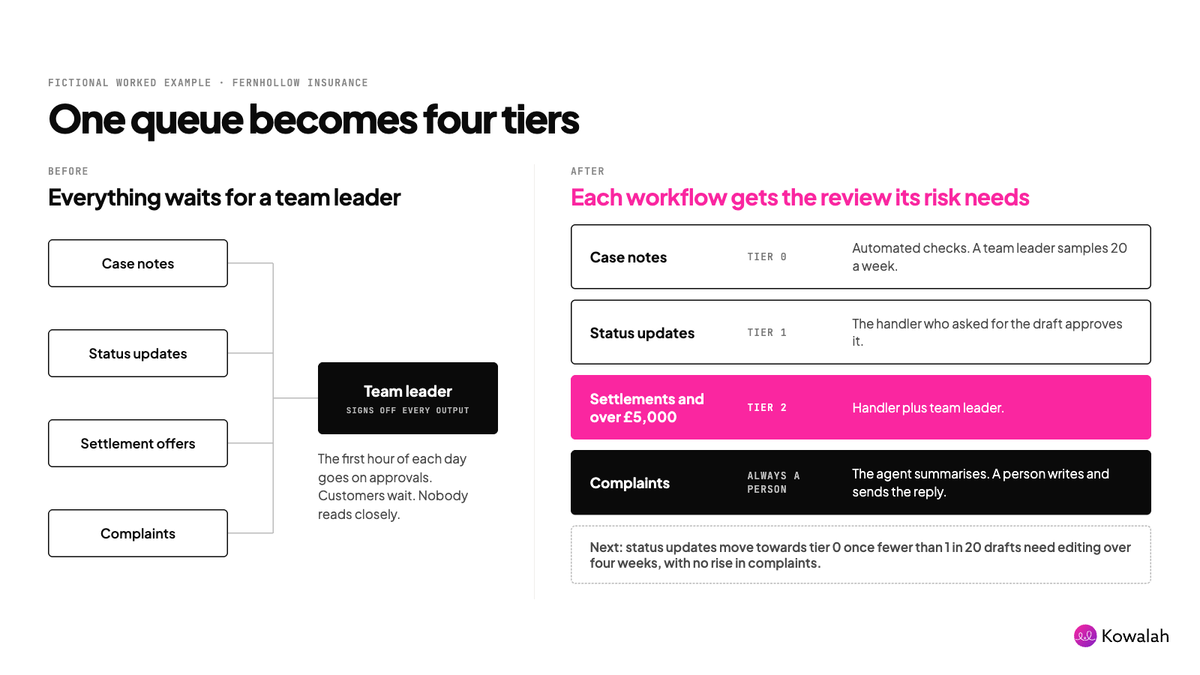
Fernhollow is a fictional UK insurer with 3,000 staff. Its claims team uses Claude to draft customer status updates and write case notes. Every output goes to a team leader for sign-off.
Six weeks in, the queue tells the story. Team leaders spend the first hour of each day approving drafts. Customers wait. Handlers stop reading drafts closely because the team leader will check. Team leaders stop reading closely because there are too many.
The AI Ops lead, Sam, runs the matrix with the head of claims:
- Case notes: tier 0. Internal and easy to correct. Automated checks confirm the required fields, and a team leader samples 20 a week.
- Customer status updates: tier 1. The handler who asked for the draft approves it. No second sign-off.
- Settlement offers and anything over £5,000: tier 2, and always a person. Handler plus team leader.
- Complaints: always a person. The agent can summarise the file. A person writes and sends the reply, and the compliance lead signs off the process.
They agree the evidence for moving status updates towards tier 0: fewer than one in twenty drafts edited over four weeks, and no rise in complaints. They log the re-tiering as an opportunity, score it with ICE (impact, confidence and ease) against the rest of the backlog, and record the team leader time it returns as an outcome.
The steering group gets three lines. Status updates moved to single sign-off, giving team leaders back most of that first hour. Settlement offers stay at two approvers. Decision needed: whether complaint acknowledgements get the same review.
Where this fits your programme
Approval tiers aren't a one-off policy. Revisit them when a workflow changes, a connector gets write access or a release changes what Claude can do. Pair the matrix with your release review and your steering group update, so every change of tier is visible and credited to the person who made it.
If you run your programme in Kowalah, logging each workflow as an opportunity and recording the time it gives back as an outcome is free.
Common questions
Does Claude approve its own work?
Not in Anthropic's product. Code Review posts findings on a pull request but never approves or blocks it, so the decision to merge stays with your team. Anthropic's own team lets some low-risk changes merge on automated checks alone. That's a choice its code owners made, with fast rollback behind it.
Is it legal to remove a human sign-off?
For most internal work, it's a process decision. Decisions with a legal or similarly significant effect on a person are different. If there's no meaningful human involvement, UK data protection law requires safeguards, including ways for the person to get human intervention and contest the decision, and special category data is more tightly restricted. Keep a person on these and involve your DPO.
Where do we start?
With one high-volume workflow where the queue already hurts. Run the matrix, start strict, agree the evidence for loosening and review it after four weeks.
Get the matrix
Copy the free AI human approval matrix. No forms, no gating. If you'd like help setting tiers for your first agents, we're a UK Anthropic Implementation Specialist, and we're happy to talk it through.
Enjoyed this?
Weekly insights for executives navigating enterprise AI. A five-minute read.