Insights
Rebuilding your processes with High Output Management
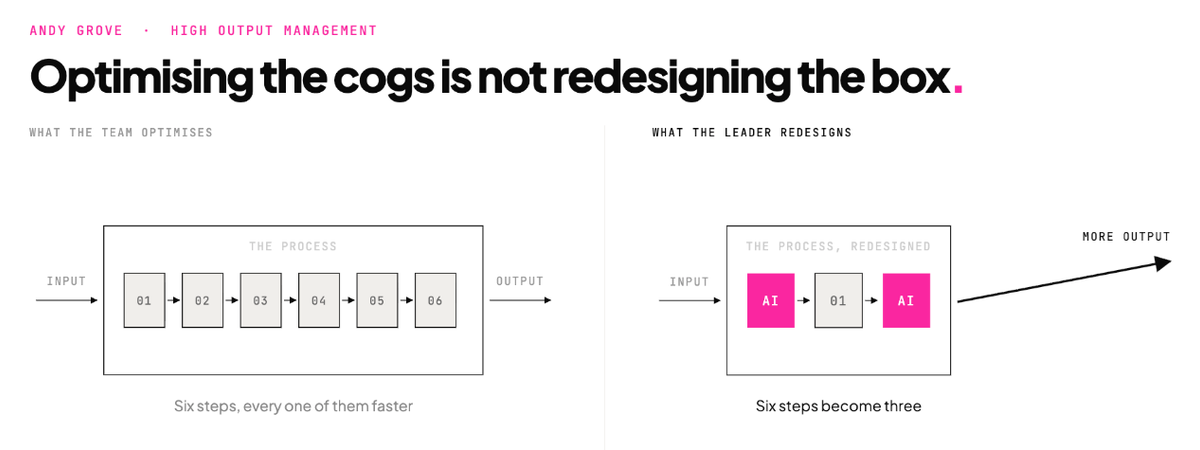
One of my top book recommendations for CxOs seeking to drive AI transformation across their businesses doesn't mention AI once.
The book is High Output Management, a business masterclass written in 1983, by then Intel CEO Andy Grove.
The book has a simple (if hard to implement) premise - that as a leader your job is to drive the highest output, at the required quality, for the lowest effective cost.
"Your job as a leader is to drive the highest output, at the required quality, for the lowest effective cost" - Andy Grove
In the book he uses the analogy of a breakfast factory - where you are managing the production process.
- You take an input (raw eggs)
- You apply labour (you cook the eggs)
- You deliver an output (cooked eggs)
Now apply that to any team or process in a company - finance, sales, people, R&D:
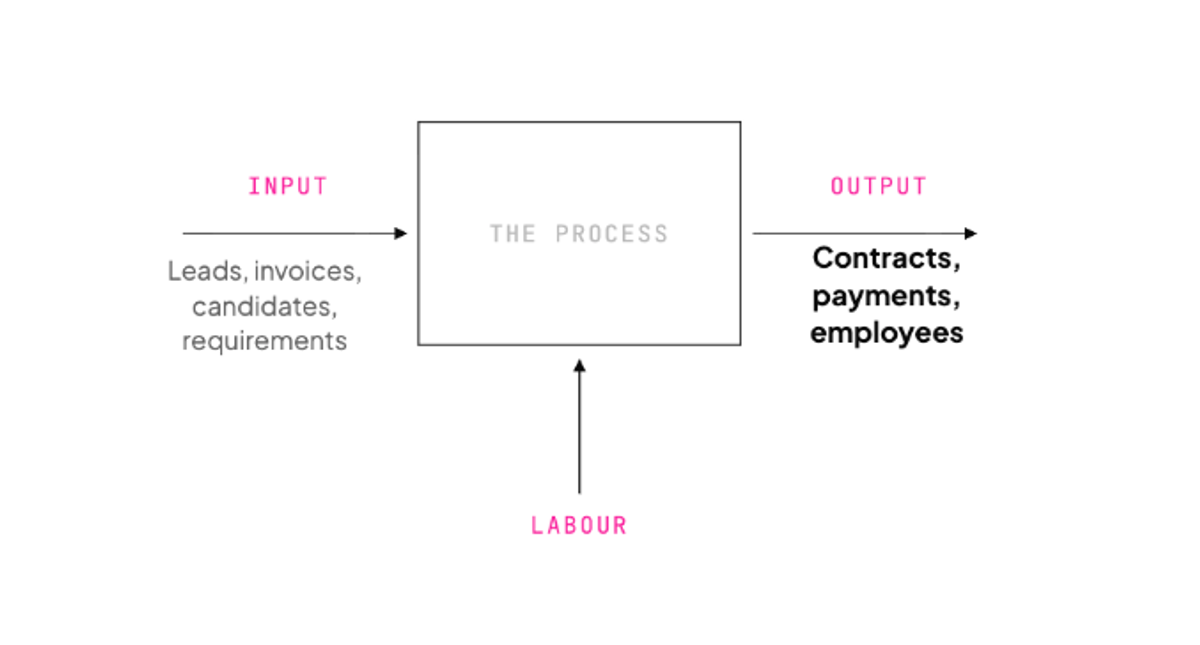
Every team in your business is a production line
Lets use the example of a sales team:
- You take an input (leads from marketing)
- You apply labour (inside sales, field sales, sales managers, sales enablement)
- You deliver an output (signed contracts and customers to onboard)
Your job as a sales leader is to deliver:
- The highest output (highest closed sales $)
- At the required quality (customers that pay and don't churn)
- For the lowest effective cost (lower cost SDRs for qualification, higher cost sellers for large enterprise accounts, closely measured quotas)
Grove refers to the process as a black box - what happens within it is not important to those outside of the process - the goal of the leader is to focus on the input and output.
This model applies at the CEO level - reporting to the board, as the business unit level, at a function level, all the way down to a manager with their team of 7-8 direct reports.
highest output, required quality, lowest effective cost.
The book goes into detail about how as a manager you can increase your leverage through hiring, goal setting (Intel were the creators of OKRs), and performance management.
How is this relevant to AI?
The role of the leader has not changed - at a company level the CEO is responsible to the board to drive the highest output, at the required quality, for the lowest effective cost.
Prior to AI the way you delivered on that was to apply human labour - carefully constructing a hierarchical org structure, adding on more layers and more people, as the complexity of your processes grew.
Today with the rapid advances in the capabilities of the models and the harnesses around them, as a leader you can deliver on your top level goal (highest output, required quality, lowest cost) in a new way, by revisiting your inputs and outputs and rebuilding your black box.
What not to do
The temptation is to look at your existing process - Andy Grove's black box - to look at each of the sub-processes within it and sprinkle some AI on it.
Lets expand on our sales example:
- We'll give our SDRs a sales email writing prompt
- We'll give our AEs a territory prioritisation skill
- We'll give our sales managers an AI-powered forecasting dashboard
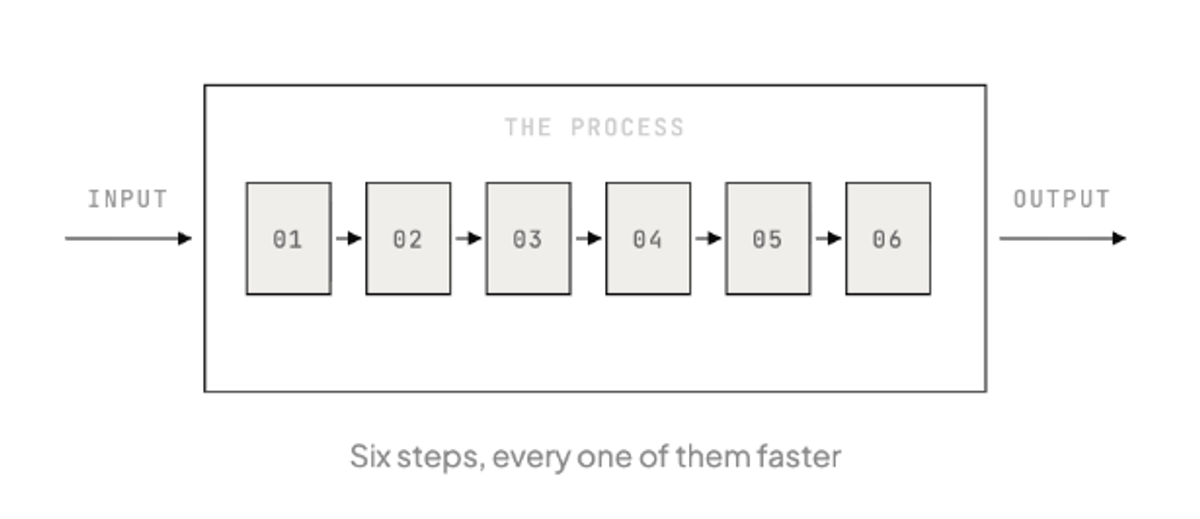
You will accelerate each cog in the box - but you won't change the output from the overall process.
You'll find documented research that while individual employees achieve productivity gains of 20-30%, these don't translate into similar improvements at the organisation level - this is why.
This reminds me of the first automobiles - horseless carriages.
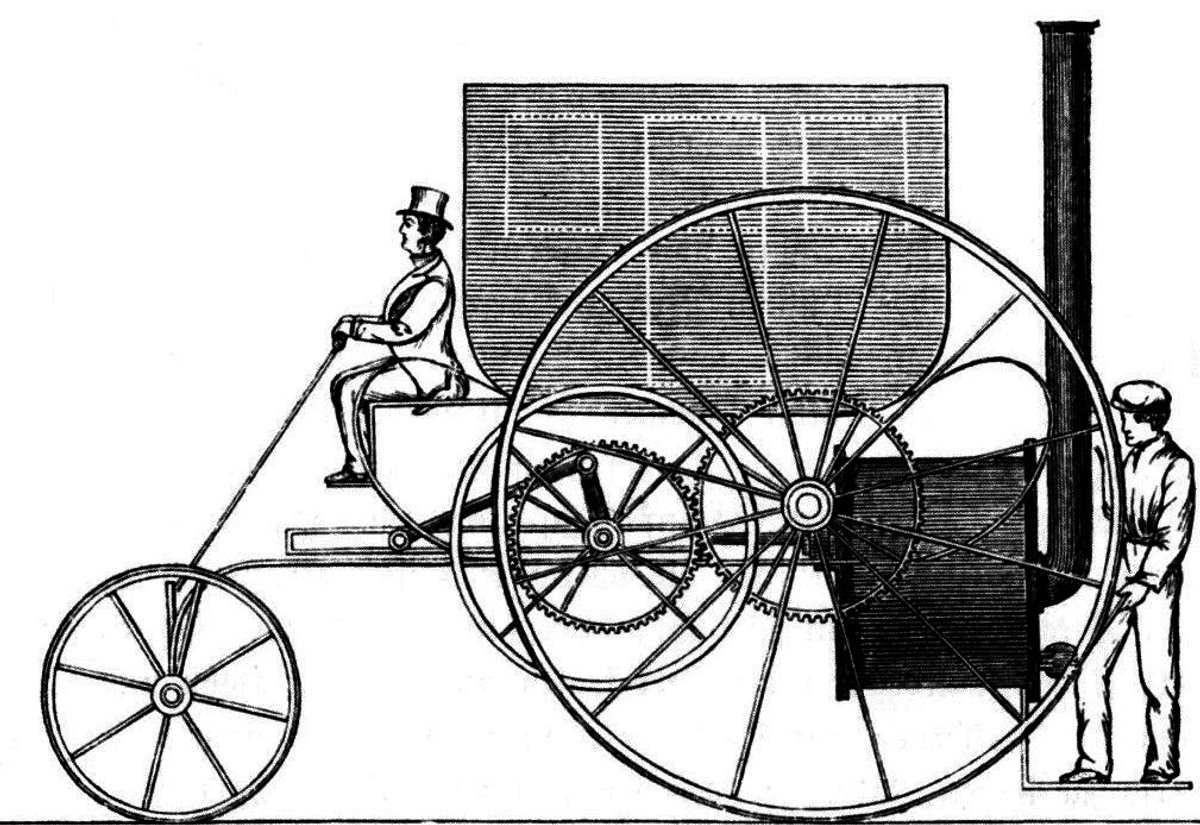
They literally took the carriage that would have been towed behind a horse and replaced the horse with a steam engine.
It was many years before new designs for the horseless era introduced enclosed carriages, windows, safety features that became what we know as cars.
What leaders should be doing
As the owner of a process (CEO for the overall company, or the CxO or VP that owns the top level processes for their business unit or function) it is your responsibility to reinvent your process for the AI-era.
Step one is to clearly define your inputs and outputs.
Inputs - what do I receive from other teams, external stakeholders, other processes
Outputs - what do I pass on to other teams, external stakeholders, other processes - are we clear on the current state numbers, required quality, and costs of doing so?
Step two is to redefine this process with an AI lens.
This will require you having a clear understanding of what the frontier models and harnesses provide, how an agent is defined and works, what the near term future of AI models looks like and could enable.
Alternatively work with a member of your AI Ops team, or external support, that has this deep understanding of what is possible.
This is not an IT project - the business leader owns and redefines the process.
Design the new process with the new AI capabilities in mind.
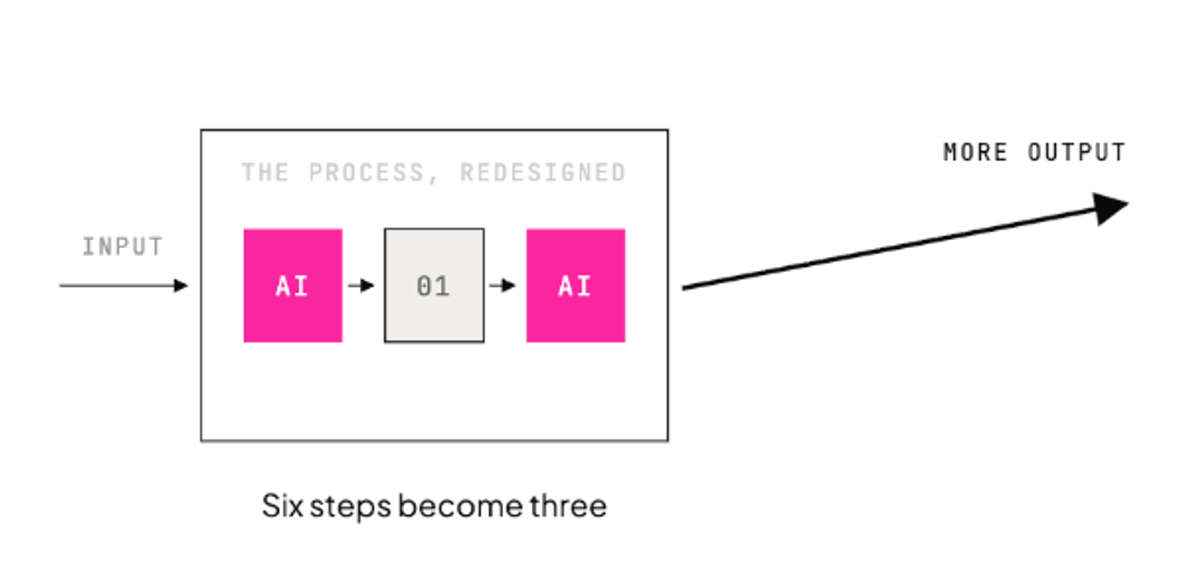
This can involve:
- Reducing the number of steps
- Removing entire parts of the process
- Allowing steps to work in parallel
- Allowing steps to be combined
- Reducing the time between steps
- Removing the number of human roles required
An example of this in our sales process is the role of an inbound BDR (a human that receives an inbound lead, triages it, qualifies it, books a meeting for the sales person)
In an AI-enabled process this is near instant, infinitely scalable, requires no human involvement, and increases the quality by applying a consistent process across all inbound leads - getting customers in front of qualified customers far quicker therefore increasing deal velocity and close rates.
Having redefined your process, you should start defining and designing the new AI solutions that will support your new process, which will include some measures that you can use to track the impact at a process level.
I'll talk about that in another post.
Go Deeper
I encourage you to grab a physical copy of High Output Management and read it over a weekend.
Reading it with an AI lens in mind will give you huge value, not just as a leader of your team, but now as a pioneer in the AI era.
To put this into practice, our free AI use case prioritisation framework walks through choosing your domains, defining their inputs and outputs, and redesigning the process before you score a single use case. With the Kowalah Plugin you can run the redesign in Claude, with the as-is and to-be processes held side by side.
Enjoyed this?
Weekly insights for executives navigating enterprise AI. A five-minute read.