Insights
The Bitter Lesson for business leaders: why your own model beats niche tools
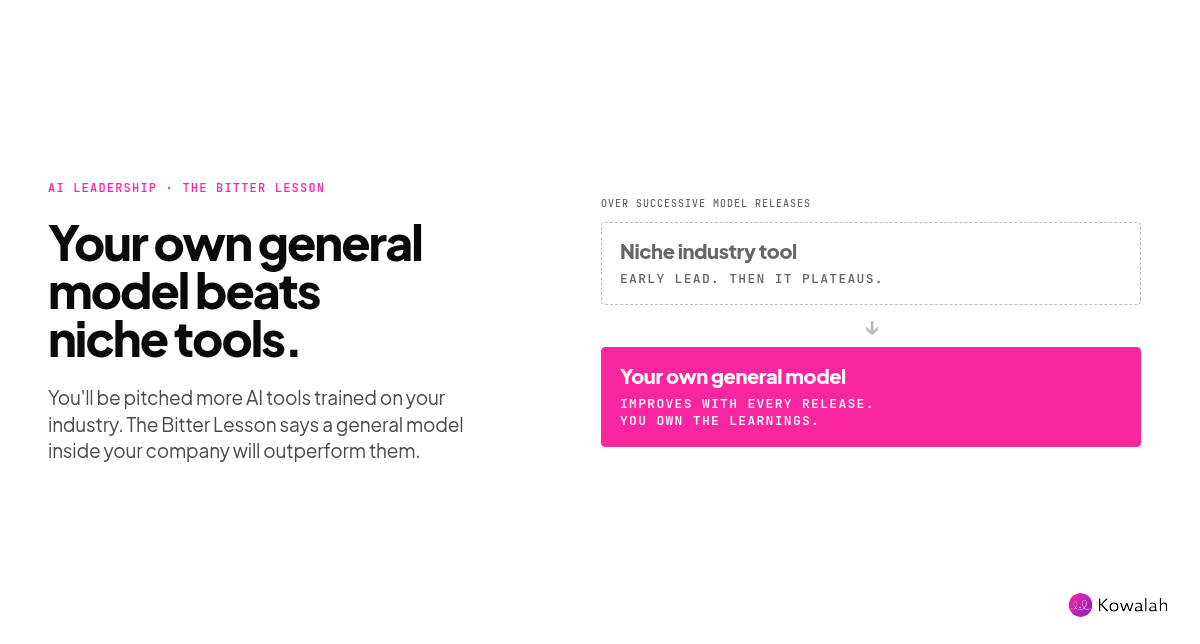
You are going to be pitched more and more niche AI tools "trained" on your industry: legal, sales, finance, manufacturing, you name it.
The Bitter Lesson says a general model like Claude or ChatGPT, used inside your own company on your own work, will outperform them. And you own the learnings.
What the Bitter Lesson actually says
In March 2019 the AI researcher Rich Sutton published a short essay, The Bitter Lesson. The opening line is the whole argument:
The biggest lesson that can be read from 70 years of AI research is that general methods that leverage computation are ultimately the most effective, and by a large margin.
In plain English: methods that get better as computers get cheaper and more powerful beat methods built from hand-crafted domain knowledge.
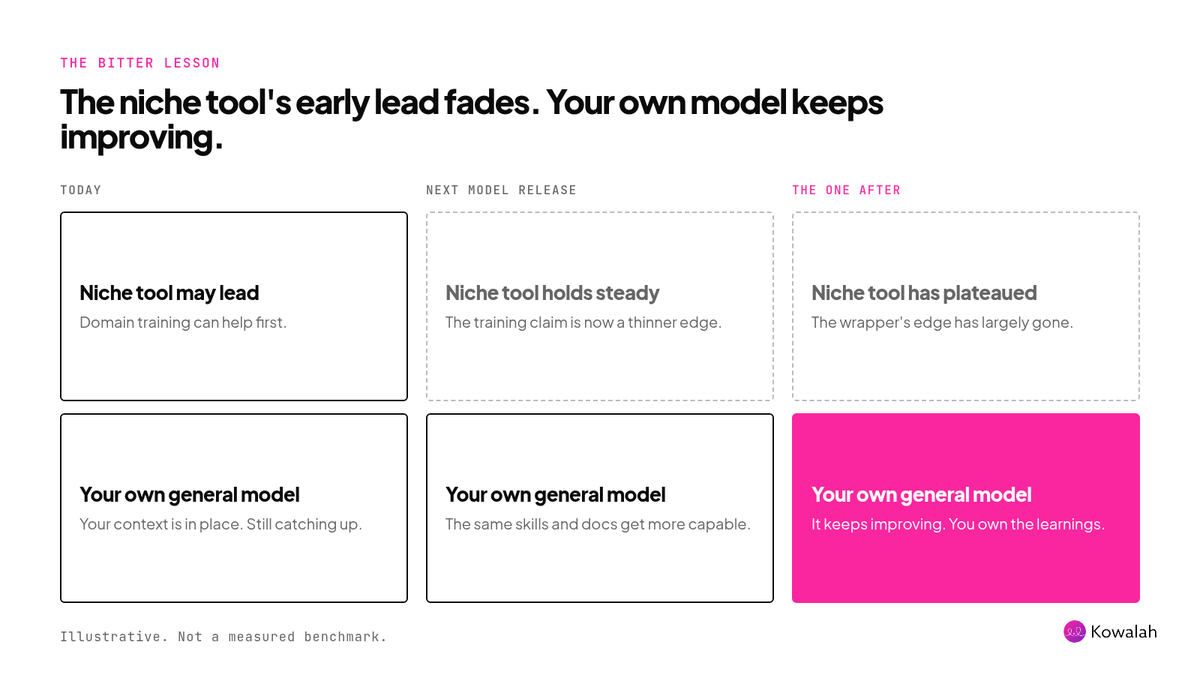
The specialist approach often wins first. It feels satisfying. Then it plateaus. The general approach keeps improving, and eventually overtakes it.
You can see the pattern in Sutton's examples. In chess, and later in Go, years of work went into encoding how grandmasters think. The systems that beat the world champions were simpler search and learning, run at scale. Speech recognition and computer vision followed the same path. Early systems were built around human ideas of phonemes, edges and features. They were overtaken by statistical and deep-learning methods that used more computation and less of how we thought we thought.
It is a bitter lesson because experts like putting their knowledge into the machine. Over a long enough horizon, that investment tends to get in the way.
What this looks like in your inbox
The current version of this pitch is a vertical AI tool: "trained on legal", "built for sales", "fine-tuned on manufacturing". Some of those products are real software, with workflow, integrations and compliance baked in. Many are a thin wrapper around a general model, plus a prompt and a dataset, sold at a premium because of the domain story.
The wrapper's edge is fragile. Every time Anthropic, OpenAI or Google ships a stronger general model, the gap shrinks. The knowledge the vendor encoded becomes less valuable. The work you did inside their product stays with them.
A general frontier model inside your own company works the other way. You give it your context: your documents, your processes, your brand voice, your skills. Each model release makes that same context more useful. The prompts, skills and data stay yours. The agents we build sit on the client's own Claude, so the learnings compound in your environment, not in a vendor's.
You have already seen a version of this in finance. In 2023 Bloomberg trained BloombergGPT, a 50-billion-parameter model, on financial data. It beat similarly sized open models on financial language tasks. Later that year, independent work found GPT-4, a general model, already matched or outperformed it on several of those public tasks. Those comparisons are now more than three years old, and general models have kept moving.
A fresher rhyme of the same lesson arrived in June 2026. An independent Nature Medicine study found that general frontier models outperformed two specialised clinical AI tools, OpenEvidence and UpToDate Expert AI, on medical knowledge tests, clinician-alignment checks and real physician queries. The specialist tools had been sold on domain training and retrieval. The general models still won.
When a niche tool still makes sense
The Bitter Lesson is not an argument for never buying specialist software.
Buy the niche tool when the value is the workflow, not the model: a system of record, a tight integration into a process your team already runs, or a compliance and audit trail you would otherwise have to build. Be wary when the pitch is mainly "we trained it on your industry" and the product is a chat box with a domain label.
Questions to ask the vendor:
- What still works if we swap in the next general model ourselves?
- Do we keep the prompts, skills, evaluations and data if we leave?
- Is the edge the workflow and the integrations, or the claim of domain training?
- Who owns the learnings as our people use it?
If the honest answers are "not much", "no", "the training" and "they do", you are buying a wrapper. Put that effort into your own model instead.
Put the general model in your company
Put a general frontier model, Claude or ChatGPT, into your company. Feed it the context that makes your work distinctive. Build skills and, where a process warrants it, agents on that foundation. Review them when a new model lands, rather than signing another niche contract.
Talk it through first
If you want a hand deciding where a specialist tool is justified and where your own model should do the work, book a free planning session. We'll walk the pitches you are seeing and the work you already have in Claude.
Enjoyed this?
Weekly insights for executives navigating enterprise AI. A five-minute read.