Insights
What Electric Twin Taught Us About AI, Speed and Expertise
Last week on our Wednesday Webinar we were joined by Tom Burke, Head of Market Development, and Diana Panizo, Insight Analyst, from Electric Twin.
Electric Twin builds AI models of real audiences, so companies can ask them questions and get answers in seconds. It's part of a growing field called synthetic research.
We came away with 3 conclusions. Tools like this let experienced researchers take on far more questions, and act on the answers much sooner. But they only amplify expertise. They can't supply it.
Where Electric Twin came from
During Covid, No. 10 Downing Street needed to know how people would react to new rules before announcing them. There wasn't time to survey millions of people and wait for results.
Electric Twin's founders, Alex Cooper and Dr Ben Warner, were both working there at the time, so they built a model instead. Tom explained:
"Electric Twin was born out of that initial problem. What we do is we give customers the ability... to ask any question that they want to the audience that they care about... and then get answers back in seconds."
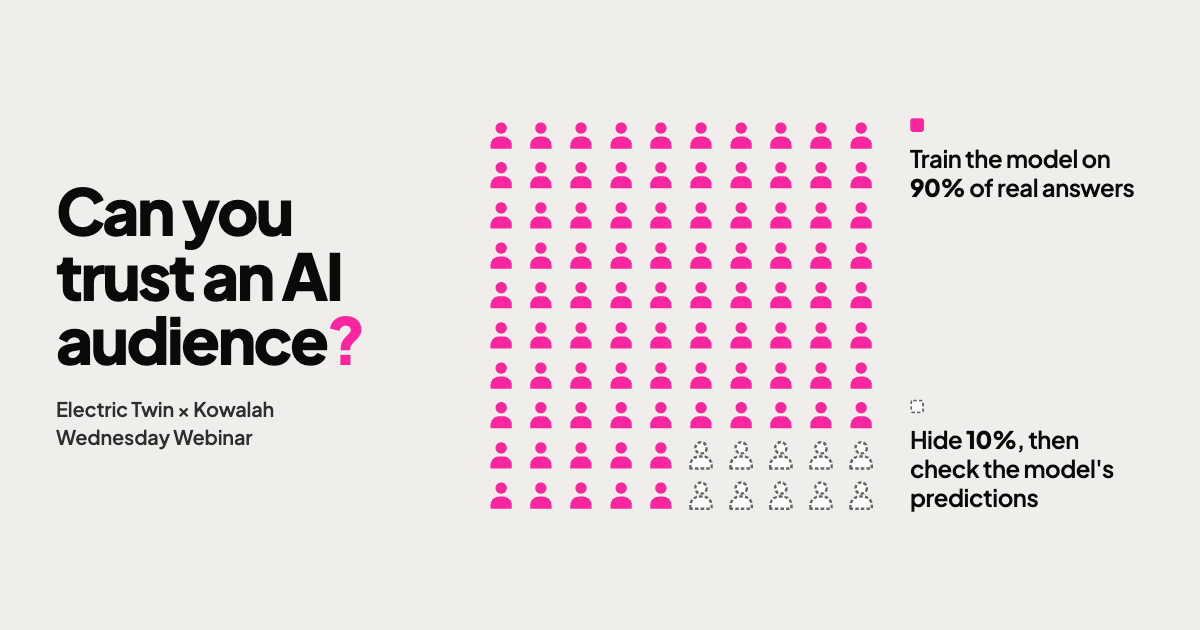
Diana explained how they check the answers. For every dataset, they train the model on 90% of the real answers, hide the other 10%, and check how close the model gets:
"...we've run over 50,000 evaluations in most of the countries in the world, and we do it for every single dataset that we onboard."
A model only gets trusted with new questions once it's passed that test.
1. Research you'd never have commissioned
The usual worry with tools like this is that they'll take work away from analysts. We see it differently: they open up research that never made sense before.
Some questions were always too expensive or too slow to research, or needed people who were hard to reach. Say you want to know whether parents of young children in Italy would pay for a weekend delivery slot. You get an answer, then test the price with the same audience that afternoon.
A traditional study for a group that narrow would take weeks and a real budget. Most teams would never have commissioned it. Now they can, and the insights lead is still the one asking the questions and deciding what the answers mean.
It's a bit like Jevons paradox: when something gets cheaper, people use more of it. As research gets cheaper, more of it becomes worth doing, and there are more results to interpret.
That means more work, including tasks that used to make no financial sense.
2. Speed is the advantage
The second point is about timing. Picture 2 similar companies with the same question.
The first is budgeting and organising a traditional field study for November. The second launches research in about 20 minutes, gets results and acts on them.
The second company has its answer, and its head start, while the first is still writing the brief.
3. The expertise is what makes the tool
Electric Twin's value comes from its founders: their time at No. 10 and years of statistical modelling. Our view is that AI know-how on its own would give you an average market research tool. What makes a product stand out is founders who've done the underlying work themselves and built that knowledge into it.
We see the same thing with our own agents at Kowalah. Brian, Joshua and Krista are useful because we've given them our own knowledge, resources and frameworks.
What this means for your business
If you're looking at synthetic research, or any AI tool that claims to predict how people will behave, here are the questions we'd ask:
- What haven't you been able to research? Look for questions you've dropped because they cost too much, took too long or needed an audience you couldn't reach.
- What's the cost of waiting? If a decision sits in a queue for weeks while you wait for research, that delay is a cost too.
- Whose expertise is in the tool? Ask vendors who built it, what they'd done before, and what real data they tested it against. Electric Twin could show us its results. Good vendors can.
Whatever tool you pick, keep your experienced people close. They're still the ones who decide what the answers mean.
Watch the full session here. If you're working out where tools like this fit in your AI programme, we'd be glad to talk it through.
Enjoyed this?
Weekly insights for executives navigating enterprise AI. A five-minute read.