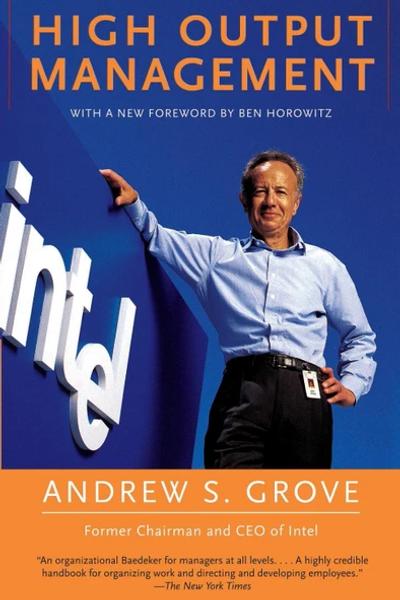
High Output Management
High Output Management is not a book about AI. It was written in 1983, at Intel, on a typewriter's worth of distance from any of this.
It is worth your afternoon because it answers a question you are being asked right now and probably cannot answer cleanly: what did all that AI investment actually change about your output?
We ask a room of senior leaders who has read it, and almost nobody has. The date on the spine files it under business history, so it sits unopened on exactly the shelf where you need it most this year.
What is High Output Management about?
Andy Grove wrote it while running Intel, and it reads that way. Very little theory. A great deal of hard-won practice about how work actually gets done inside an organisation.
His founding claim is one sentence, and everything else falls out of it. A manager's output is not their own work. It is the output of the organisation under them, plus the output of the neighbouring organisations they influence.
Sit with that for a moment. Forget your calendar and how busy the quarter felt. The number is what your organisation produced, which makes the only question worth asking this: which of your activities most increases it?
To make it concrete, Grove uses a breakfast factory. You are serving a three-minute egg, buttered toast and coffee, all delivered together, hot. That trivial-sounding problem carries the whole book: inputs, the labour applied to them, throughput, the limiting step, and how you tell whether any of it is working. Every team and every division in your business is a version of that factory. It takes an input, applies effort, produces an output.
Grove also treats the production process as a black box. You cannot see inside it directly, so you cut windows into it using indicators, and those windows are how you spot trouble before it reaches the customer.
What is managerial leverage?
This is the engine of the book, and it is arithmetic rather than philosophy.
Managerial output = the sum of every activity multiplied by its leverage.
Hours worked appear nowhere in that equation. Output equals activity times leverage, added up across everything you did.
Grove identifies three sources of high leverage:
- One action affecting many people. A decision, a standard or a piece of training that reaches a large number of people at once.
- A brief action with long-lasting influence. A short intervention that shapes behaviour for months afterwards. A well-run one-to-one. A definition of what good looks like.
- Unique knowledge affecting a large body of work. Information only you hold, applied where it changes what many people do.
He then uses this to defend the things managers treat as overhead. One-to-ones, training, clear indicators, well-run meetings. Each one is justified on output per hour invested, not on good intentions. Training, he insists, is the highest-leverage thing you do, and you cannot hand it to a function.
Two more tools travel with it. The limiting step: find the slowest, most constrained part of the process and schedule everything else around it. Paired indicators: never report a measure of quantity without its matching measure of quality, because people optimise whichever one you count.
Why this matters more in 2026 than it did in 1983
Grove was writing for a world where the only resource a manager applied to the factory was people. Motivated, capable, well organised people, deployed to produce the highest output at the required quality for the lowest effective cost.
You now have something else to apply. That adds a new term to his equation, and most organisations have yet to work out where to put it.
AI for your people, or AI for your company
This is the distinction that decides whether any of it shows up in your numbers, and Grove gives you the language for it forty years early.
AI for your people
You buy licences. Everyone gets an assistant. Each person becomes faster and sharper at their own work.
What you have done is let every individual optimise their own cog inside the black box. That is real, and it is worth having. But the box keeps its shape. The limiting step stays exactly where it was. The handoffs between teams still cost what they cost. Grove would point out that time saved and never redeployed turns into slack, and slack stays invisible on a P&L.
This is where the overwhelming majority of programmes stop, and it explains the gap between how good the tools feel and how little moves at company level.
AI for your company
Now build at the level above the individual. Managed agents. Skills and workflows the company owns. Processes that run without anyone holding them.
Run that through Grove's three sources of leverage and something obvious happens. A company-level agent affects many people at once. Its influence persists long after the day you built it. And it encodes knowledge that previously sat with a handful of individuals, applied across a large body of work.
It hits all three at once, which is rare enough that a senior leader has few other options with the same profile.
This is the version where you stop optimising cogs and start redrawing the box. Which is what Grove was writing about the entire time: the manager's job is the design of the organisation, not the heroics performed inside it.
The windows in the black box
One more piece worth taking. Grove's indicators exist so you have visibility into a process you cannot otherwise see.
Most AI reporting cuts windows onto the wrong wall. Licences issued, seats active and prompts written are all procurement measures, and they show you the purchase rather than the process. Apply his rule instead: pick the output measure that matters to your customer, pair it with a quality measure so nobody games it, and put your window on the limiting step.
Three questions for the executive team
For the CEO. Draw your business as Grove's factory. Where is the limiting step? If your AI work is not pointed at it, you have bought speed in a place that was never the constraint.
For the CFO. Which side of the line does this spend sit on? Individual assistance belongs in a productivity case, underwritten on the returns productivity programmes deliver. Building at company level has a longer horizon and a different risk profile, so it needs its own case with its own maturity.
For the COO. What windows have you cut into the box? A report showing adoption rates with no throughput measure tells you the tool arrived, and nothing at all about whether the work got faster.
Where the book is weaker
Two things to know before you buy it.
It was written in 1983. You have to carry yourself forward to a world with the internet and AI in it, and Grove will not do that work for you. Some of the specifics have aged oddly, particularly the volume of meetings he prescribes. The reasoning underneath still holds, though you will be translating the examples as you read.
It is a book on leadership and management, not on AI. That is exactly why we recommend it, but it sets a condition. If you do not lead or manage people, the interpretation is hard work, because Grove assumes you own an organisation whose output you are accountable for.
Who should read it
CEOs, COOs and anyone accountable for what a large group of people produce.
Read it if you are being asked what AI changed and find yourself reaching for adoption statistics. Grove will tell you why that number is empty and what to count instead.
What you will take away
- A way to draw any team in your business as a process with inputs, effort and outputs
- The arithmetic to work out where AI produces leverage, and where it produces slack
- A clear line between buying assistance for individuals and building capability at company level
- A far better set of measures than seats, licences and prompts
The line worth remembering
Give AI to your people and they will optimise their own corner of the box. Give AI to your company and you get to redraw the box. Grove spent 250 pages explaining why the second one is your actual job.