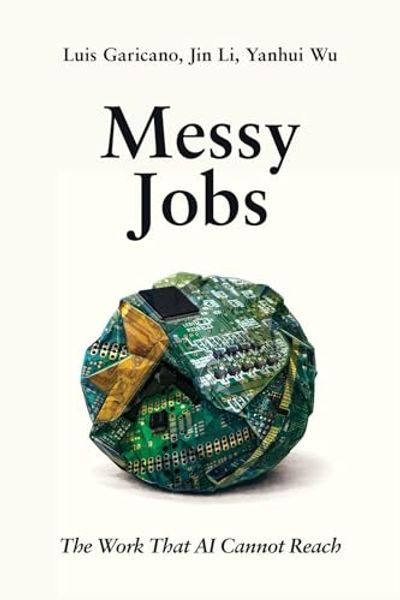
Messy Jobs: The Work That AI Cannot Reach
Who Should Read This Book and Why
- Leaders redesigning roles and operating models who need a rigorous way to judge which work AI will take on
- HR and workforce planners trying to separate hype from evidence on job displacement
- Anyone anxious about AI and jobs who wants an economist's answer rather than a forecast
Summary
Messy Jobs, published in 2026, applies organisational economics to the question of how AI will reshape work. The authors argue that predictions of mass job loss get the economics wrong: AI automates tasks, but jobs are more than tasks.
Jobs bundle judgement, coordination, accountability, tacit knowledge and relationships. The messier and more tightly bundled a job is, the harder it is for AI to replace. The jobs that survive won't be the hardest ones; they'll be the messiest.
Key Learning Points
Tasks are not jobs
AI can automate individual tasks without eliminating the job. When tasks are tightly bundled, pulling one out doesn't remove the need for the person who holds the rest.
The autonomy threshold
AI only works on its own once its capability crosses a threshold. That threshold rises with messiness, so messy work stays human-plus-AI for longer.
Three tiers of jobs
- Clean, verifiable tasks: AI learns them quickly and can work autonomously
- Strong bundles of tasks: AI takes on parts of the role, but coordination costs keep the job together (radiology is the worked example)
- Relationship-based work: value comes from trust, accountability and human connection
Coordination costs decide the pace
As coordination becomes cheaper, tasks can be unbundled and AI does more. Leaders should watch coordination costs, not just model capability.
By the End of This Book You Will...
- Have a practical framework for judging which roles AI will replace, reshape or leave alone
- Avoid restructuring the wrong jobs on the back of task-level automation
- Understand why judgement, accountability and relationships remain valuable as cognition gets cheap
- Know how workers, managers and leaders should respond