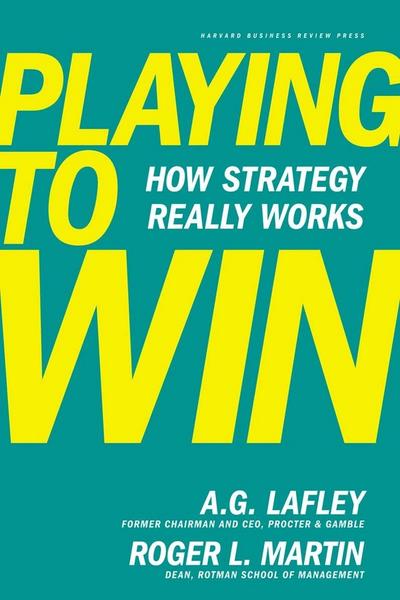
Playing to Win: How Strategy Really Works
Author resources
Playing to Win is not a book about AI. It came out in 2013, well before any of this.
We recommend it anyway, because AI has made its central question expensive to keep avoiding. What is your company actually choosing to be good at?
We open leadership sessions by asking who has read it. Usually one hand goes up. Often none. That still surprises me, given how many of the people in those rooms will sign off a strategy document before the year is out.
What is Playing to Win about?
A.G. Lafley ran Procter & Gamble through one of the most studied turnarounds in modern business. Roger Martin, then Dean of the Rotman School of Management, was his strategy adviser throughout. The book is their account of what they actually did, written while the results were still being audited.
Their argument starts by separating strategy from two things it gets confused with. A plan is a list of activities. A vision says where you would like to end up. Strategy is the set of choices that puts a company in a position to win somewhere specific, and choosing means ruling things out.
Most documents titled "strategy" contain ambitions rather than choices. That distinction is the whole book, and it reads in about four hours.
What is the strategic choice cascade?
Five questions, answered in order, each one constraining the next.
- What is our winning aspiration? Not a mission statement. What winning looks like, and for whom.
- Where will we play? Which markets, segments, channels, geographies, customer types, and which stage of the value chain. By omission, this also names where you have decided not to compete.
- How will we win? What makes a customer choose you in those places over the alternative. Stated specifically enough to be wrong.
- What capabilities must be in place? The small number of things the company has to do better than anyone else for question three to hold up.
- What management systems are required? The measures and routines that keep the choices alive once the offsite finishes.
The cascade is hard to fake. Vague answers to questions two and three fall apart at four and five, because there is nothing for them to hang from. You will probably find that uncomfortable, which is usually a sign it is working.
Lafley and Martin pair it with a second tool: "What would have to be true?" Instead of arguing about whether an option is right, you ask what conditions would need to hold for it to be right, then go and test the least certain one. It turns a boardroom argument into a piece of work.
Why this matters more in 2026 than it did in 2013
The book landed in a world where execution capacity was the binding constraint. Most companies knew roughly what they wanted to do and struggled to do enough of it. A fuzzy strategy survived, because the bottleneck sat downstream of the thinking.
That has changed. When your organisation's capacity to produce work rises sharply, the absence of a decision about which work matters stops being survivable. Capacity without direction produces motion, and motion reaches the cost line long before it reaches the value line.
Where AI actually sits in the cascade
Most executive teams file AI under question four. A capability. Something to buy, roll out and measure in adoption rates.
That reading is fair as far as it goes, and it is also why so many programmes deliver efficiency without moving the company anywhere. Access to the technology is a commodity. Your competitors buy the same models, from the same vendors, at the same list price, in the same quarter. None of that changes why a customer picks you.
What the technology makes newly possible is a separate question, and it reaches higher up the cascade than most boards have noticed.
Question two: new places to play
Lafley and Martin name the stage of the value chain you occupy as one dimension of a where-to-play choice. Revisiting that used to be expensive, so most companies chose once and lived with it.
Say you run a services business. You accumulate proprietary data as a by-product of delivery: benchmarks, patterns, what worked and what didn't across hundreds of engagements. Productising it used to demand engineering you didn't have, at margins that never justified the build, so it stayed in project files. Change those economics and a new place to play opens up. You sell a product alongside the service, with a different cost structure and eventually a different valuation multiple.
The logic runs the other way too. Segments you could never serve economically, because onboarding or support cost too much per customer, come back into range.
Those are strategic choices. They sit with you, not with a technology function.
Question three: how you win
If you sell a product, the way your customer experiences it is part of why they choose you.
When someone describes what they want instead of navigating to it, or when your product answers their questions continuously instead of through a quarterly account review, the basis of choice moves. That is a how-to-win change.
It also holds up better than the technology underneath it, because it compounds on your data and your customer relationships. A competitor buys the same model from the same vendor. Those they cannot buy.
Question four: capability
This is real work and it needs doing. It is also where most programmes stop.
The test is simple. If your AI work touches only question four, you are buying efficiency on the same terms as everyone else in your market. That is a defensible use of capital. It will not change where you stand relative to them.
Three questions for the executive team
For the CEO. Name what this organisation has decided not to do this year. If the answer takes more than a sentence, you have a list of ambitions, and every programme underneath it will inherit that shape.
For the CFO. Which of the five choices does this investment strengthen? Answer that before saying anything about payback. Something that only strengthens question four should be underwritten as a cost programme and judged on what cost programmes return. Something that opens a new place to play needs a different case and a longer horizon.
For the COO. What changed in the operating rhythm? Question five is management systems. If no measure moved and no reporting line was redrawn, nothing changed. Licences issued and tools deployed tell you about procurement.
Where the book is weaker
Two things worth knowing before you buy it.
It is a P&G book. The examples come from consumer goods at enormous scale, so if you run a mid-sized services business you will do some translation work. The framework survives that translation. The illustrations don't always.
And the cascade reads better backwards than it works forwards. Following how Olay's choices fit together is satisfying. Sitting in a room with your own team and no obvious answer is a different experience, and the book has more to say about what good looks like at the end than about how to get through the middle.
Who should read it
CEOs, CFOs and COOs. If you own how the company creates value, rather than the function that owns the tooling, this is written for you.
This is a book about strategic choice and organisational design. It happens to be the most useful preparation you can have before deciding where technology of any kind belongs in your business.
It is also worth an evening if you have ever been handed a strategy document and found you couldn't say what it ruled out.
What you will take away
- The vocabulary to state where your company plays and how it wins, in a single sentence
- A way to tell an investment that buys efficiency from one that changes your position
- A clear view of why capabilities and management systems decide whether a decision survives contact with the organisation
- "What would have to be true?" as a way to end circular strategy arguments
The line worth remembering
If you cannot say what your company has chosen not to do, no technology will rescue you. It will only make you faster at the wrong things.