Insights
How to write an AI marketing plan your CEO will read (free template)
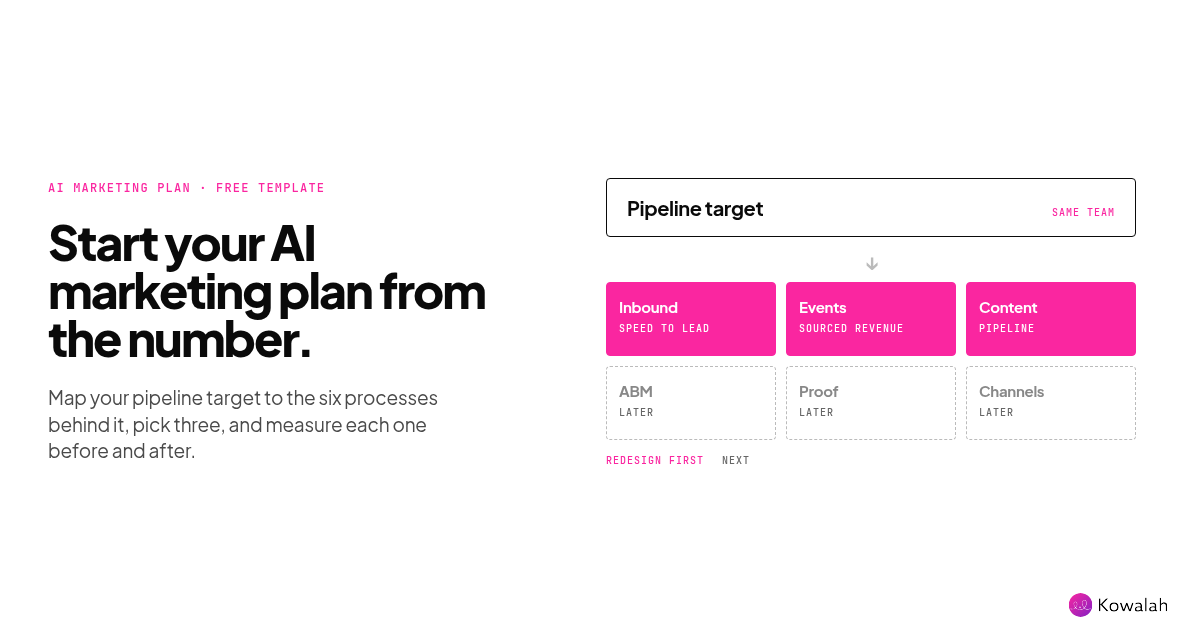
Most AI marketing plans are a list of tools. The plan your CEO will actually read starts from the pipeline number, maps it to the processes that fill your team's week, and picks three to redesign first, each measured before and after. Here's how to write one in seven steps, with a free AI marketing plan template to fill in as you go.
This guide is for CMOs, VPs and Heads of Marketing at B2B tech companies of 200 to 1,000 people whose pipeline target went up while the team didn't.
Why most AI marketing plans don't get read
Budgets aren't growing to close the gap. Gartner's 2026 CMO Spend Survey puts marketing at 7.8% of company revenue in 2026, up from 7.7% in 2025. CMOs now spend 15.3% of that budget on AI, yet only 30% report mature AI readiness, and 70% say their marketing processes aren't mature enough to scale it. The survey covered 401 marketing leaders, most at companies with more than $1 billion in revenue, but the pattern will be familiar at 300 people too.
So buying AI isn't the hard part. Changing the work is. A plan that says "Claude for content, an AI SDR for outbound, a chatbot on the site" doesn't tell your CEO what moves, by how much, or how you'll know. A plan worth reading answers three questions: what's the number, which work moves it, and what's the proof.
Step 1: Write down the number, the date and the gap
Start with one line: the pipeline target, the date, and the gap between that and your current run rate. Then add the line most plans skip: what you'd stop spending to fund closing it. An agency retainer, a tool nobody uses, a hire you'd rather not make.
If you can't name all three, the plan isn't ready. Everything after this step is judged against that number.
Step 2: Map the number to the six processes behind it
Pipeline doesn't come from "marketing". It comes from a handful of processes, each with its own KPI. For most B2B marketing teams, there are six.
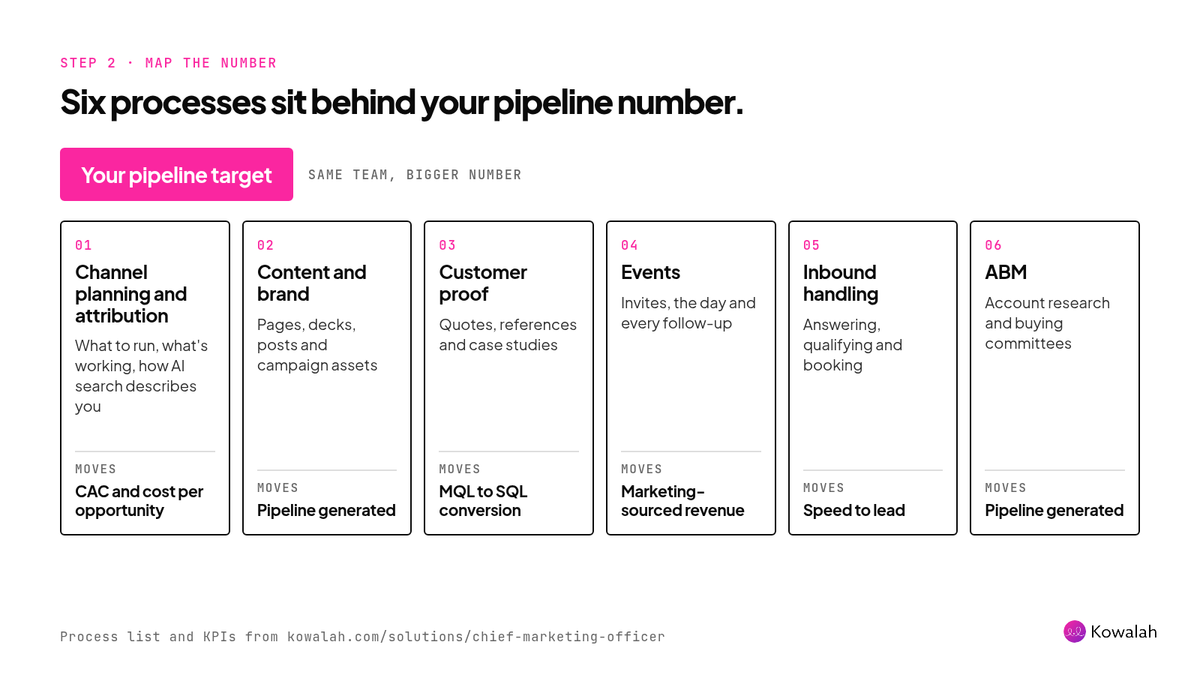
- Channel planning and attribution moves CAC and cost per opportunity, and now includes how AI assistants describe you when buyers ask them.
- Content and brand moves pipeline generated.
- Customer proof moves MQL to SQL conversion.
- Events move marketing-sourced revenue.
- Inbound handling moves speed to lead.
- ABM moves pipeline generated in your target accounts.
Write the owner next to each. This is the map your CEO hasn't seen: the number, broken into work someone is accountable for.
Step 3: Measure one normal week
Before you decide what to change, find out where the hours go. Ask each person in the team to log one normal week, counting four jobs separately: content, event follow-up, answering enquiries and reporting. Multiply the hours by 52 and you have the time a year that agents and skills could take on.
Then take a baseline for each KPI you mapped. Three are worth doing even if you do nothing else:
- Time to first reply on inbound enquiries, measured from the moment the form is submitted, not from when someone notices it.
- Share of event attendees followed up within a day.
- What Claude, ChatGPT and Perplexity say about you when a buyer asks for a company like yours.
Without a baseline, nothing in the plan can be proved later.
Step 4: Pick three processes with ICE
Six processes is too many to change at once. Score each one from 1 to 10 on three things, then multiply:
- Impact: how much would it move the number if it worked?
- Confidence: is the process documented, and do you have the data to measure it?
- Ease: are the systems connected, and who has to approve the change?
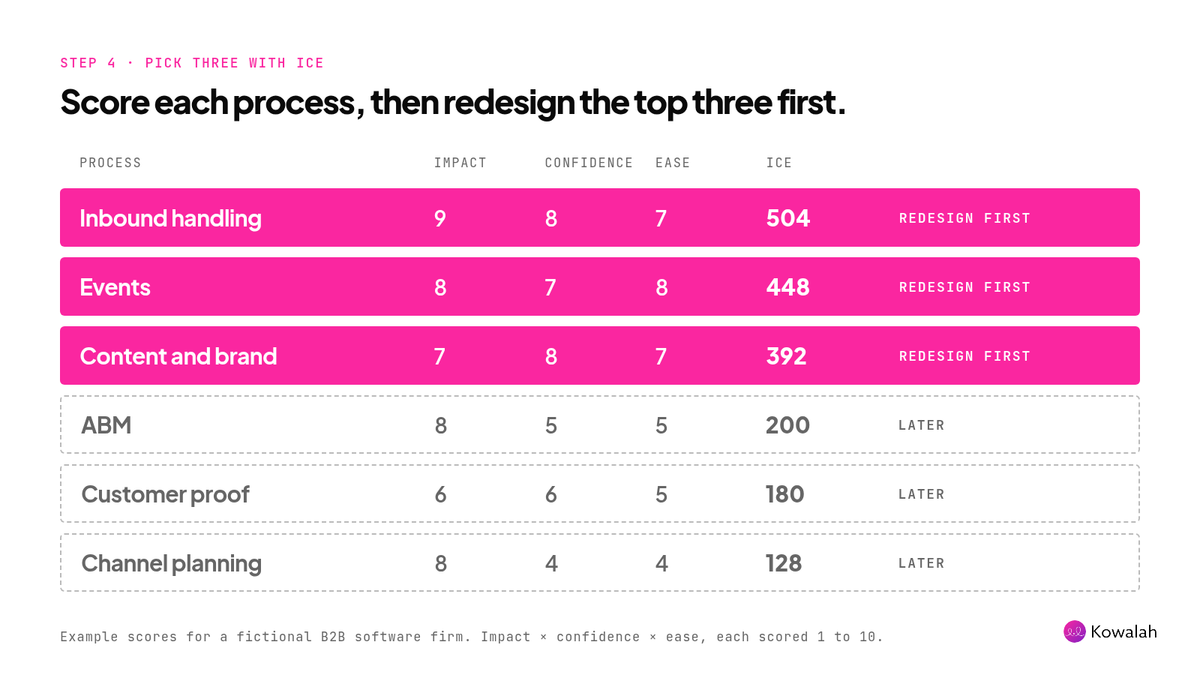
Start with the top three. Inbound handling often comes first because it's documented, rule-based and measurable within weeks. One revenue team we spoke to chose inbound over outbound for exactly that reason: inbound followed clear rules, while outbound was still an experiment.
The research on speed backs the instinct, with a caveat. A 2011 Harvard Business Review study of 1.25 million leads at 42 US companies found firms that tried to contact a lead within an hour were nearly seven times as likely to qualify it as those that waited even an hour longer. It measured conversations with decision makers, not sales, and it's 15 years old. So treat it as a reason to measure your own response time, not as a promise.
Step 5: Redesign each process before you choose a tool
For each of your three processes, write the steps as they happen today, then as they'd work with Claude. Take an inbound enquiry:
Today: the enquiry lands in a shared inbox. Someone reads it the next morning if it came in after five. They look the company up, email back and forth to find a time, and the research never reaches the CRM.
Redesigned: an agent reads the enquiry, researches the company and replies within minutes. It qualifies against your rules and books the meeting. It writes the research into the CRM for whoever takes the call.
Then decide where people stay in the loop. One team we work with drew the line like this: automate the obvious rules, such as country, company domain or whether there's a phone number, and keep a person on the ambiguous cases so good leads aren't lost. They also kept pre-call research light for inbound: location, industry and rough size were enough to reply fast. Start agents read-only, and let your team approve what goes out under your brand until the results earn more trust.
Only now pick the tools. Anthropic's own marketing plugin for Claude covers campaign briefs, content drafts and brand voice checks, and it's a reasonable starting point for the content process. But the redesign decides what you need, not the other way round.
Step 6: Decide who builds it, and who you hire
Every plan needs a named builder. Usually that's marketing ops or RevOps, working with the CMO who owns the number.
This is also where the hiring question comes up. Many teams' first instinct is to hire a GTM engineer: one person, a familiar budget line, the role everyone is talking about. The trouble is that one person can't redesign a function, and automations only they understand leave when they do. Redesign the three processes first, then decide what role you actually need.
Plan the team change as well as the tooling. The roles stay the same, but the week changes: content marketers edit and approve drafts rather than start from a blank page, and marketing ops sets the rules while agents route and update records. Say that early, because "my team will see this as replacing them" is a common worry. Budget for training by role, not one launch session.
Step 7: Put it on one page, with a 12-month view
Your CEO needs one page. It should show:
- The number: target, date, gap and what you'll stop spending to fund it.
- Three processes: each with its owner, KPI, baseline and target.
- What changes: what agents and skills do, and what people approve.
- The team: who builds, what training each role gets, and the hiring decision.
- The year: first process live and measured in the first quarter, the second in the next, the third after that, and a before-and-after report to the board at the end of the year.
Review it monthly. Move to the next process only when the one before it shows a measured result. That rhythm, one process at a time, is what turns a plan into proof.
Use the free template
The AI Marketing Plan Template follows these seven steps: the number and the gap, the six-process map, a one-week time log, baselines, ICE scoring, a redesign sheet for each process, team and hiring, a quarter-by-quarter roadmap, the one-page CEO summary and a monthly review log. It's free and ungated, with a Google Docs version you can copy.
Where Kowalah fits
Inbound handling is where many marketing teams start. On our page for CMOs, that's the job of the inbound BDR agent: it reads every enquiry, researches the company, replies within minutes and books the meeting, while your team owns the conversation. The agent runs on your own Claude and connects to the CRM you already pay for.
If you'd like help with the plan itself, bring your number to a free 45-minute working session. We'll map your pipeline target to your processes and team, and you'll leave with a one-page plan: the first three processes to change, the agents and skills for each, and how your team changes. Bring your number. Leave with a plan.
Frequently asked questions
What should an AI marketing plan include?
The pipeline number and the gap, the processes behind it and the KPI each moves, a baseline for each KPI, the three processes you'll change first, what agents and skills will do and what people approve, who builds it, and a 12-month roadmap. Tools come last.
How is an AI marketing plan different from a normal marketing plan?
A normal plan decides what to run. An AI marketing plan decides which work changes, so the same team can run more and follow up everything. It sits alongside your campaign plan rather than replacing it.
Which marketing process should we change first?
Score each one on impact, confidence and ease, and start with the top three. Inbound handling often comes first because it's documented and the result, speed to lead, shows within weeks.
Should we hire a GTM engineer before we write the plan?
Write the plan first. Redesigning the processes tells you what kind of role you need, and whether one person is enough to keep it running.
Do we need Claude to use this template?
No. The template works whichever AI your company uses. The process map, baselines and ICE scoring come before any tool choice.
Enjoyed this?
Weekly insights for executives navigating enterprise AI. A five-minute read.