Insights
AI showback vs chargeback: who should pay for your Claude spend?
Your CFO wants to know what the company is getting for its AI spend, and which teams should pay for it. There are two ways to answer: show each team its cost, or charge each team for it.
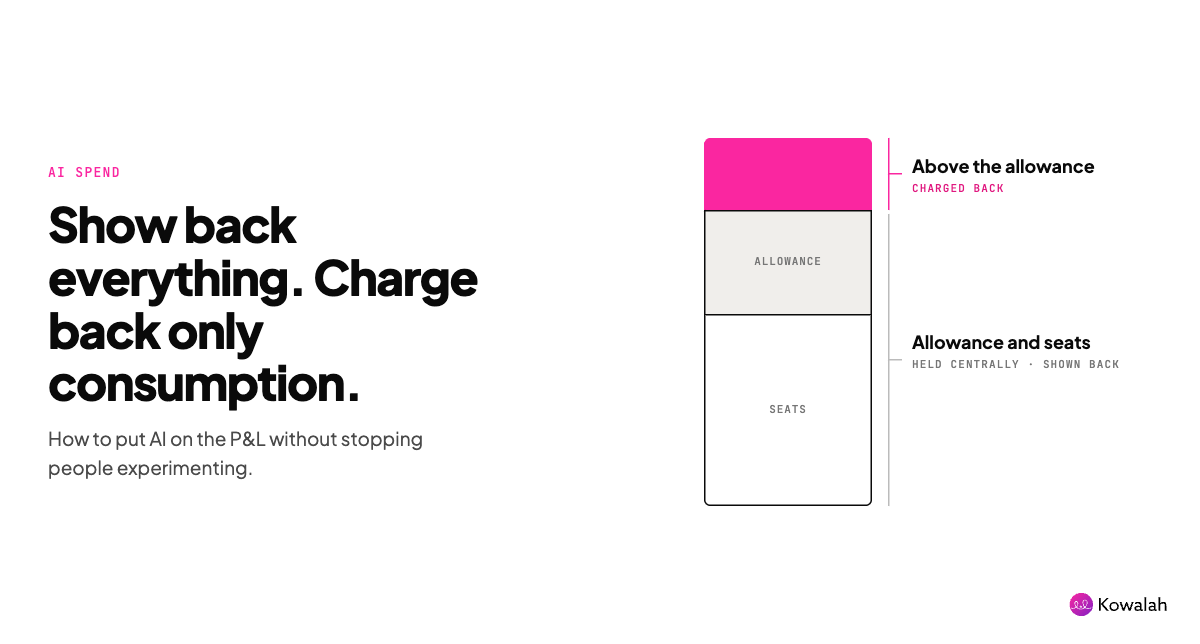
Our answer: always show back. Charge back only consumption.
The short answer
- Showback shows each team its share of AI cost. No money moves.
- Chargeback puts the cost in the team's budget. It changes behaviour, and it needs numbers finance will defend.
- Seats are a fixed cost. Recharging them moves money between budgets and changes nothing, so show them back.
- Consumption varies. API calls, Claude Code and agents go up and down with use, so that's the only spend worth charging back.
- Give everyone an allowance, held centrally, so nobody is afraid to experiment. Charge back only what goes above it.
Why it matters
AI spend has two halves, and they behave differently.
Seats are predictable. You commit to them for the year, and nobody can use less of one.
Consumption is lumpy. In Anthropic's example smart report, code was 9% of a team's sessions but 40% of its spend, and the most expensive 5% of sessions took 47% of the bill. Spread that across departments by headcount and the light users quietly pay for the heavy ones.
Showback vs chargeback
| Showback | Chargeback | |
|---|---|---|
| What happens | Each team sees its share of cost | The cost lands in the team's budget |
| Data it needs | Directional is fine | Numbers finance will defend |
| What it changes | Awareness and better questions | Behaviour |
| The risk | Easy to ignore | People stop experimenting |
| Best for | Every AI cost, always | Metered consumption only |
Our view: seats back, consumption charged
Charge back a seat licence and nothing changes. The cost is already committed, the team can't use less of it, and you've created an internal invoice nobody can act on.
Metered spend is different. A team choosing Opus over Haiku, or running an agent overnight, is making a decision a budget owner can actually influence. That's what chargeback is for.
If seats are most of your spend, that's fine. Show them back, and decide seat counts centrally at renewal using the usage data.
The three-layer model
- Seats. Fixed licences, set at renewal. Held centrally and shown back.
- An allowance per person. A monthly amount of consumption everyone gets, held centrally and shown back. This protects experimentation: nobody has to justify a budget to try something.
- Use above the allowance. API, Claude Code and agent spend beyond the allowance. Charged back to the cost centre. This is the only money that moves.
An illustrative example: a finance team of 120 people has a £20 monthly allowance each, so £2,400 is held centrally. In March they use £3,100. Finance is charged £700.
To set the allowance, start generous. After a quarter of showback, look at what the median user consumes and set the allowance a little above it. The overage is then the power users and the agents, which is the spend a budget owner can decide about.
Where the numbers come from
- For showback: smart reports in Claude Enterprise show work, cost and friction by team, and can be scoped to a department or cost centre. They sample transcripts, so treat the numbers as directional.
- For chargeback: the spend export in Claude Enterprise usage analytics gives a CSV per user and per model, with net and gross spend, up to 90 days back. Owners and Primary Owners can see spend; Admins can't.
Two gaps to plan for: the export has no cost-centre column, so you match on email to your HR or identity data, and it's in US dollars, so agree an exchange-rate rule for sterling budgets.
One detail makes the model easy to run. On seat-based Enterprise plans, the spend export only covers usage above the seat allotment. The platform already separates the fixed seat from the variable overage.
When to start charging back
Wait until four things are true:
- Trusted. You've run a quarter of showback and budget owners don't dispute the numbers.
- Metered. The spend goes up and down with use.
- Owned. The person whose budget it hits can change it.
- Agreed. Finance has signed off how the recharge works.
A UK point to raise early: within one company, a recharge is a budget transfer. Across legal entities in a group, it's an intercompany charge, with VAT and transfer-pricing questions. Involve your tax adviser before you start.
Fund the middle before you fund more seats
Showback tends to surface a second decision: where the next AI pound goes.
Take an illustrative company of 5,000 people that licensed 1,000 Claude seats for phase one. Six months in, departments without access want it, the next tranche is on offer at renewal, and the board wants to know why everyone isn't using AI.
Look inside the first 1,000 and you'll usually see a curve. In our experience of client rollouts, roughly a fifth have a seat and rarely use it, roughly a fifth are power users asking for more, and around 60% sit in the middle, using Claude weekly for simple tasks. That split is a Kowalah estimate, not survey data.
Buy 4,000 more seats and you mostly buy more of the same curve. The better first move is to reassign idle seats to people waiting for access, and spend on moving the middle from weekly to daily: skills, connectors and enablement aimed at their actual work. Then widen access with evidence that a seat gets used. It's an order of priority, not a refusal to grow.
Frequently asked questions
What's the difference between AI showback and chargeback?
Showback reports each team's share of AI cost without moving money. Chargeback puts that cost into the team's own budget. Showback builds trust in the numbers; chargeback changes behaviour.
Should we charge back Claude or ChatGPT seat licences?
Usually not. Seats are a fixed, committed cost, so recharging them moves money without changing behaviour. Show them back, and charge back only metered consumption above an allowance.
How big should the per-person allowance be?
Start generous. Run a quarter of showback, then set the allowance a little above what the median user consumes, so the overage reflects genuinely heavy use.
Won't chargeback kill AI adoption?
It can, if it hits every prompt. Holding seats and a per-person allowance centrally means people experiment for free, and only heavy use lands in a budget.
Where do the numbers come from in Claude Enterprise?
Smart reports for directional showback by team. The usage analytics spend export, per user and per model, for anything you charge back.
Next step: the free showback and chargeback template will be on our templates page. It has showback and chargeback tabs, a central allowance setting and a usage curve by team.
Enjoyed this?
Weekly insights for executives navigating enterprise AI. A five-minute read.