Insights
Claude Enterprise rollout plan: the first 90 days
You have signed Claude Enterprise. The board expects progress, the licences are live, and the next 90 days decide whether this becomes a programme you can defend at the 12-month review or a line item nobody can explain. This guide sets out a week-by-week plan for those 90 days: what to decide, what to produce, and where rollouts stall.
We are Kowalah, a UK Anthropic Implementation Specialist, and this plan follows The Kowalah Way, the phase-gated method we use with clients. It works on its own, whoever you choose to run it. To run it, copy our free Claude Enterprise: your first 90 days checklist, with week-by-week tick lists, an owners table, an adoption tracker and a steering committee report outline.
The short answer
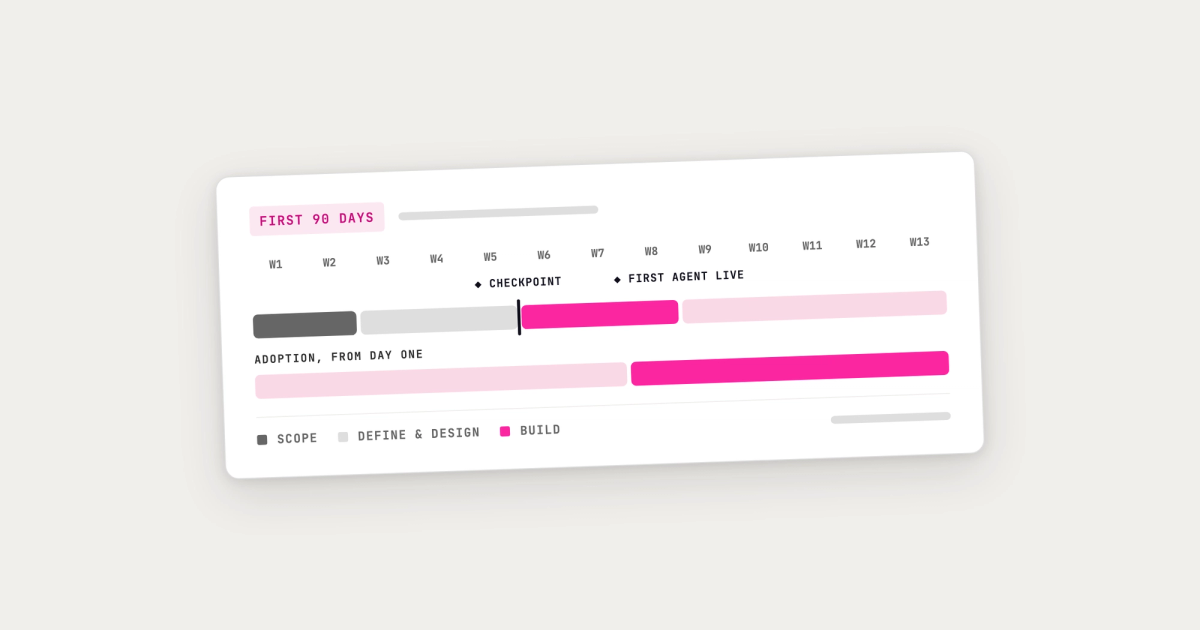
- Weeks 1 to 2: agree the business outcome, choose the first use case and produce a roadmap.
- Weeks 3 to 5: specify the work, design the solution, then pass a real checkpoint on security, scope and readiness before any build starts.
- Weeks 5 to 8: build, test and deploy the first agent or workflow, with the people who will use it trained and ready on launch day.
- Weeks 9 to 13: measure adoption and the business metric, report to the board, and line up the next use cases.
- From day one: run change enablement alongside the build, not after it.
Why the first 90 days go wrong
Claude rollouts rarely fail on technology. They fail quietly: the licences go out, a few enthusiasts use Claude well, the agents that were built go into production, and six months later usage is flat and nobody can say what the organisation got for the money.
Three patterns cause this:
- Licences without a use case. People are given Claude and told to "find ways to use it". The value stays locked up with the few who work it out for themselves.
- Build without adoption. An agent goes live with no champions, no training and no measure of use, so it is technically correct and commercially dead.
- No outcome to report. Nobody agreed at the start which business number the programme would move, so there is nothing to show the board at the review.
The plan below is built to prevent all three.
Before week 1: set up to succeed
Four things need to be in place before the programme starts:
- A named executive sponsor who will chair the steering committee and defend the programme's priorities.
- A business outcome the board recognises: hours returned to a function, a process made faster, revenue protected. Adoption is how you get there, not the goal itself.
- Your data rules. Agree with your DPO which data classes Claude is allowed to process, and check the UK data residency position before anything goes live.
- Admin controls. Set organisation-wide spend limits, user groups and default models on day one. Our guide to moving from Claude Team to Enterprise covers the setup.
Weeks 1 to 2: scope the programme
Start with a structured workshop that maps where Claude creates value across the business, not a long discovery phase. We run this as a Vision Map Workshop, and it produces a fundable proposal within five working days.
By the end of week 2 you should have:
- A vision map: the use case clusters that matter, grouped and phased.
- A roadmap: quarter-by-quarter milestones and the success metrics each one serves.
- The first use case, chosen on business value, feasibility and the appetite of the team who will use it.
- A target architecture: which Claude surfaces, integrations and security model the first release needs.
- Success metrics: the business measure, and the leading indicators you will track weekly.
Weeks 3 to 5: define, design and check
Define the work
Turn the first use case into a delivery-ready backlog: user stories with acceptance criteria your team has agreed, a definition of done, and a governance rhythm. Issue the first written status report and hold the first steering committee in this window, so the board-reporting habit starts early.
Design the solution
Produce the solution design: which agents and workflows, which integrations, which Claude capabilities, and how it runs inside your Microsoft 365 or Azure estate. Plan user acceptance testing now, with named testers from the team who will use it.
Pass the checkpoint
Before any build begins, stop and check. Are the stories approved? Is the architecture sound? Has security reviewed the data handling and connector permissions? Are the people available? A problem found here costs a fraction of the same problem found in testing. Treat this as a gate with a formal go or no-go, not a formality.
Weeks 5 to 8: build, test and deploy the first agent
Build in short cycles: two-week sprints for integration-heavy work, and two-day bursts for well-scoped, standalone agents. Every release passes the same gates before production: testing, a security review, a compliance check (UK GDPR, data residency, your own policies) and user acceptance testing signed off by the business.
A first agent or workflow, scoped to one measurable outcome, goes live in six to eight weeks from the start of the programme. Measure usage from launch day, so you have a baseline rather than a guess.
Weeks 9 to 13: prove it and set up to scale
The last month turns one live agent into a programme:
- Measure usage per person per week, and whether the business metric has started to move.
- Intervene where usage is flat: talk to the team, find the blocker, fix the workflow. Flat usage should trigger action, not a report.
- Report to the steering committee and the board in the same format you use for any other IT programme.
- Build the backlog. Collect use cases from across the business, score them on impact, confidence and ease, and choose the next two or three.
- Plan the next quarter, function by function, using what the first release taught you.
The adoption workstream, from day one
Adoption is not a phase after go-live. It runs alongside the build from the first week.
- Claude Champions. Nominate 5 to 10% of the people in scope as internal Champions. They are not AI experts; they run structured Claude sessions for their own teams and answer the everyday questions no central team can.
- Foundation sessions. Short, practical sessions for everyone in scope, grounded in their own work. The aim is orientation and confidence, not a training course.
- Communications. A plan from the sponsor through the first year: why the organisation is doing this, what is live, and the early wins, with Champions recognised by name.
- Measurement. Track use per person per week from launch, and review it at every steering committee alongside the business metric.
What to decide, and when
| Week | Decision | Owner |
|---|---|---|
| Before week 1 | Executive sponsor, business outcome, data rules, admin controls | CIO |
| 1 to 2 | First use case and roadmap | Sponsor, with the programme lead |
| 3 to 4 | Scope of the first release and acceptance criteria | Business owner of the use case |
| 5 | Go or no-go on the build | Steering committee |
| 8 | Go-live | Business owner, after acceptance testing |
| 12 to 13 | Next use cases and next quarter's plan | Steering committee |
Where Kowalah fits
We run this plan end to end for UK organisations that have signed Claude Enterprise, across strategy, build, change enablement and managed services. To see it in practice, watch our webinars Scoping your first AI implementation and 90 Days In: what AI adoption looks like. The first 90 days checklist turns this plan into a working document, and our use case discovery template helps you choose where to start. For the other decisions around Claude Enterprise, read our Claude Enterprise guide for UK organisations. When you are ready to start, see Claude implementation for UK enterprises or book a conversation.
Frequently asked questions
How long does a Claude Enterprise rollout take?
A first agent or workflow, scoped to one measurable outcome, goes live in six to eight weeks. The wider rollout is then phased function by function, with each quarter's plan built on what the last release taught you.
What should we do in the first week after signing Claude Enterprise?
Name an executive sponsor, agree the business outcome the programme will move, agree data rules with your DPO, and set organisation-wide spend limits, user groups and default models before inviting users.
Should we give Claude to everyone at once?
Give access broadly if you want, but build around one use case first. A single agent that a team uses every week, with a measured result, teaches the organisation more than a wide launch with no focus.
How do we measure Claude adoption?
Track use per person per week from launch day, by team, and review it alongside the business metric at every steering committee. Treat flat or falling usage as a prompt to fix the workflow, not a number to report.
What are Claude Champions?
Internal employees, 5 to 10% of the people in scope, who run structured Claude sessions for their own teams and support colleagues day to day. They carry adoption into teams a central programme cannot reach.
Enjoyed this?
Weekly insights for executives navigating enterprise AI. A five-minute read.