Insights
How to pick AI use cases: the 4 Vs
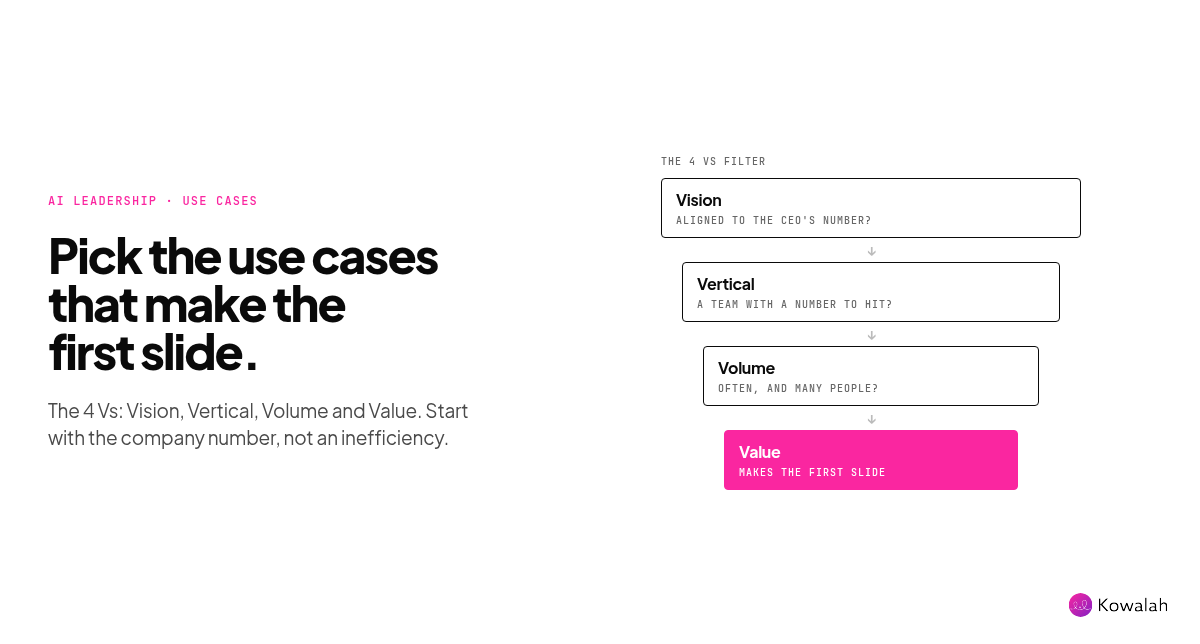
"How do we pick which use cases are the right ones for our AI programme?"
This comes up a lot as execs with an AI mandate struggle to find something impactful to work on.
I walk them through the 4 Vs.
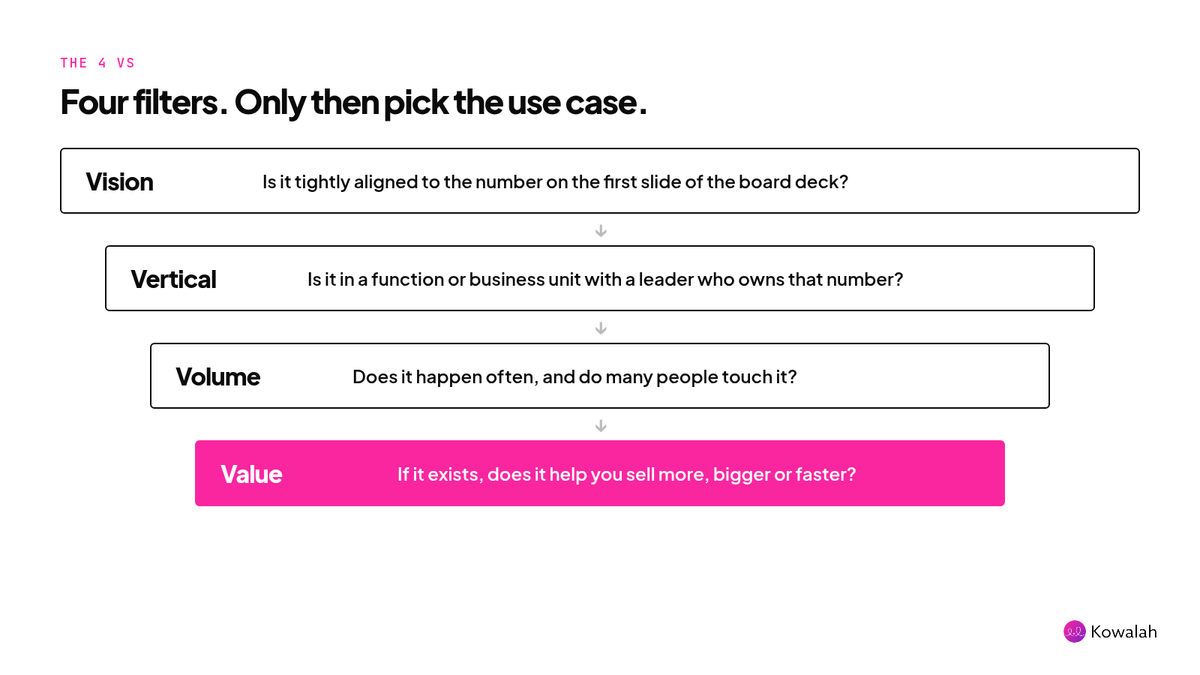
Vision
What is the company's vision? Forget AI. What does the CEO say at the company all-hands, what is the first slide of the board deck, what is the first number the CEO is thinking about: revenue, deal size, talent, retention, new markets?
If your use case isn't tightly aligned to that, keep looking.
Vertical
By vertical I mean a function or mission-orientated team in your organisation. It could be marketing, sales, it could be a business unit or region. A team with a leader with a number on their mind.
The opposite of vertical is horizontal. Here we think of shared services and operational teams like finance, legal, HR, IT. No doubt there are useful use cases here but they focus on efficiency, cost reduction, headcount impacts (whether explicitly mentioned or not) and there is a floor to how much you can save.
In business as in your personal life, you can't cut your way to wealth. You have to put more in at the top.
Volume
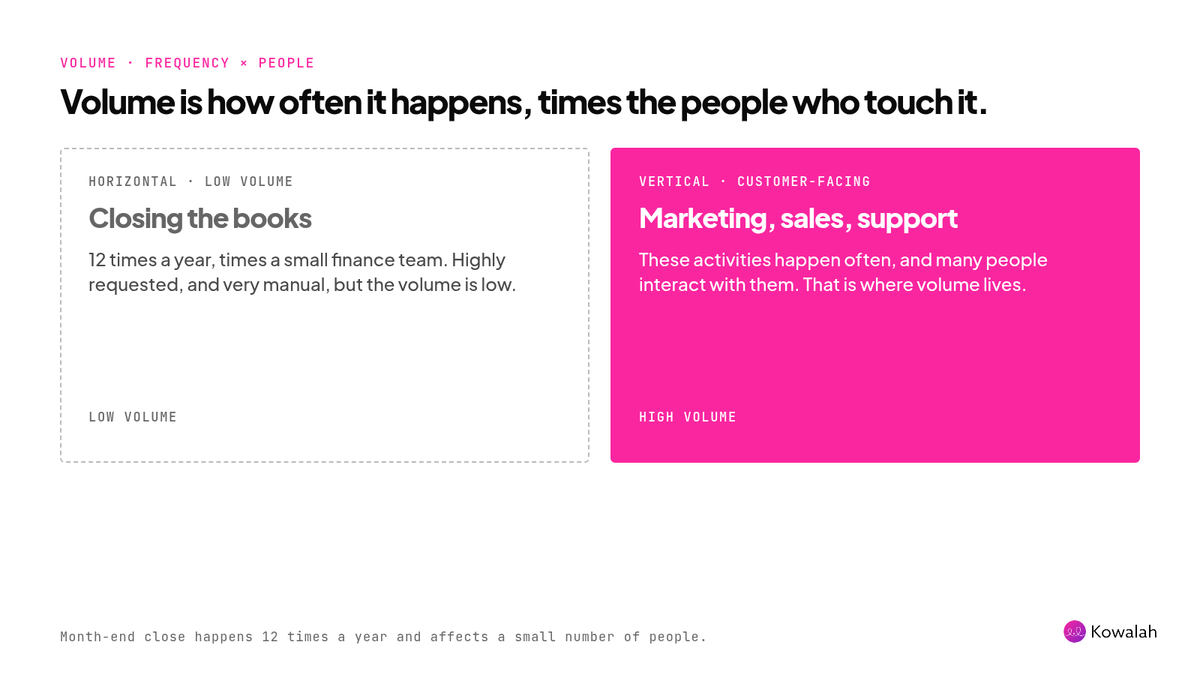
Look for use cases that have significant volume, driven by the number of times that process or activity occurs multiplied by the number of people that interact with that process or activity.
Often these are customer-facing activities: marketing, sales, customer support.
Closing the books each month is a highly requested use case, and very manual and not what finance teams got into finance for, but it happens 12 times a year and affects a small number of people.
Value
That leads me into the fourth V: Value. If this thing exists, what value does it drive to the business?
If we have aligned it to the company's vision, embedded it in a vertical, and focused on a high volume use case, then we should be accruing significant value (in pounds) to the business.
- We sell more.
- We sell bigger.
- We sell faster.
- We sell in new markets.
- We sell new products/services.
- We keep our customers for longer.
Efficiency use cases will tick the "we spend less" box, but unless that is tightly linked to helping you sell more without hiring more people, it's not going to make the first slide of the board deck as a high-value win.
How to get started
- Instead of starting with "we want to do AI, let's look for some inefficiency", start with your company vision: what are we trying to achieve as a company, and how we apply our efforts to that number.
- Who is the senior executive that owns that number? And how are they designing their system to deliver it?
- Within their system, what are the high volume processes that could be accelerated and have quality improved by applying AI?
- And if we do that, what is the value, in pounds, that will be returned to the company in terms of growth?
For a longer walk from board numbers to domains and use cases, see How to pick the right processes to reinvent with AI.
Questions leaders ask
How do you pick the right AI use cases?
Walk the 4 Vs. Start with the company's vision and the number on the first slide of the board deck, then a vertical with a leader who owns that number, then a high-volume process, and only then the value it returns.
Why not start with efficiency use cases in finance, legal, HR or IT?
Those use cases can be useful, but they focus on efficiency, cost reduction and headcount impacts, and there is a floor to how much you can save. You can't cut your way to wealth. Unless the work is tightly linked to helping you sell more without hiring more people, it won't make the first slide of the board deck as a high-value win.
Is closing the books a good first AI use case?
It is highly requested, very manual, and not what finance teams got into finance for. But it happens 12 times a year and affects a small number of people, so the volume is low.
What counts as value?
Value is what the use case returns to the business in pounds: we sell more, we sell bigger, we sell faster, we sell in new markets, we sell new products or services, and we keep our customers for longer.
Where Kowalah fits
We're a UK Anthropic Implementation Specialist. We work with leadership teams to map the processes behind their revenue goals, decide which steps need a person, a skill or an agent, and build the first agents with their team on their own Claude. Each agent is measured on the KPI it moves, and you own it.
Talk it through first
Book a free 45-minute planning session. Bring the number on the first slide of the board deck, and we'll walk the 4 Vs with you.
Enjoyed this?
Weekly insights for executives navigating enterprise AI. A five-minute read.