Insights
How to write a steering group update for an AI programme
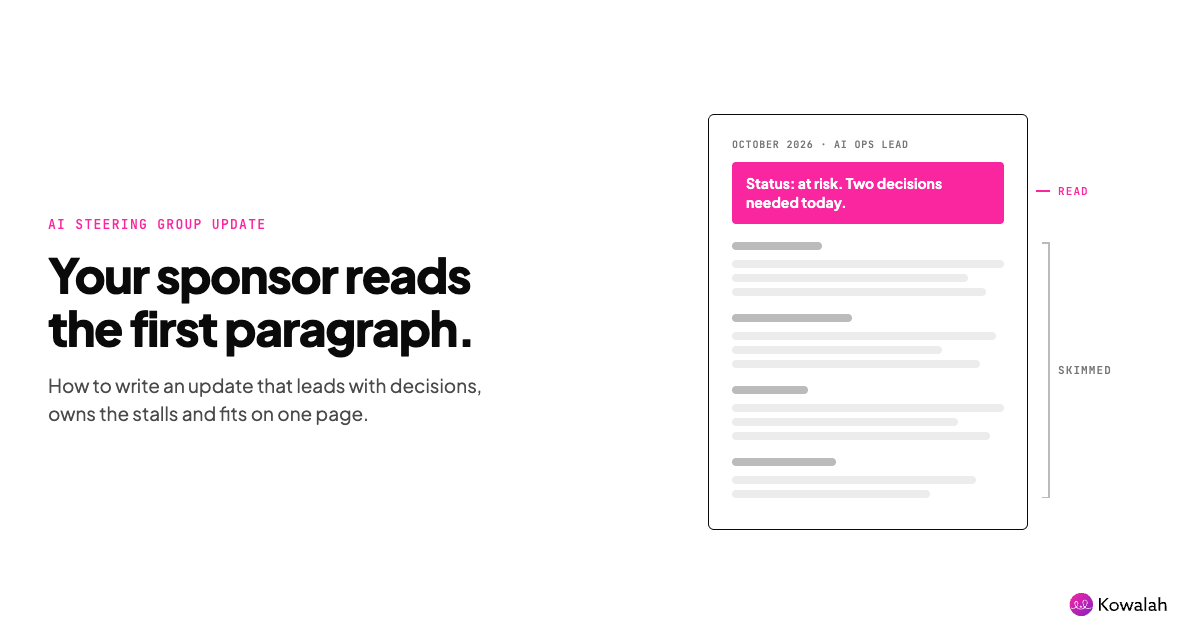
Your sponsor will read the first paragraph of your steering group update and skim the rest. So put the answer there: what changed in the business, what's stuck, and what you need them to decide.
This guide is for the AI Ops lead, forward deployed engineer or AI builder who writes the Friday or monthly update for a CIO or CEO sponsor. It uses Smart Brevity, the writing style we use at Kowalah, and tries to practice what it preaches. If you'd rather start from a page, copy our free AI steering group update template. It's ungated and comes with a Claude skill that drafts the update from your notes.
The short answer
- Decisions first. Say what the group needs to decide, with your recommendation and a date.
- Outcomes before activity. Every number gets a baseline, how it was measured, and whether the business owner has verified it.
- Stalls before wins. Each stalled item comes with a specific ask: who, what, by when.
- One page. Monthly by default, fortnightly in an early build.
- Your view last. Three lines of judgement. It's the part only you can write.
Why it matters
An AI programme lives or dies on whether the sponsor believes it. Not whether it's good. Whether they believe it.
The update is where that belief gets built. Eleven pages of activity reads like a programme with nothing to show. One page that provides the number, the stall and the ask reads like a programme in control, even when the news is mixed.
It also carries your name. It's how the value you've created gets seen and credited.
Smart Brevity in one minute
Smart Brevity is a way of writing for busy readers. Respect their time. Say less, better.
- Get to the point in the first sentence. If the reader stops there, they still got the news.
- Short sentences, active voice. "We missed the date" beats "The date was not achieved".
- Signpost. "Why it matters", "The ask", "My view". Readers skim headings, so make the headings carry meaning.
- Cut what the reader can't act on. If a line doesn't change what the sponsor thinks or does, delete it.
What belongs in the update, and what doesn't
Put in
- Decisions needed, with options, your recommendation and the date you need them by.
- Outcomes: processes with a baseline and a current value.
- The pipeline: opportunities and deliverables by stage, with the change since last time.
- Stalled items, each with the ask that unblocks it.
- Risks and security: the top three risks, plus any approvals pending.
- Adoption, labelled as reach, not value.
- Next month: three to five things that will be true by the next update.
- My view: three lines of your own judgement.
Leave out
- Meeting counts, workshop counts and "engaged with stakeholders".
- Feature lists copied from vendor release notes.
- Prompts written, demos given and people who are "excited".
- Anything from the last update that hasn't changed.
- Detail the group can't act on. Attach the tracker or risk register instead.
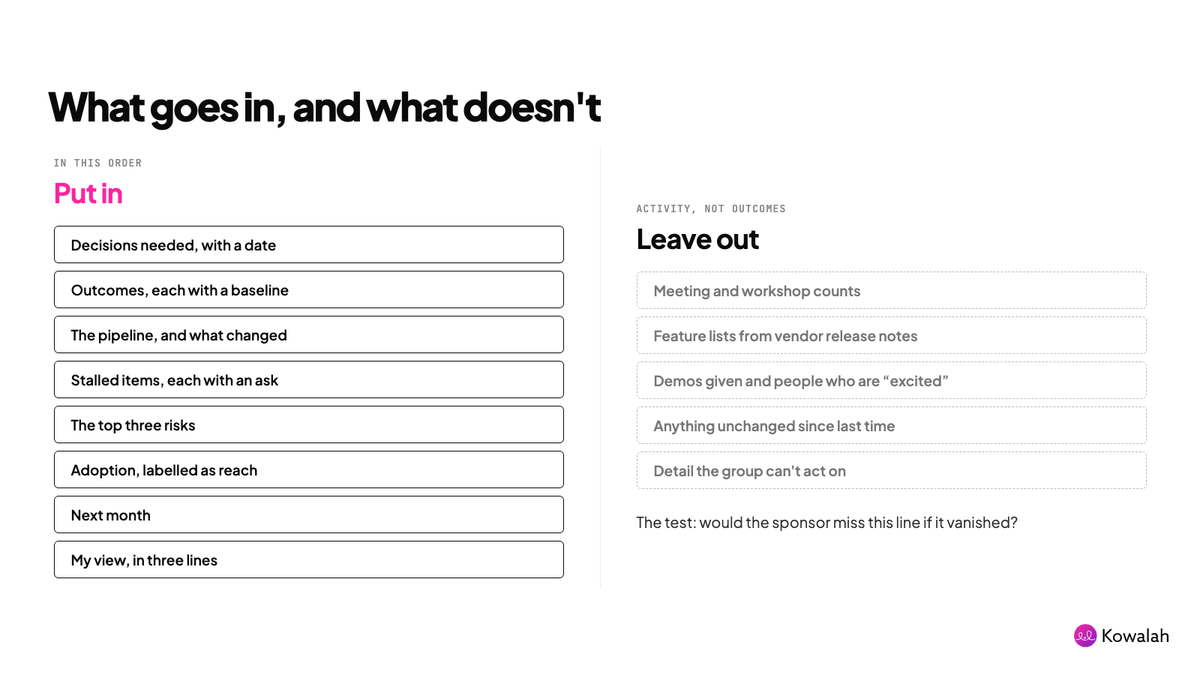
The test: would the sponsor miss this line if it vanished? If not, it goes.
Reporting outcomes when logins look fine but the value is unclear
This is the hardest part of an AI programme status report. The admin dashboard shows logins climbing. Nobody can say what changed.
Why it matters: adoption is reach. It tells you who arrived, not what they achieved. A steering group told twice that "usage is up" starts asking what it's for.
Three rules fix most of it:
- Baseline to now. Only processes with a baseline go in Outcomes. "Quote turnaround: three days to one" is an outcome. "Claude is helping the sales team" is not. No baseline yet? It goes in the pipeline, with the date you'll capture one.
- Say how you measured it. Estimated, sampled or measured. An estimate is fine if it's labelled as one.
- Claimed or verified. A claimed benefit comes from the AI team. A verified one is confirmed by the business owner of the process, who will carry it on their scorecard. Keep them in separate columns and never add them together.
Nothing verified yet? Say so in the first line. "No verified outcomes yet; first measurement due 14 November" is credible. Padding the section with adoption charts isn't.
Surfacing blockers without sounding defensive
Most AI work stalls in the same three places:
- Security. The review of a new connector or agent permission hasn't happened.
- Connectors. The integration needs an admin, a licence or a credential nobody owns.
- Data. It's in the wrong place or the wrong shape, or nobody will say whether Claude may touch it.
These are facts, not failures. Report them that way, and attach the ask.
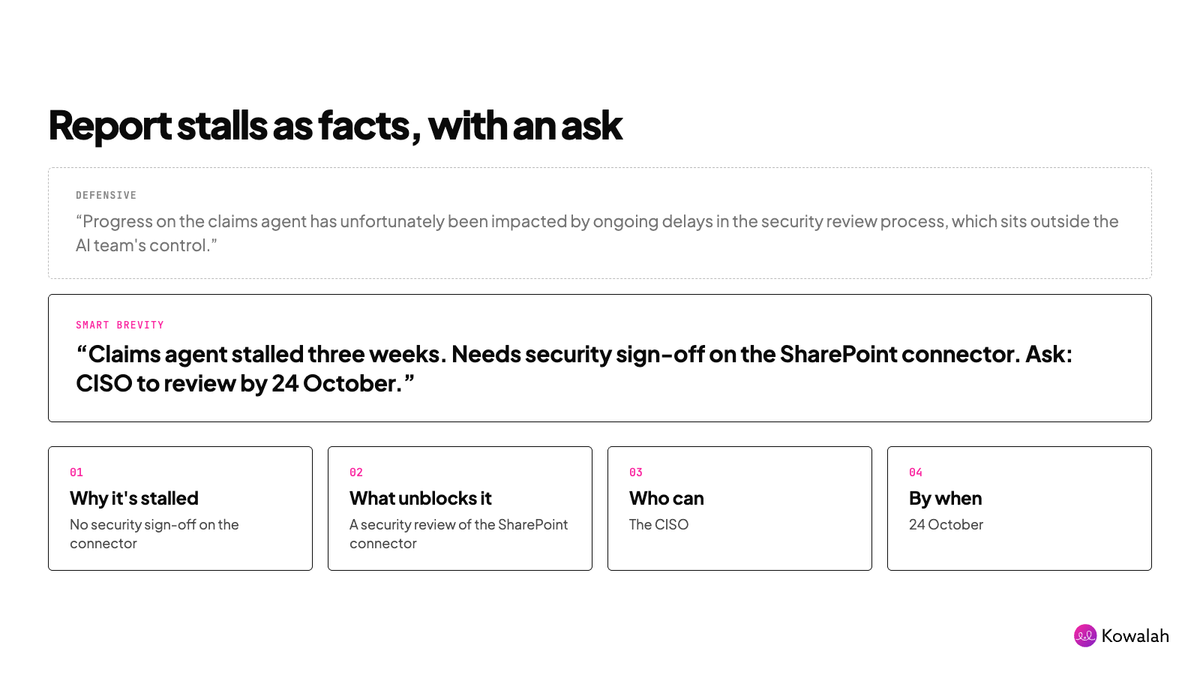
Defensive: "Progress on the claims agent has unfortunately been impacted by ongoing delays in the security review process, which sits outside the AI team's control."
Smart Brevity: "Claims agent stalled three weeks. Needs security sign-off on the SharePoint connector. Ask: CISO to review by 24 October."
Each stalled item gets four things: why it's stalled, what unblocks it, who can, and by when. Put stalls above wins. Stopping is a result too. If you killed something, say what you learned.
What the sponsor should decide in the room
Put decisions up front. The steering group is the one meeting where the people with authority are in the same room. Don't spend it on a status read-out they could have read on the train.
Typical decisions:
- Unblock: approve a connector, name a data owner, release a budget line.
- Scale, redirect or stop a live release, based on its outcome.
- Promote an opportunity into a deliverable.
- Accept a risk, or fund the mitigation.
For each one, give the options, your recommendation, what happens if it's deferred and when you need it. If nothing needs deciding, write "No decisions needed this month" and move on.
How it differs from a PMO red, amber, green pack
A RAG pack asks: are we on plan? An AI steering group update asks: did the business change, and what's in the way?
| Generic PMO RAG pack | AI steering group update | |
|---|---|---|
| Leads with | A status colour per workstream | Decisions needed and outcomes |
| Measures | Milestones and budget | Baseline to now, claimed vs verified |
| Bad news | Amber, explained at length | Stalled items, each with an ask |
| Scope | Fixed plan | A pipeline that changes as you find use cases |
| Length | A slide deck | One page |
| Author's voice | None | My view |
Why it matters: an AI programme's scope moves. You discover use cases as you go, so the pipeline matters as much as the plan. Rank it with an ICE score: Impact × Confidence × Ease, each scored 1 to 10, for a total out of 1,000. It isn't precise. It makes the ranking defensible when a director asks why their idea is fourth.
If your organisation expects a RAG status, keep one: a single line in the header, with one line on why. Then get on with the update.
Worked example: Fernhill Mutual (fictional)
Fernhill Mutual is a made-up 800-person UK insurer, eight months into a Claude rollout. Every name and number below is illustrative.
Before: the bloated update
This is how their AI lead's update used to open. It ran to eleven pages.
"This month the AI team continued to make strong progress across all workstreams. We held 14 workshops with stakeholders in Claims, Underwriting and Finance, and ran three lunch-and-learn sessions, which were very well received. Usage of Claude continues to grow, with 412 active users. The team has also been exploring the new features announced this month, which we believe could unlock significant value. Work on the claims triage agent is progressing, although there have been some delays relating to the security review process. We remain confident in the overall direction of the programme…"
What's wrong: no outcome, no baseline, the one stall is buried with no ask, and the sponsor reaches the end without knowing what to decide.
After: the Smart Brevity one-pager
Same month, same facts, rewritten on the template.
October 2026 | AI Ops lead | Status: at risk. Claims triage is stalled on one security sign-off; everything else is on track. Two decisions needed today (section 5).
1. Outcomes
- Underwriting referral notes: 45 to 15 minutes per case. Sampled across 40 cases. Verified by the Head of Underwriting.
- Finance month-end commentary: two days to one. Estimated. Claimed; verification due 7 November.
2. Opportunities and deliverables pipeline (leading indicators, not results)
- Opportunities: Captured 31 (+6), Shortlisted 9 (+2), Promoted 4 (+1).
- Deliverables: In progress 3, Done 2 (+1).
3. Top opportunities by ICE score
- Broker email triage, Claims: 8 × 7 × 8 = 448. Faster first response on the busiest inbox.
- Policy wording comparison, Underwriting: 7 × 6 × 7 = 294. Reuses the referral notes pattern.
- Complaints summary for the board, Compliance: 6 × 8 × 6 = 288. Cuts a monthly manual report.
4. Stalled items and asks
- Claims triage agent, stalled three weeks. Needs security sign-off on the SharePoint connector. Ask: CISO to review by 24 October.
- Stopped: a meeting-notes summariser for Sales. It duplicated a tool the team already had. Lesson: check existing tools before discovery.
5. Decisions needed
- Approve the SharePoint connector for claims data, subject to the CISO's review. Recommend: yes. If deferred: claims triage slips to Q1. Needed by 24 October.
- Promote broker email triage to a deliverable. Recommend: yes. If deferred: no build capacity until December. Needed today.
6. Risks and security
- No named owner for the claims document store. Owner: COO. Mitigation: name one by 31 October.
- Connector approvals pending: one (SharePoint). Incidents: none.
7. Adoption
- 412 of 600 licensed seats active, up from 380. Reach, not value. Finance is flat; a champion session is booked.
8. Next month
- Month-end commentary verified by the Finance Director.
- Claims triage in user testing, if the connector is approved.
- Baseline captured for broker email triage.
9. My view
Underwriting proves the pattern works. Claims is the bigger prize, and it's waiting on one approval. Approve it today and we should have two verified outcomes by Christmas.
Why it works: the sponsor gets the status in one line, can see what's verified and what's claimed, and knows the two decisions before the meeting starts.
Own what you report
The ICO opened a call for evidence on agentic AI on 8 October 2026. It closes on 20 November, and accountability is one of the areas it covers.
Whatever the guidance ends up saying, the question of who answers for what an agent does isn't going away. Your update already holds a large part of the answer: each deliverable with an owner, each outcome with a verifier, each risk with a name against it. Write it as if someone outside the room might read it one day.
Log it as you go
The update is easy to write if you've kept the record all month. It's miserable if you're piecing it together on Thursday night.
Log each opportunity when it's raised, score it, and record outcomes against their baseline as they land. A spreadsheet works. So does Kowalah: AI Ops leads can log opportunities and outcomes on the platform for free as they go, and the template's Claude skill can draft from that record once it's connected.
New to the role? The AI Operations Lead's first 90 days covers setting up the backlog and baselines that feed this update. When an opportunity needs funding, the AI business case template picks up from there.
Next step: get the free AI steering group update template. One page, ungated, with a Claude skill that drafts it from your notes and leaves "My view" for you.
Frequently asked questions
How do I write a steering group update for an AI programme?
Lead with the decisions you need and the outcomes you can evidence. Then cover the pipeline, stalled items with their asks, risks and security, adoption and next month, and finish with three lines of your own view. Keep it to one page.
What should an AI programme status report include?
Outcomes with a baseline, the opportunities and deliverables pipeline, the top opportunities by ICE score, stalled items and asks, decisions needed, risks and security, adoption, next month and your view. Leave out activity counts and anything the group can't act on.
How do I report AI value when usage is high but results are unclear?
Treat adoption as reach and report it separately. Only put a process in Outcomes once it has a baseline, say how it was measured, and mark it as claimed until the business owner verifies it.
What's the difference between claimed and verified outcomes?
A claimed outcome comes from the AI team. A verified outcome has been confirmed by the accountable business owner of the process. Report them in separate columns and never add them together.
How often should I send an AI steering group update?
Monthly by default. Send it fortnightly during an early build phase or when decisions are blocking. Keep the same structure either way and only update outcomes when there's a new measurement.
How is an AI steering group update different from a RAG status report?
A RAG pack reports progress against a fixed plan. An AI steering group update reports what changed in the business, what's stalled and what needs deciding, on one page, with an ICE-scored pipeline because the scope changes as you discover use cases.
Enjoyed this?
Weekly insights for executives navigating enterprise AI. A five-minute read.