Insights
Meet Mabel, how we built our company brain
"Hey Charlie, we're heading into a meeting at ACME. Didn't you work with a similar client last year? Any tips?"
Every company runs on questions like this. And every one of them depends on luck: you have to know that I worked with that client, and I have to still be here to ask.
Why it matters
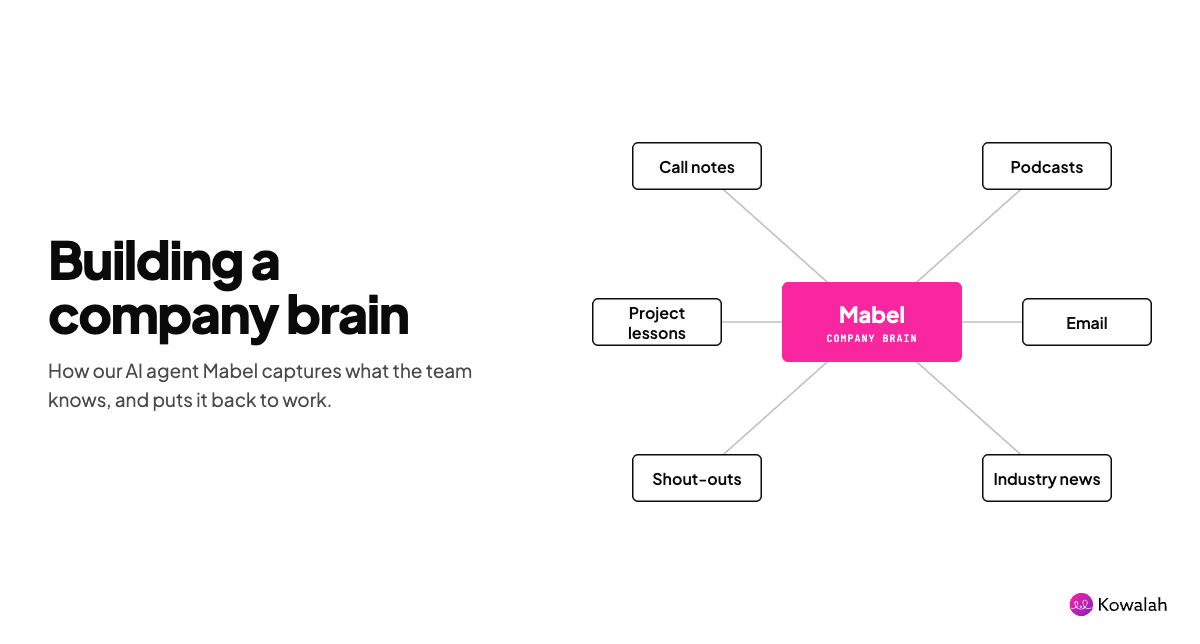
A company brain matters because a company is more than its written-down processes. It's the lessons learned, the past work, the mistakes, the podcast someone listened to on a run, the workaround a consultant found on a customer project.
That micro-knowledge lives in people's heads, in chat threads and in email. It rarely makes it into a formal process or standard operating procedure.
So company knowledge is on loan. It sits with individuals, it only gets used if someone knows to ask, and it walks out of the door when they leave.
A company brain fixes that. It gives the team an easy way to capture this knowledge, and it puts that knowledge in front of the people who need it, even when they didn't know to ask.
For the past four months we've been running ours. Her name is Mabel. Here's what she is, how she works, and what we've learned so far.
Meet Mabel
Mabel is named after my labrador. She loves her food and hoovers up everything in sight, which felt like the right job description for a company brain.
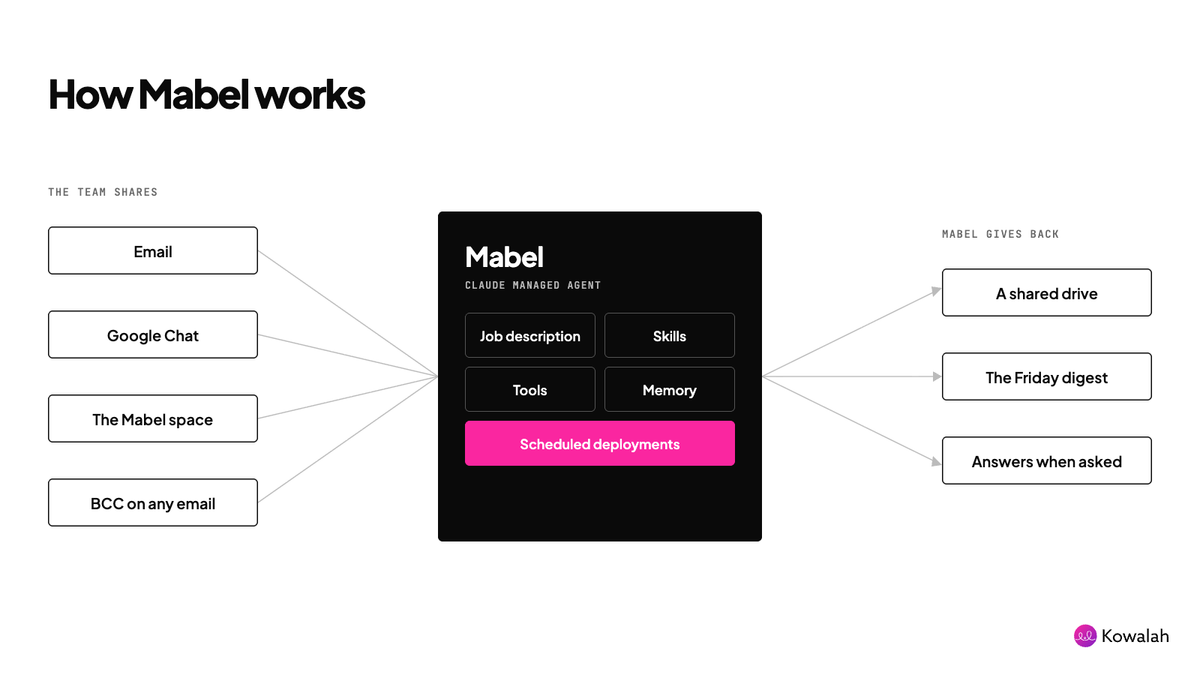
We set Mabel up as a Google Workspace user in our organisation, so she has her own Gmail, Google Chat and Google Drive. That means the team works with her exactly as they would with a human colleague:
- Email: anyone at Kowalah can email her at mabel@kowalah.com.
- BCC: copy Mabel on any email, including one going to a client, and she files it silently. No reply, no clutter. It's the easiest way to save something without breaking your flow.
- Direct message: anyone at Kowalah can message her in Google Chat.
- The Mabel space: a Google Chat space open to the whole team, where everyone can see what's shared.
- Shared drive: her own shared drive, which we can all read and which Mabel uses to file and create documents.
No new app, no new login. If you can send a message, you can feed Mabel.
How it works
Behind the Google account, Mabel is a Claude Managed Agent. She runs in Anthropic's environment and is made of five parts:
- System prompt: her job description. It sets out her role, who she works with, which channels she uses, and how she collects, uses and stores information.
- Skills: three skills that spell out how she works, mainly how she gathers information and how she shares it.
- Tools: access to Gmail, Google Chat and Google Drive. She can read and send email and messages, and create and organise Docs, Sheets and files in her drive.
- Memory: three layers. Her own memory store, a shared Kowalah store that all our agents use, and a store for each person who talks to her. She notes what matters from each conversation and how she should work.
- Scheduled deployments: Anthropic's term for running an agent on a schedule. They let Mabel start work on her own, without anyone prompting her.
Start with the job
Before we built our company brain, we asked a simple question: if we were hiring a human Mabel, what would the job description say? (This works for any new agent, by the way.) We landed on three responsibilities.
- Uncover what isn't written down. Think investigative journalist: find the story behind the story. What's happening in projects, which workarounds people use, what customers say, the podcast, YouTube video, product release or course someone rated.
- Share it with the team. Turn what she gathers into something people read, so everyone keeps up with the company and the wider AI world.
- Speak up when it matters. Bring that knowledge into future conversations, even when nobody asked. "By the way, Jo listened to a great podcast on exactly this two weeks ago."
Her week, step by step
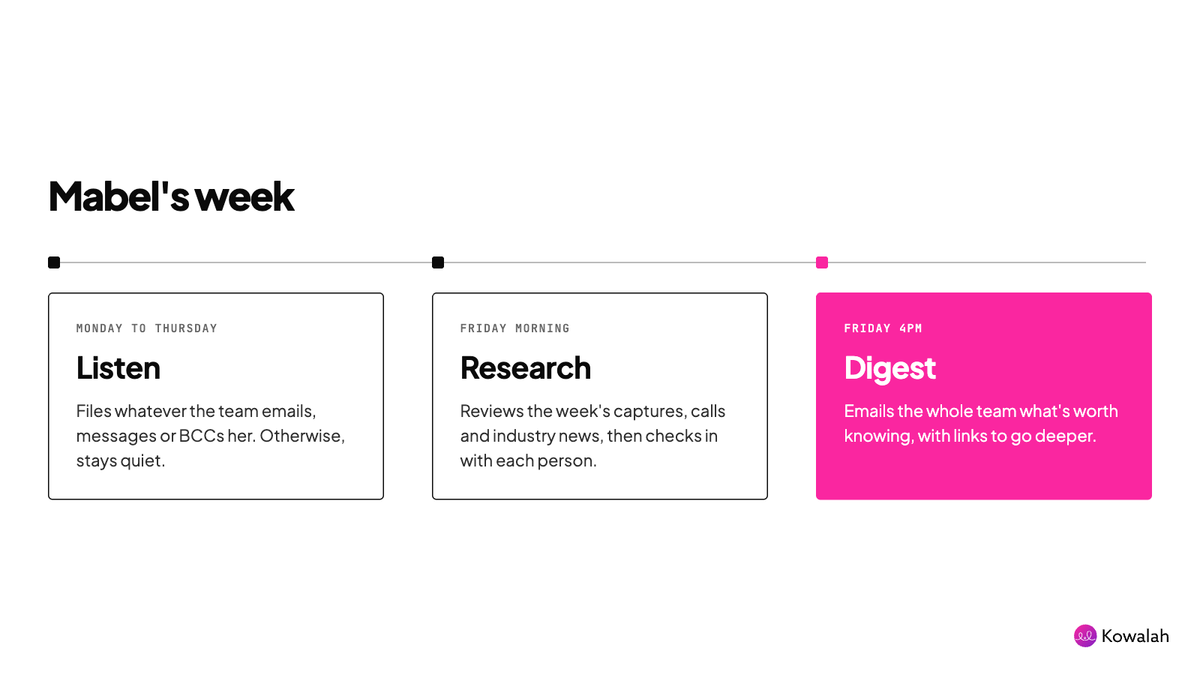
Monday to Thursday: a quiet colleague. Mabel listens. Anyone can email her, message her or post in the Mabel space to share something useful: a podcast, a shout-out for a colleague, a lesson from a project.
Each message triggers the agent. Mabel follows her skill, thanks the person and files what they sent in that person's folder, for example Charlie/2026-09/useful-podcast-280926.
Friday, 8.30am: research. Her scheduled deployment kicks in. She reviews the past seven days across:
- what people sent her during the week
- every call recorded in Granola
- each person's calendar
- HubSpot and the Kowalah platform
- the web, for industry news and product releases
Then she messages each person individually:
"Hey Charlie, here's what I've seen from your week: [highlights]. Anything to add? Any podcasts or videos worth sharing? Anyone you'd like to shout out?"
Granola alone gives her plenty to work with, so the digest doesn't depend on everyone replying.
Friday, 4pm: the digest. Mabel sends an all-hands email with:
- three things worth knowing from the team
- three things worth knowing from the industry
- go-deeper links for anyone who wants more
It's a good way to end the week, and it gives everyone something to read or listen to over the weekend.
Mabel in the room
The digest is useful. But Mabel's biggest value is bringing what she's accumulated into live work, especially sales cycles and customer projects.
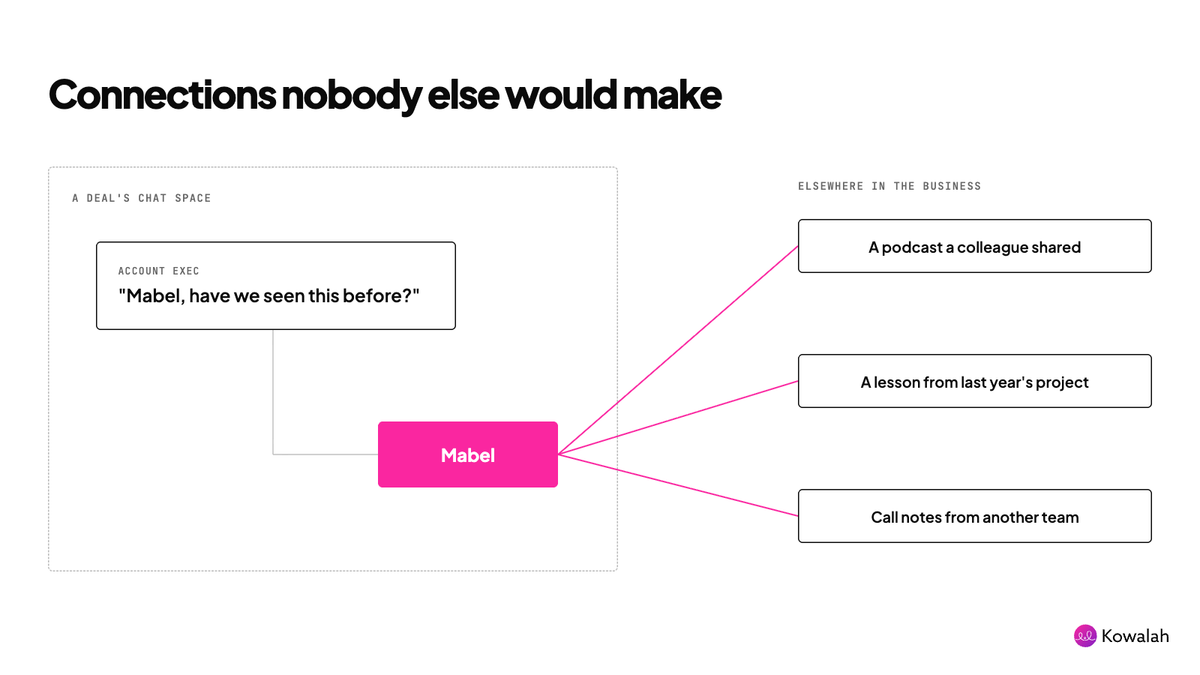
We add her to the Google Chat spaces we use for each opportunity and project. She listens in ambient mode, following the conversation without interrupting. When someone asks "Mabel, have we seen anything like this before?" or "Mabel, any advice here?", she draws on everything she knows and gives her view.
The best moments are the connections we would never have made ourselves. The person who holds the relevant experience often has nothing to do with the current deal or project. Without Mabel, nobody would think to ask them.
Yes, but… is it safe?
An AI agent that reads the team's calls and email needs clear rules. These are written into Mabel's job description:
- Internal only. Mabel only talks to @kowalah.com addresses. Anything from outside isn't filed or answered; it goes straight to Charlotte, our Operations Director.
- The knowledge stays inside. She never quotes what she holds in anything external.
- She files, she doesn't rewrite. Captures are kept word for word. Who sent it, when and where from are recorded exactly, or marked "not provided". Never guessed.
- Humans decide what becomes canon. Only three of us can promote an entry into our approved playbook, the Kowalah Way. For the first 30 days, every promotion was a draft she showed us and we signed off.
- Nothing gets deleted on her say-so. She asks first, every time.
- She has a manager. Mabel reports to Charlotte, like any other member of the team.
If you're building your own, start here. It's much easier to set the rules on day one than to rebuild trust later.
What we've learned
- Write the job description first. Imagining Mabel as a hire gave us her role, her channels and her rhythm before we wrote a line of config.
- Meeting notes beat asking. Granola is by far her richest source. People are busy; their calls already hold most of what's worth knowing.
- Meet people where they already are. Email and Google Chat meant no new tool to learn and no adoption drive.
- Feeding her is a habit, not a feature. The more people share, the more Mabel helps them later. We're still building that habit.
What's next
Next, we want feeding our company brain to take less effort. Part of that is helping the team see that what they share today helps them tomorrow.
We also don't want Mabel to become the colleague who's always chasing you for updates. So the next step is plugging her into more of the systems and conversations we already use, letting her gather knowledge herself. Granola has shown how well that works.
Go deeper
Thinking about a company brain for your own organisation? Talk to our team, and we'll show you how Mabel is set up.
Enjoyed this?
Weekly insights for executives navigating enterprise AI. A five-minute read.