Insights
The MQL to SQL handoff, torn down: where inbound leads go missing, and how to redesign it
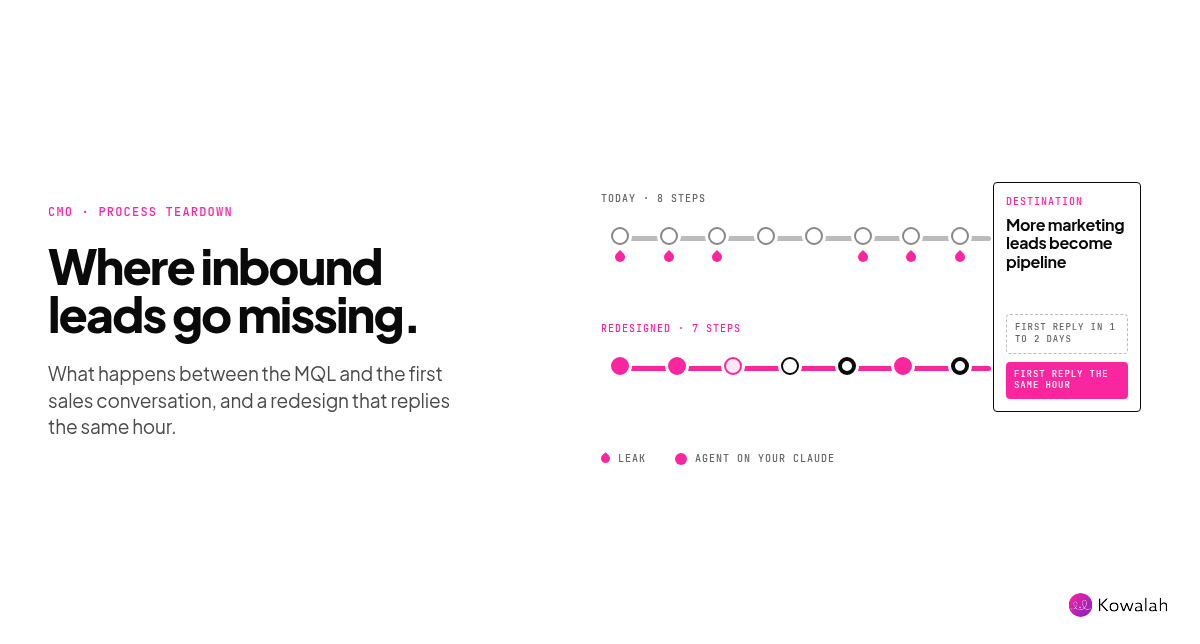
Every quarter, marketing reports the MQLs it delivered and sales reports how few became pipeline. Both numbers are right. The leads go missing in the handoff between them: a common version runs to eight steps, five roles and a day or two before the buyer hears from a person.
This teardown walks through those steps, where time and context leak, and a redesigned process. An agent built on your own Claude does the checking, research and handoff notes, and your SDRs and account executives make the calls that need judgement.
This is a process teardown: one revenue process, before and after. The numbers are illustrative, built on a typical inbound team in a UK enterprise of a few thousand people: a marketing ops lead, a demand gen team, eight SDRs and the account executives they book meetings for. They are not a client result.
The goal: more of marketing's leads become pipeline
Why it matters: the MQL is still the number most teams report, and few believe it. In The Trust Gap, a September 2026 survey of 192 marketing, demand gen and RevOps practitioners run by Heinz Marketing for Docket, nearly 9 in 10 respondents reported MQL volume to leadership. Of those, 7% were confident it predicts real pipeline. At 78% of organisations, sales rejected more than half of MQLs.
The goal is pipeline from inbound demand: more of the leads marketing pays to generate become sales opportunities the sales team believes in.
The KPI that shows it is MQL to SQL conversion: the share of marketing qualified leads that sales accepts as sales qualified within a set window, say 30 days. Two companions keep it honest:
- Working hours from MQL to the first reply from a person
- Rejected leads with a specific reason recorded, not "bad lead" or "other"
Conversion on its own can be gamed by passing fewer leads. Speed on its own can be gamed with a template. Read the three together.
Today's process
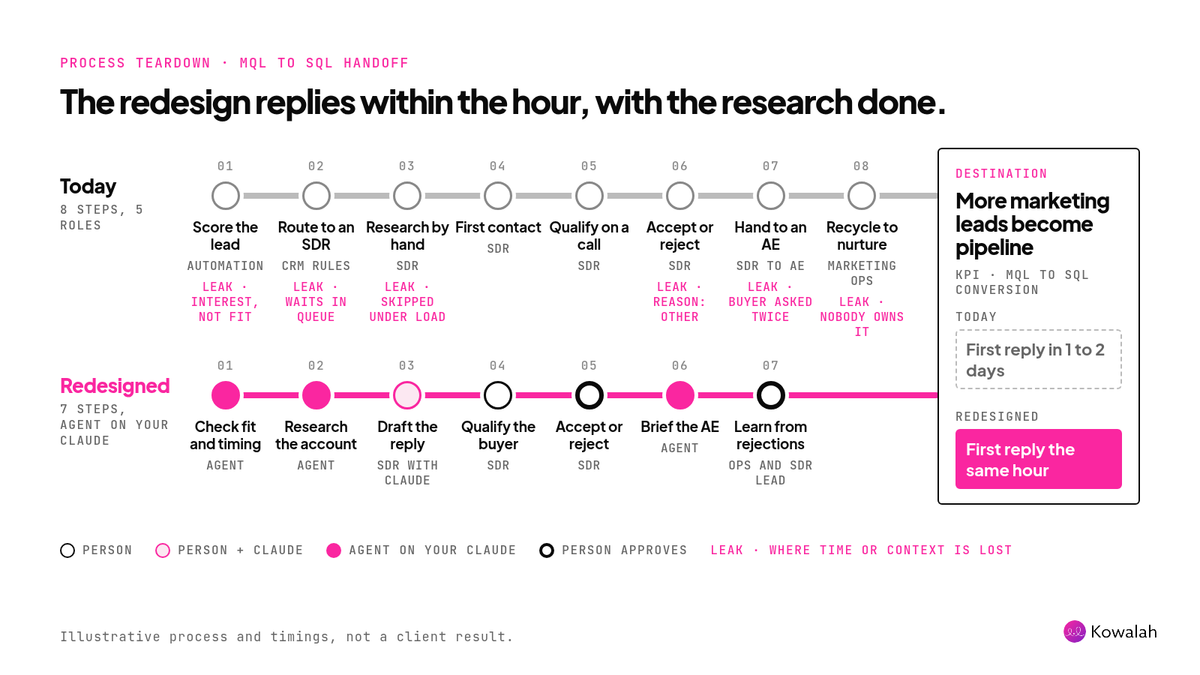
- Score the lead (marketing automation). HubSpot or Marketo adds points for a guide download, a pricing page visit, a job title. Cross the threshold and the contact becomes an MQL. Marketing ops set the model a year or two ago.
- Route to an SDR (CRM rules). Round robin by territory or segment. A lead from a company with an open deal still goes to the next SDR in line, and a lead assigned to someone on holiday waits for them.
- Research by hand (SDR, 10 to 15 minutes a lead). LinkedIn, the company website, the CRM history, a news search. On a busy Monday, this is the step that gets skipped.
- First contact (SDR). A sequence in Outreach, Salesloft or HubSpot: an email, a call, a LinkedIn request. The first email is the sequence's, lightly edited.
- Qualify on a call (SDR). Budget, authority, need and timing, or the team's own version. A share of leads never pick up.
- Accept or reject (SDR). A status change in the CRM. Rejected leads get a reason from a drop-down, and "Other" is the easiest one to pick.
- Hand to an account executive (SDR to AE). A meeting booked and a few lines of notes. The AE opens the call by asking the questions the SDR already asked.
- Recycle to nurture (marketing ops, monthly). Rejected and unresponsive leads go back into a nurture programme, if someone remembers to run the list.
Around it sits the weekly pipeline meeting. Marketing shows MQLs against target, sales shows meetings against target, and each team has a reason to read the same lead differently.
Where it leaks
The score measures interest, not fit. A student who downloads three guides scores higher than a senior buyer from a target account who visited pricing once. Sales learns to distrust the threshold, and SDRs start picking the leads that look best.
When did sales and marketing last review, together, what your lead score rewards?
The queue waits on people. The lead qualifies in seconds and waits hours for a person. The Trust Gap found roughly 3 in 10 organisations make first human contact within an hour. Answering as buyers, fewer than 1 in 5 respondents said they got fast, relevant follow-up after their last form fill.
How many of yesterday's MQLs have had a reply from a person today?
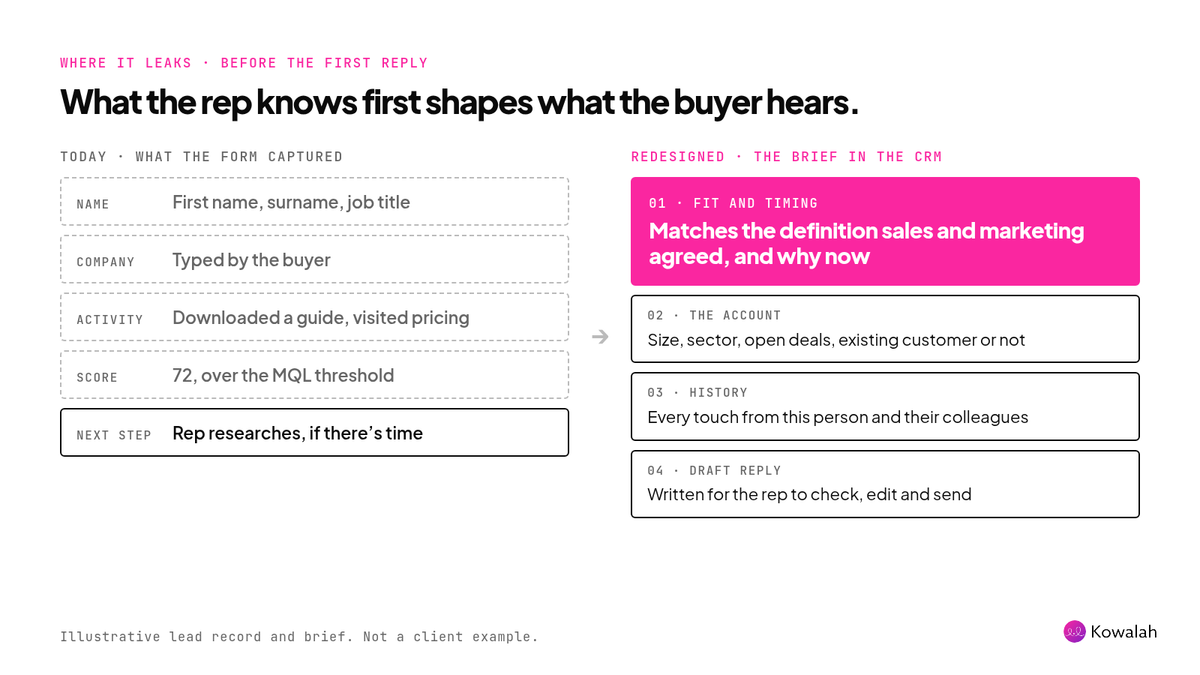
Research is the first thing to go. At ten minutes a lead, a heavy week of inbound costs each SDR a day of research. Under pressure, reps send the sequence and research the ones who reply.
What does a rep know about an MQL before they first get in touch?
Rejection reasons nobody reads. The SDR picks a reason, the lead closes, and the reason sits in a field nobody reports on. The scoring model never learns from it.
What share of last quarter's rejected MQLs have a reason more specific than "bad lead"?
Context lost at the handover. The AE gets a meeting and three lines. The buyer explains their situation a second time, to a company that already asked.
How often do your buyers answer the same question twice?
Recycled leads belong to nobody. Marketing thinks sales is working them, and sales thinks they went back to marketing. They come back to life when the buyer fills in another form, months later.
Who owns a lead that sales rejected 60 days ago?
Behind all six sits a buyer who has moved on. In the 6sense 2026 B2B Buyer Experience Report, buyers spent roughly 60% of their buying journey deliberating internally before the sales cycle, 82% of first vendor conversations were initiated by the buyer's team, and only 35% of buyers used their own contact information. When a buyer does raise a hand, a slow or generic reply wastes it.
The redesigned process
The redesign starts from the goal, not the tools. Each step gets the cheapest thing that does it well: a person, a skill in Claude, or an agent. The sequence below is an example of what can be built on your own Claude account, not a product to install. An inbound agent takes the routine steps, and your team keeps the judgement calls.
- Check fit and timing (agent, within minutes). The agent reads the lead, the account in the CRM and your enrichment data, and checks them against the definition sales and marketing agreed: company size, sector, role, and signs of timing such as a pricing visit. It spots existing customers and accounts already in a sales cycle, and routes those to their owner.
- Research the account (agent). It writes a short brief into the CRM: the company, the people from that account who have engaged, every previous touch, and why this lead matters now.
- Draft the first reply (SDR, working with Claude). The agent drafts a reply to what the buyer did, not the sequence's opening line. The SDR checks, edits and sends. Nothing goes to a buyer without a person approving it, unless you agree otherwise up front.
- Qualify the buyer (SDR). The conversation stays with a person, who now starts it knowing the account.
- Accept or reject, with a reason (SDR). A short, agreed list of reasons. "Other" needs a sentence.
- Brief the account executive (agent). The agent turns the SDR's notes, the call summary and the brief into a handoff note in the CRM, so the AE starts where the SDR finished.
- Learn from rejections (marketing ops and the SDR lead, weekly). The agent summarises the week's rejection reasons and the recycled leads showing new activity, and suggests changes to the score. People decide which to make. A recycled lead with a new signal goes back to step 1 with its history.
| Today | Redesigned | |
|---|---|---|
| Time to first reply from a person | 1 to 2 working days | The same working hour |
| Research before first contact | When there's time | Every lead, in the CRM |
| First email | The sequence's | Written for what the buyer did |
| Rejection reasons | A drop-down, "Other" a favourite | An agreed list, read every week |
| AE handoff | A meeting and three lines | A brief and the call notes |
| Recycled leads | Nobody owns them | Watched for new activity |
| SDR time per lead before first contact | 10 to 15 minutes | 2 to 3 minutes, checking the draft |
What the agent needs: read access to your CRM and marketing automation (Salesforce or HubSpot), your enrichment data, the lead definition sales and marketing agreed, and examples of good first replies. It runs on your own Claude and Anthropic account, so you own it and see what it costs each day. It starts read-only, and people approve what goes to buyers.
What it doesn't do: settle the argument about what a good lead is. It applies the definition you write down, every time. Writing it down is still a conversation between marketing, sales and RevOps.
The KPI to watch, and how to measure it
Baseline first. Before you change anything, pull four numbers for last quarter:
- MQL to SQL conversion within 30 days
- Median working hours from MQL to the first reply from a person
- Share of rejected MQLs with a specific reason
- SDR hours a week spent on research before first contact (a quick survey is enough)
Then compare. Run the redesigned process for one segment or region for six to eight weeks and read the same four numbers. Record the baseline and each reading against the goal, so the leadership team sees the KPI move, not a list of tasks.
Watch quality as well as speed. Have the SDR lead review a sample of the agent's briefs and drafts every week for the first month. A fast reply that gets the account wrong is worse than a slow one.
Where to start
Start with the definition. Get marketing, sales and RevOps to agree in writing what makes a lead worth a rep's time, how fast a person replies, and which rejection reasons count. That's useful whether or not you add an agent, and an agent can't apply rules nobody has written down. The free Lead Handoff Agreement has a page for the definition and reply times, a rejection reasons list, the fields for the AE brief, and a worksheet to map your own process against the goal.
For the first reply to every enquiry, including evenings and weekends, see Speed to lead: 6 myths that keep B2B enquiries waiting.
We're a UK Anthropic Implementation Specialist. We work with CMOs to redesign processes like this one against the KPI they move, then build the agents with your team on your own Claude account. A first step can be an AI Baseline, which measures where your team's time goes today, or an Agent Pilot: one agent on one bottleneck, measured against a baseline.
Talk it through first
Book a free 45-minute planning session. Bring last quarter's MQL and SQL numbers, and leave with the redesigned process and the KPI to watch. Book a planning session, or see how we work with CMOs.
Enjoyed this?
Weekly insights for executives navigating enterprise AI. A five-minute read.