Insights
Speed to lead: 6 myths that keep B2B enquiries waiting
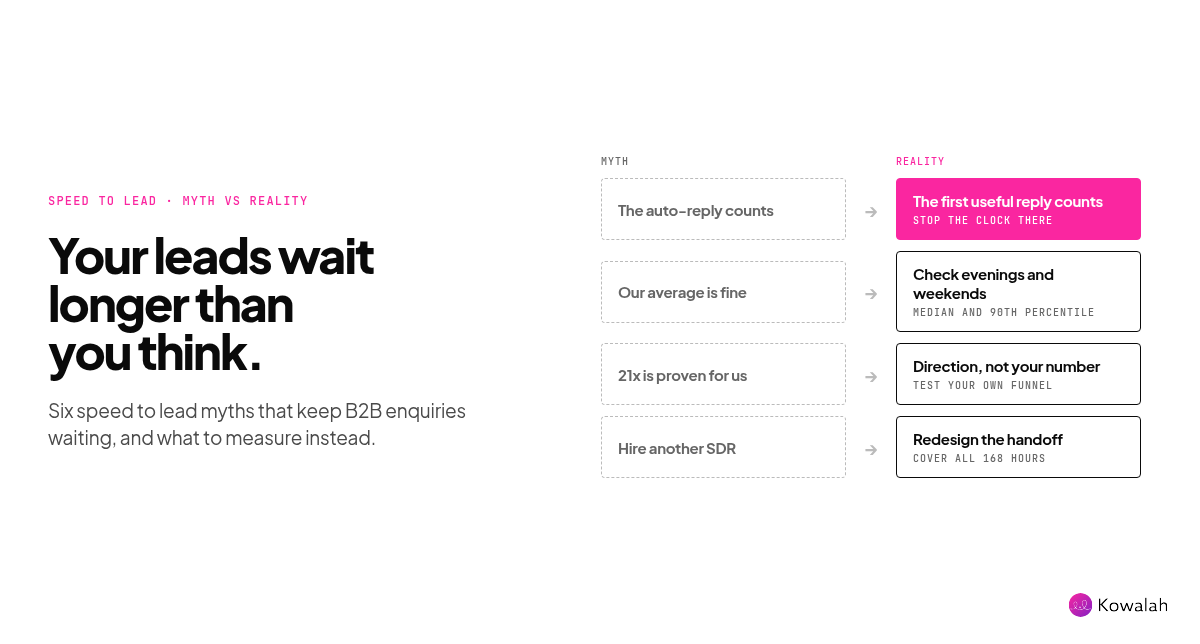
Speed to lead is the time between a buyer raising a hand and getting a reply worth reading. Most B2B teams think theirs is fine. The evidence says most aren't, and the statistics on the slides are shakier than they look. Here are six myths CMOs hear about speed to lead, what is actually true, and what to measure instead.
This is for CMOs, VPs and Heads of Marketing at B2B tech companies of 1,000 to 10,000 people whose pipeline target went up while the team didn't, and whose enquiries still wait in a shared inbox.
Why this keeps coming up
In 2024 RevenueHero submitted demo requests to 1,000 B2B SaaS companies, most with 51 to 500 staff. 635 never replied. The 365 that did took an average of 1 day, 5 hours and 17 minutes, counting automated replies.
The pattern is old. Harvard Business Review's 2011 audit of 2,241 US companies found 23% never responded to a web lead, and those that did took 42 hours on average.
In our conversations with revenue teams, the question isn't whether speed matters. It's how to answer an enquiry fast when the person who owns it is on leave, in a meeting or asleep.
Myth 1: Leads contacted in five minutes are 21 times more likely to convert
Reality: that number is about qualification by phone, not revenue. It comes from the 2007 Lead Response Management Study by James Oldroyd and InsideSales.com: six companies, more than 15,000 leads and over 100,000 call attempts. It compared the odds of contacting and qualifying a lead at five minutes against thirty. It didn't measure closed deals, and odds ratios read bigger than they feel.
The more careful evidence still points the same way. A peer-reviewed 2023 study in Operations Research found conversion fell 31% when the first call moved from 5 to 30 minutes, in an auto insurance call centre. HBR's analysis of 1.25 million leads found firms that tried to reach a lead within an hour were nearly seven times as likely to qualify it as firms that tried even an hour later.
So: direction, yes. Your multiplier, no. Use the studies to justify a test, not to forecast next quarter's pipeline.
Myth 2: 78% of buyers go with the first vendor to respond
Reality: nobody seems able to find where it came from. Peregrine traced the most-quoted lead response statistics to their sources and found no original study, sample or date behind the 78% figure, or behind the related claim that 35% to 50% of sales go to the first responder.
Keep it out of the board pack. If a number goes in front of your CEO, it should be your own.
Myth 3: Our average response time is fine
Reality: averages hide the evenings. A team working 9 to 5.30, Monday to Friday, is on hand for 42.5 of the 168 hours in a week, about a quarter. An enquiry that lands at 6pm on a Friday can wait until Monday morning and still leave the weekly average looking respectable.
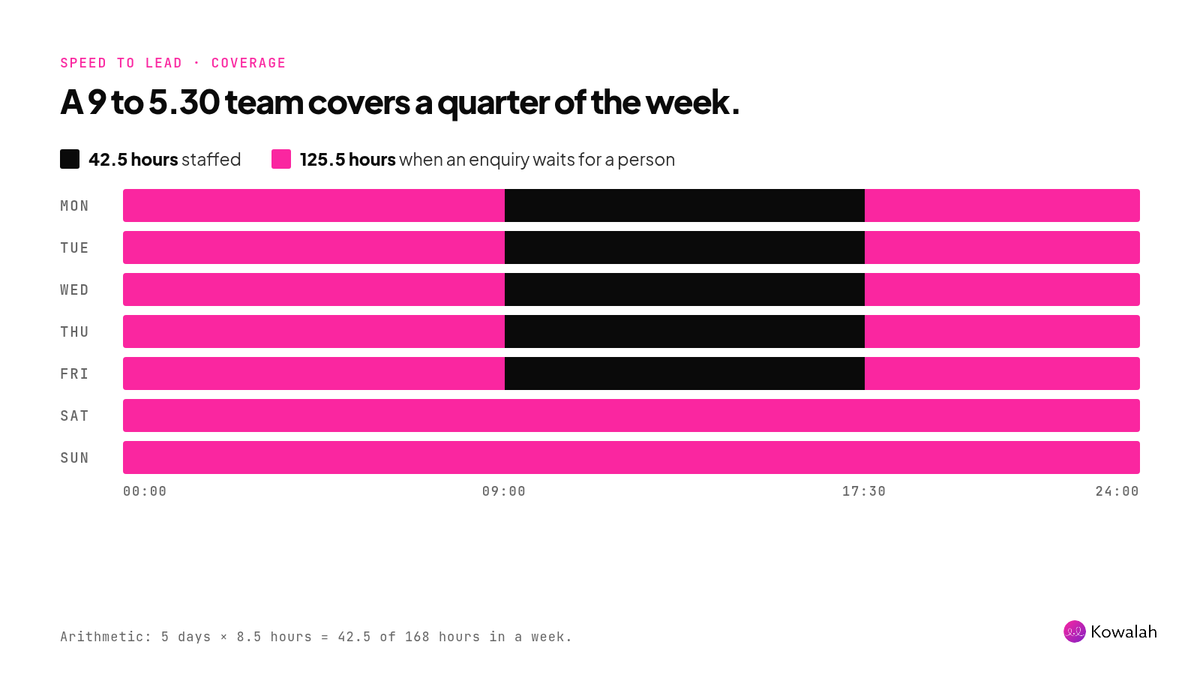
Report the median and the 90th percentile, split by lead source and by hour of day. The slowest tenth is where deals go cold. It is usually the out-of-hours enquiries, and the ones whose owner was out.
Myth 4: Our auto-reply means we respond instantly
Reality: an acknowledgement isn't an answer. In RevenueHero's test, 60% of the companies that replied sent an automated response, and even the companies that automated their first response averaged 17 hours and 20 minutes. The buyer wanted an answer and a time to talk. "Thanks, we'll be in touch" is neither.
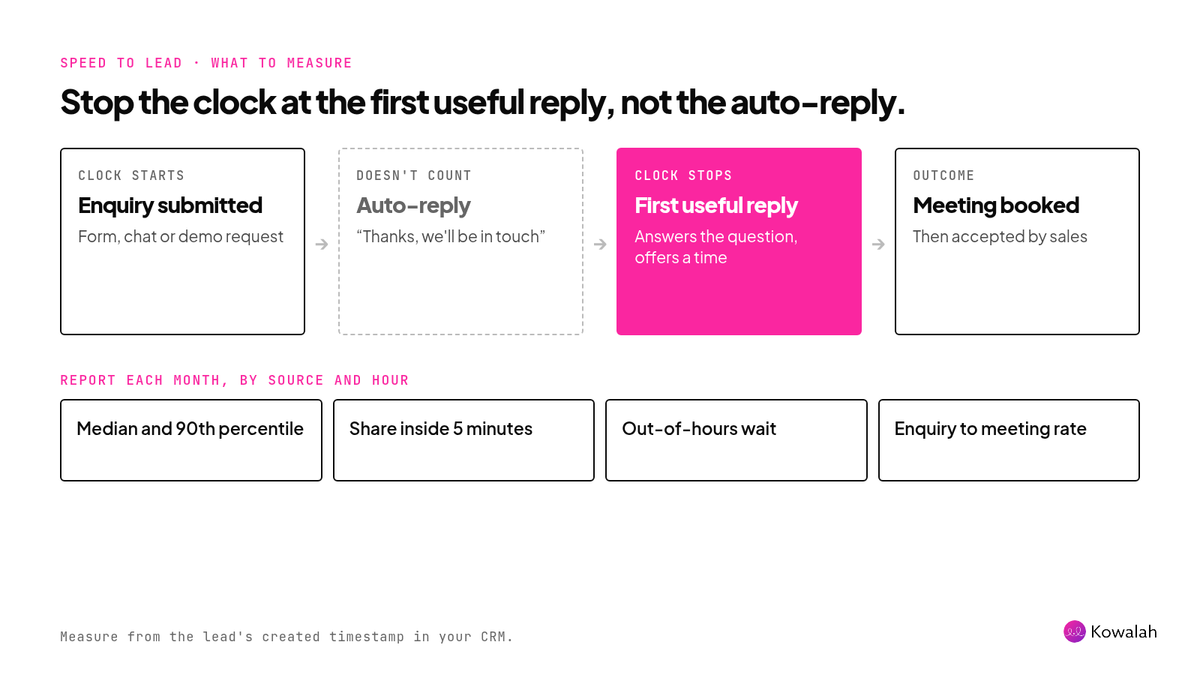
Stop the clock at the first useful reply: one that answers the question they asked, or offers a meeting time.
Myth 5: Faster replies mean hiring another SDR
Reality: another SDR adds hours, not coverage, and the hire goes through a CFO who may already have said no. The delay usually sits in the handoffs, not the headcount.
Look at the steps between enquiry and meeting. The enquiry lands in a shared inbox. Someone reads it when they get to it. They look the company up and decide whether to call. They email back and forth to find a time. The research never reaches the CRM. Each step is a wait, and none of them needs another person.
Redesign those steps first, then decide what role you need. If you're weighing the options, our comparison of an AI SDR tool, an inbound agent and hiring a BDR sets them side by side.
Myth 6: An AI reply will damage our brand
Reality: a wrong reply will. A fast one needn't. The worry is fair: nobody wants an agent emailing a prospect something wrong under their name. So set the rules before anything goes live.
Start read-only. Let the agent reply only to the questions, and in the tone, you've agreed. Route everything else to a person as a draft. Speed buys attention; relevance earns the meeting. Whether a relevant reply at 7pm beats a polished one the next morning in your market is exactly the kind of thing to test in your own funnel.
What to measure instead
Pull two timestamps from your CRM for every inbound lead: when it was created, and when it got its first useful reply. Then report four numbers each month, by source and hour:
- Median and 90th percentile time to first useful reply.
- Share of enquiries answered within five minutes.
- Out-of-hours enquiries, and how long they waited.
- Enquiry to meeting booked rate, then meetings accepted by sales.
Take four weeks as a baseline. Change one thing, such as who answers out of hours. Run it for four more weeks and compare. That's a before-and-after you can put in front of the CEO.
Where Kowalah fits
Kowalah is a UK Anthropic Implementation Specialist. On our page for CMOs, speed to lead is the KPI behind inbound handling. The Inbound BDR agent reads every enquiry, researches the company, replies within minutes and books the meeting, within the rules you set. Your team owns the conversation, and the research is written into your CRM for whoever takes the call.
Start for free. Bring your pipeline number to a 45-minute working session and leave with a one-page plan. Bring your number. Leave with a plan. Or start with the free AI marketing plan template, where inbound handling is one of the six processes to score.
Frequently asked questions
What is speed to lead?
The time between a prospect submitting an enquiry, such as a form, chat or demo request, and getting a first useful reply from your company. Measure it from the lead's created timestamp in your CRM.
What is a good speed to lead for B2B?
No single benchmark holds for every business. The research consistently shows the odds of reaching and qualifying a lead fall within the first minutes and hours, so many teams aim for minutes, around the clock. Set your own target from a four-week baseline.
Does an automated reply count as a response?
Only if it's useful. A reply that answers the question or offers a meeting time counts. An acknowledgement email doesn't.
Can AI fix speed to lead?
It can close the out-of-hours gap, if the process behind it is redesigned and the agent works within agreed rules. Without a clear qualification rule and a person who owns the conversation, it just sends noise faster.
Should marketing or sales own speed to lead?
Whoever owns the number. In many 200 to 1,000-person firms it's shared: marketing owns the enquiry and the first reply, sales owns the meeting. Write the handoff down so neither team assumes the other has it.
Enjoyed this?
Weekly insights for executives navigating enterprise AI. A five-minute read.