Insights
Why AI programmes stall in the middle, and what CEOs can do about it
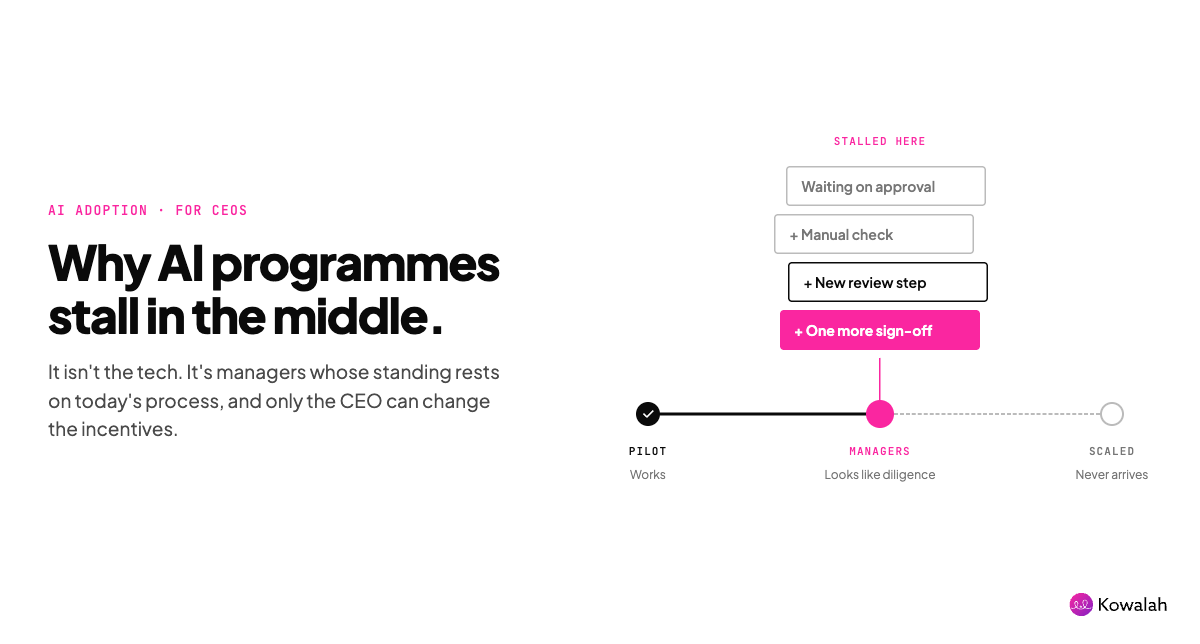
We are witnessing AI programmes that don't stall in the pilot or in IT - they stall in the middle of the organisation, with capable managers whose standing rests on the process AI is about to change. That isn't a character flaw. It's an incentive problem, and only the CEO can fix it.
This piece is for CEOs and executive sponsors at UK organisations of 1,000 to 10,000 people, and for the AI Ops leads who work with process owners every day. To run it, copy the free Manager AI Transition Plan. It's ungated, with a Google Doc version.
Why it matters now
This week's news made the tension hard to miss. On 21 October, TechCrunch reported a Nielsen survey of about 1,700 directors and senior managers across seven countries, commissioned by monday.com. The report found:
- 53% say AI has made it harder to evaluate an employee's original work.
- 47% spend more time reviewing and guiding their team's output.
- 58% expect to manage more AI agents than people within 12 months.
- Only 29% say their AI pilots have fully scaled.
It's a vendor-commissioned survey, so read it with that in mind. But the direction matches what we see.
Two days earlier, Calcalist reported that monday.com is flattening its own structure and, according to sources close to the company, steering middle managers towards voluntary exits. At Workday Rising, chief executive Aneel Bhusri said Workday had 13 levels between him and a developer, and that it offers middle managers individual contributor roles (InformationWeek).
Your managers read the same headlines. They can do the maths.
They have spent their career getting to the top of their pyramid - and there is little incentive for them to blow the existing structure up in the name of efficiency.
The evidence: fear slows adoption
A pre-registered experiment published by the Institute for Fiscal Studies tested this directly. It showed 2,000 managers in the US and UK a short video on AI's productivity benefits, on its potential to displace jobs, or a placebo. Managers shown the displacement evidence sharply reduced their intended AI adoption and advocacy. The productivity evidence made no significant difference on average.
The lesson for a CEO: telling managers AI will make them more productive doesn't win them over. Letting them believe it will shrink their team actively loses them.
The Wharton and GBK Collective 2026 AI Adoption Report shows where many organisations end up. Two-thirds of departments say they use AI agents, but only 17% let an agent complete a task without a person approving each step. GBK's Brian Smith calls it the "supervised middle", where returns are weakest.
How to spot a stall in the middle
It rarely looks like resistance. It looks like diligence.
- The pilot works, but the rollout keeps waiting for one more sign-off.
- Each redesign arrives with a new review step, so the process gets slower, not faster.
- Use cases stay personal (drafting, summarising) and never touch the team's core workflow.
- Ideas come from the AI Ops lead or the champions, never from the people who own the process.
- The business case counts hours saved, but nobody will say where those hours go.
Then look at what each manager's standing rests on today: the size of their team, the approvals that route through them, the expertise nobody else has. If AI changes that, expect caution, and plan for it.
We hear versions of this in client conversations most weeks. This week, one team with a promising prototype planned to show it to their sponsor before central teams heard about it, because they expected it to be slowed down. In another organisation, the person doing the most inventive work was building in his own time, without visible backing from above.
What the CEO has to change
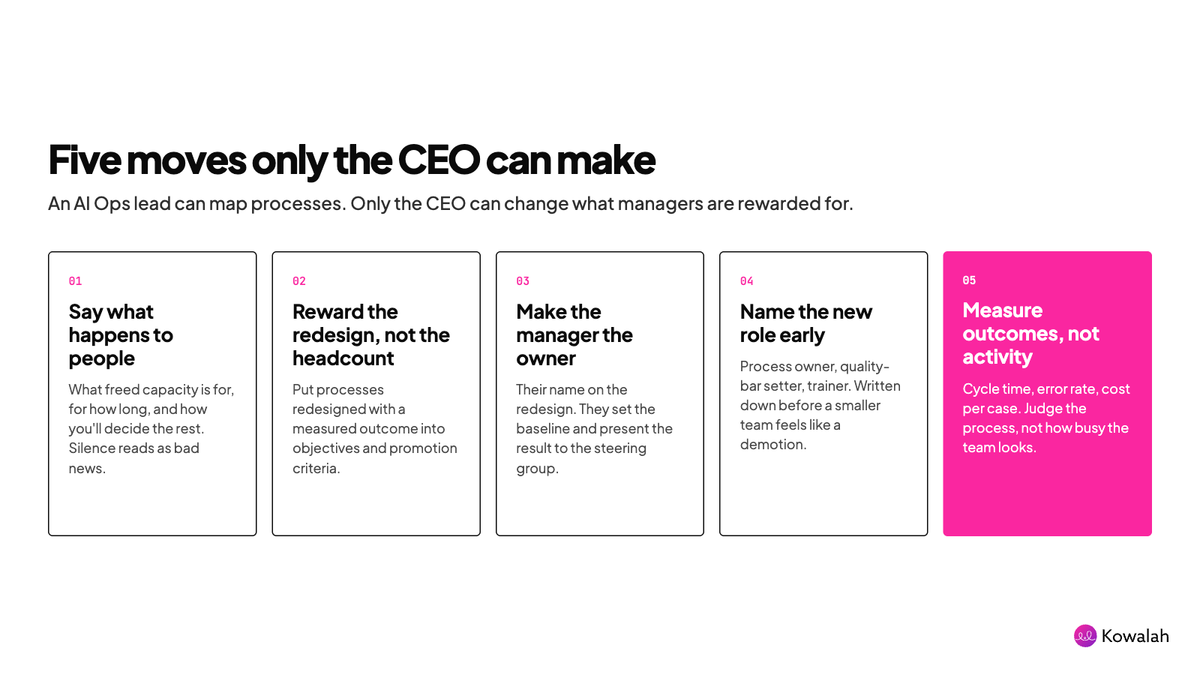
An AI Ops lead can map processes and score opportunities. Only the CEO can change what managers are rewarded for. Five moves make the difference.
1. Say what happens to people, plainly
Silence reads as bad news. Say what you will and won't do with capacity AI frees up, for how long, and how you'll decide the rest. If you can't promise no job losses, don't. Promise a clear process and a timetable instead.
2. Reward the redesign, not the headcount
If a manager's grade, budget and status rise with team size, they will protect team size. Add "processes redesigned with a measured outcome" to objectives and promotion criteria, and give it real weight.
3. Make the manager the owner, not the subject
Put the process owner's name on the redesign. They propose the opportunities, set the baseline and present the result to the steering group. People rarely block a change they get the credit for.
4. Name the new role before you need it
Workday offers managers individual contributor roles. Other routes include owning an agent-supported process, setting the quality bar agents work to, or training the next team. Write the role down early, so a smaller team doesn't feel like a demotion.
5. Measure outcomes, not activity
Managers already find AI-assisted work harder to judge. Give them better measures: cycle time, error rate, cost per case, customer outcome. Then judge the manager on how the process performs, not on how busy the team looks.
A worked example (fictional)
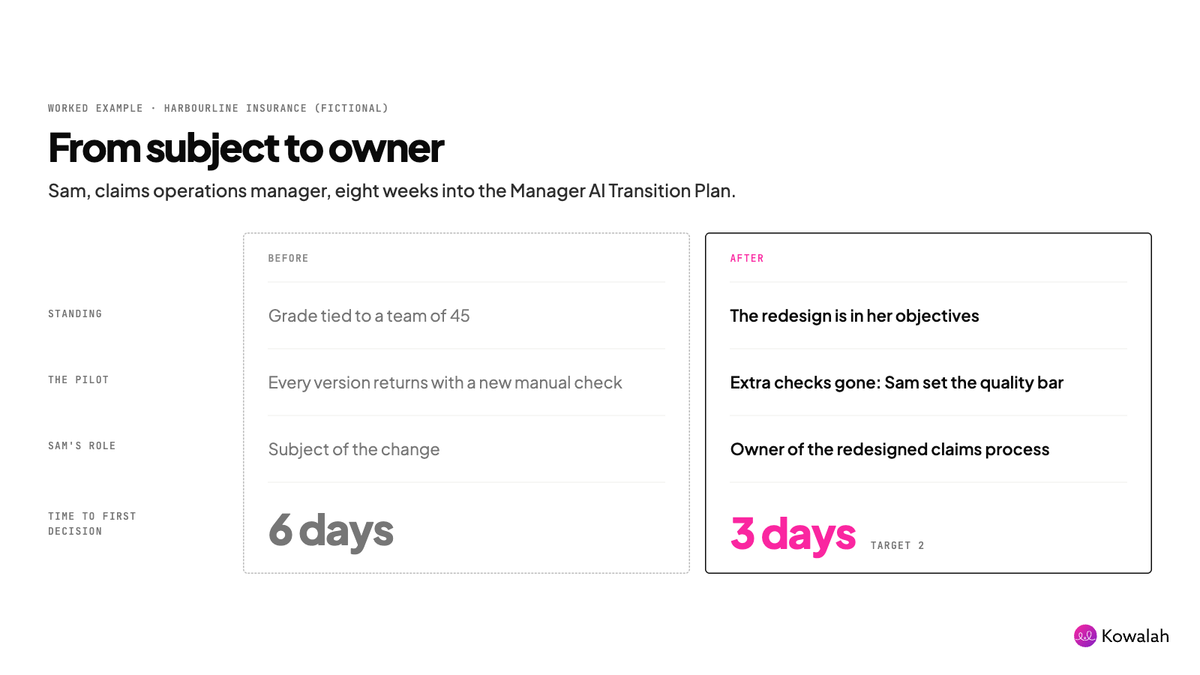
Harbourline Insurance is a fictional UK insurer with 4,000 staff. Its Claude rollout is six months in. Usage is healthy, but the claims redesign has been stuck for three months.
The claims operations manager, call her Sam, runs a team of 45 handlers. Her grade is tied to the size of her team. The AI triage pilot works, but every version comes back with a new manual check.
The CEO and the AI Ops lead sit down with the Manager AI Transition Plan:
- Status-quo map. Sam's standing rests on team size and on being the person who knows complex claims.
- Commitment. No compulsory redundancies from this redesign for 12 months. Freed capacity goes to the complex-claims backlog first.
- New role. Sam becomes owner of the redesigned claims process, including the quality bar the triage agent works to.
- Outcome. Average time to first decision: baseline 6 days, target 2, checked monthly by finance.
- Recognition. The redesign goes into her objectives, and she presents the result to the steering group.
- Next opportunity. Drafting fraud referral notes scores 336 on ICE (impact 7, confidence 6, ease 8).
Eight weeks later, the extra checks are gone, because Sam set the quality bar herself. The headline in the steering update is hers: time to first decision down from 6 days to 3, with the target still 2.
Common questions
Isn't this just change management?
Partly. The difference is that AI changes what a manager's job is, not just how the team works. A standard change plan trains people on a new tool. This plan changes what managers are measured and rewarded for.
Should we just remove a management layer?
Some companies are. But flattening without redesigning the work leaves the same approvals with fewer people. Redesign the process first, then decide the structure. Our piece on designing your org structure for an AI world goes further.
Who owns this: HR, the AI Ops lead or the CEO?
The CEO sponsors it, HR changes objectives and grading, and the AI Ops lead runs the plan with each manager. If only the AI Ops lead owns it, the incentives won't change.
How do we track it without another spreadsheet?
The template works on its own. If you'd rather keep it live, Kowalah's free plan lets you log each redesign as an opportunity, map the process and record outcomes as they land.
Get the plan
Copy the free Manager AI Transition Plan. No forms, no gating. If you'd like help running it with your leadership team, we're happy to talk it through.
Enjoyed this?
Weekly insights for executives navigating enterprise AI. A five-minute read.