Insights
GTM engineer vs RevOps: which should you hire first?
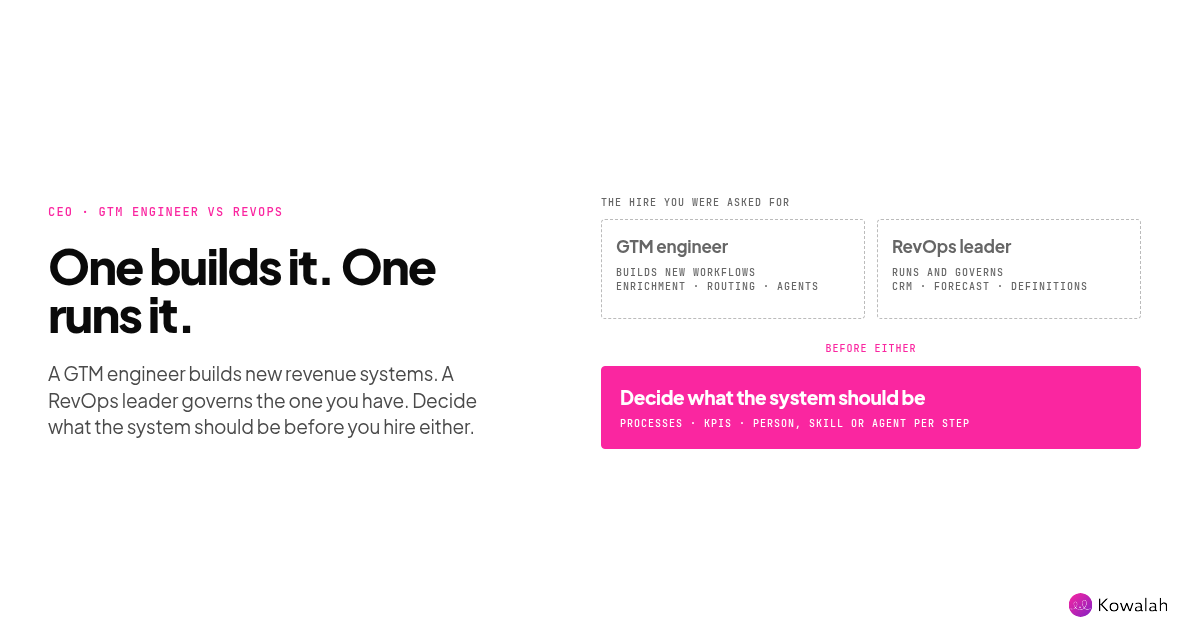
A GTM engineer builds new revenue systems: enrichment, routing, outbound workflows and agents. A RevOps leader owns the system the business already runs on: the CRM, the definitions, the forecast and the reporting. If your CMO wants one and your CRO wants the other, the right first hire depends on a question they can both answer: has anyone agreed what the system should do?
Below: the two roles side by side, what each costs in the UK, where each goes wrong on its own, and three questions that settle the order.
Why this lands on the CEO's desk
Both roles compete for the same headcount, and the job ads blur them. EMARKETER, citing Bloomberry's analysis of over 1,000 listings, reports that GTM engineering job postings grew 205% year over year between 2024 and 2025. The same analysis found that nine of 10 RevOps responsibilities also appear in GTM engineering listings.
So the skills lists overlap and the titles sound alike. The difference that matters is accountability: who builds, and who owns what the business runs on. EMARKETER puts it in one line: "RevOps manages and optimizes existing tools and processes, while GTM engineers build net-new infrastructure."
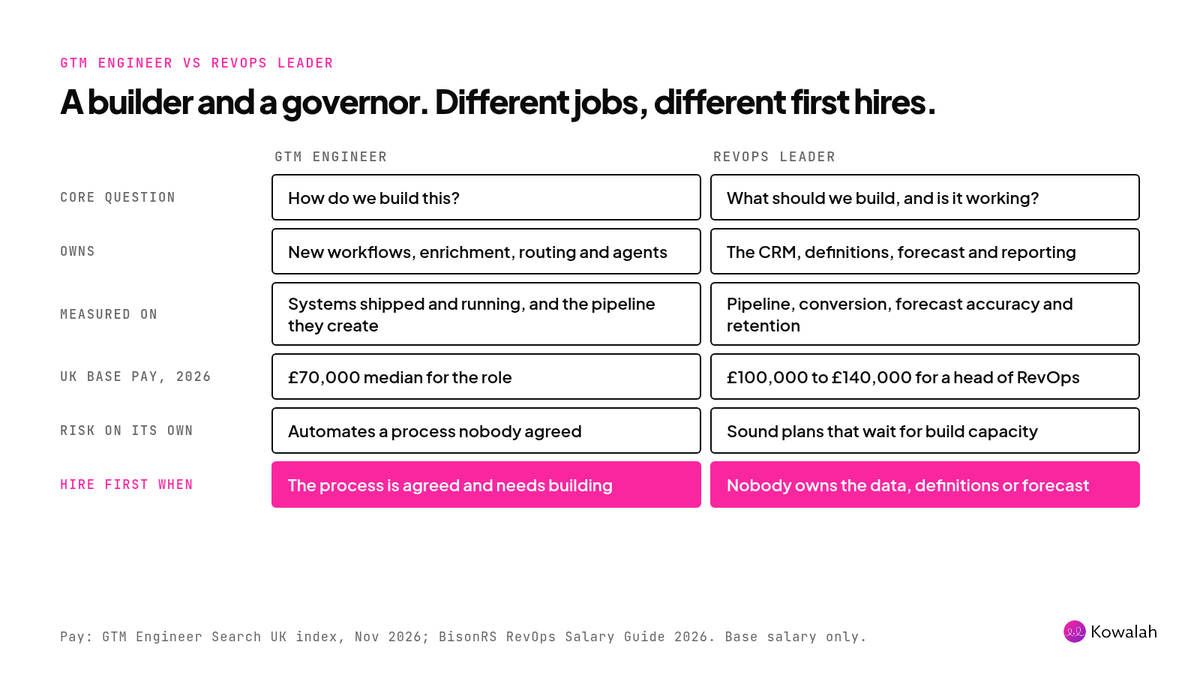
GTM engineer vs RevOps leader, side by side
| GTM engineer | RevOps leader | |
|---|---|---|
| Core question | How do we build this? | What should we build, and is it working? |
| Owns | New workflows, enrichment, routing and agents | The CRM data model, definitions, forecast and reporting |
| Measured on | Systems shipped and running, and the pipeline they create | Pipeline, conversion, forecast accuracy and retention |
| UK base pay (2026) | £70,000 median, middle half £60,000 to £85,000 | £100,000 to £140,000 for a head of RevOps |
| Typical background | SDR, RevOps or growth, plus SQL, Python and APIs | Sales or marketing operations, analytics, process design |
| Risk on its own | Automates a process nobody agreed | Sound plans that wait for build capacity |
| Hire first when | The process is agreed and needs building | Nobody owns the data, the definitions or the forecast |
What a GTM engineer does
A GTM engineer is a builder. EMARKETER describes the work as designing, building and maintaining automated systems: data enrichment pipelines, lead scoring models, CRM integrations and outbound sequences. Bloomberry found that 38% of GTM engineering postings ask for SQL or Python, and EMARKETER names SDR or BDR work as the most common route into the role.
Cost: the GTM Engineer Search salary index puts the UK median base at £70,000 across 24 postings from 19 employers in the last year, with the middle half between £60,000 and £85,000 (as of 16 November 2026). That's base only, before employer National Insurance, pension and recruiter fees.
What a RevOps leader does
A RevOps leader is a governor. They own the revenue system across marketing, sales and customer success: the CRM data model, stage definitions, routing rules, the forecast and the reports the board reads. As agents take on more of the admin, the job shifts. On our CRO page we describe it as RevOps setting the rules while agents keep the CRM current and flag the exceptions.
Cost: the BisonRS RevOps Salary Guide 2026, drawn from over 200 placements, puts a UK head of RevOps on £100,000 to £140,000 base, or £120,000 to £175,000 with bonus. A RevOps manager sits at £65,000 to £85,000 base.
Where each goes wrong on its own
A GTM engineer with no agreed process. They build what they're pointed at, and the backlog comes from whoever asks loudest. EMARKETER's warning is plain: automated systems amplify bad data, and clean data infrastructure must come before automation. Ask yourself: could your CMO and CRO agree, today, on the definition of a qualified lead?
A RevOps leader with no build capacity. The data gets cleaner and the forecast more honest. The new workflows queue behind IT, an agency or one stretched CRM admin. Ask yourself: how long did the last routing change take to ship?
Both at once, with no reporting line agreed. The experts disagree. Revenue Wizards puts the GTM engineer inside the RevOps function and argues the first hire should be a RevOps generalist. Oren Greenberg argues GTM engineering should sit alongside RevOps, both reporting to the CRO, and never report into it. Ask yourself: who ranks the build backlog, and against which revenue goal?
The question before either hire
Both hires assume someone has already decided what the revenue system should do. That decision is the gap, and neither role is set up to make it alone. A GTM engineer builds what they're pointed at. A RevOps leader governs what exists. Redesigning how the business finds, wins and keeps customers needs the CMO and CRO in the room, process by process, with a KPI on each.
That's the third option we'd put on the table: redesign the function first, then hire the role the work needs. We covered that route in Should you hire a GTM engineer? This piece is about the order once you know the work.
Which comes first: three questions
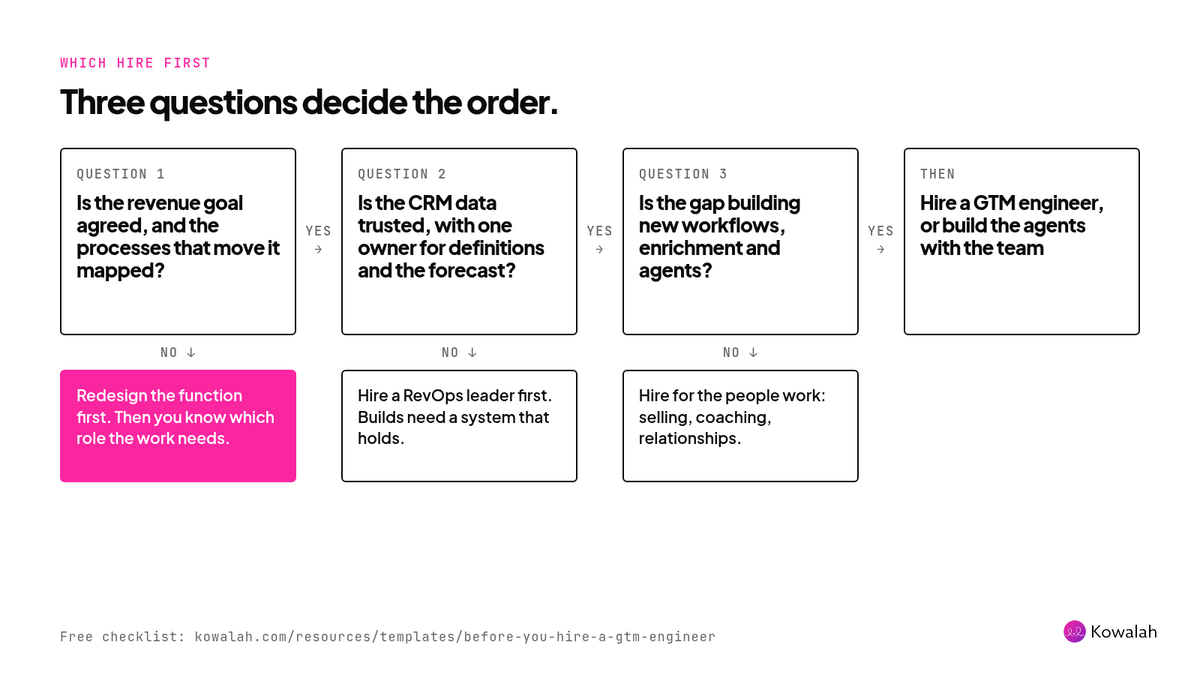
- Is the revenue goal agreed, and the processes that move it mapped? If not, redesign first. Pick the goal (new pipeline, net revenue retention, cost per opportunity), map the processes behind it, and tag each step as person, skill or agent.
- Is the CRM data trusted, with one owner for definitions and the forecast? If not, hire a RevOps leader first. Agents and workflows built on data nobody trusts spread the errors faster.
- Is the gap building new workflows, enrichment and agents? If yes, hire a GTM engineer, or build the first agents with your team on your own Claude and hire once you know what's left to run. If not, the gap is people work: selling, coaching and relationships. Hire for that.
Questions leaders ask us
These come up when leadership teams weigh the two hires.
Our new revenue leader wants a RevOps hire first, with a GTM engineer underneath. Is that the right order? It's a sound order if the CRM and the forecast are the weak point. Read the job description first. If it reads like a sales operations role from five years ago, it won't attract someone who can run a system where agents do part of the work.
Can one person do both? For a while, on a small team. The skills overlap, as the job data shows. The accountability doesn't: the person who sets the definitions shouldn't also be the only one grading the builds against them. Split the roles when the build backlog starts crowding out the governance work.
Should we use a consultant before we hire? EMARKETER suggests a three-to-six-month engagement before committing to a full-time GTM engineer, citing The Signal. If you go that way, make sure what gets built stays with you: documented, owned by a named person, and running on your own accounts.
Who should own the AI work in the revenue team? The executive who owns the number. RevOps runs the system and a GTM engineer builds in it, but the CMO and CRO own the goals each agent is measured on.
Where Kowalah fits
We're a UK Anthropic Implementation Specialist. We work with CMOs and CROs to map the processes behind their revenue goals, decide which steps need a person, a skill or an agent, and build the first agents with their team on their own Claude. Each agent is measured on the KPI it moves, and you own it. The aim is a first agent live before a new hire would start, so the role you post is defined by the work, not the other way round.
That work can take the form of an AI marketing or sales plan or an Agent Pilot on one bottleneck.
Talk it through first
Book a free 45-minute planning session. Bring the revenue goal and the role you're about to post, and we'll work out the order with you. Or start with our free Before you hire a GTM engineer checklist. For how we work with each role, see the CMO and CRO pages.
Enjoyed this?
Weekly insights for executives navigating enterprise AI. A five-minute read.