Insights
Marketing attribution: 6 myths that stop CMOs proving marketing's contribution
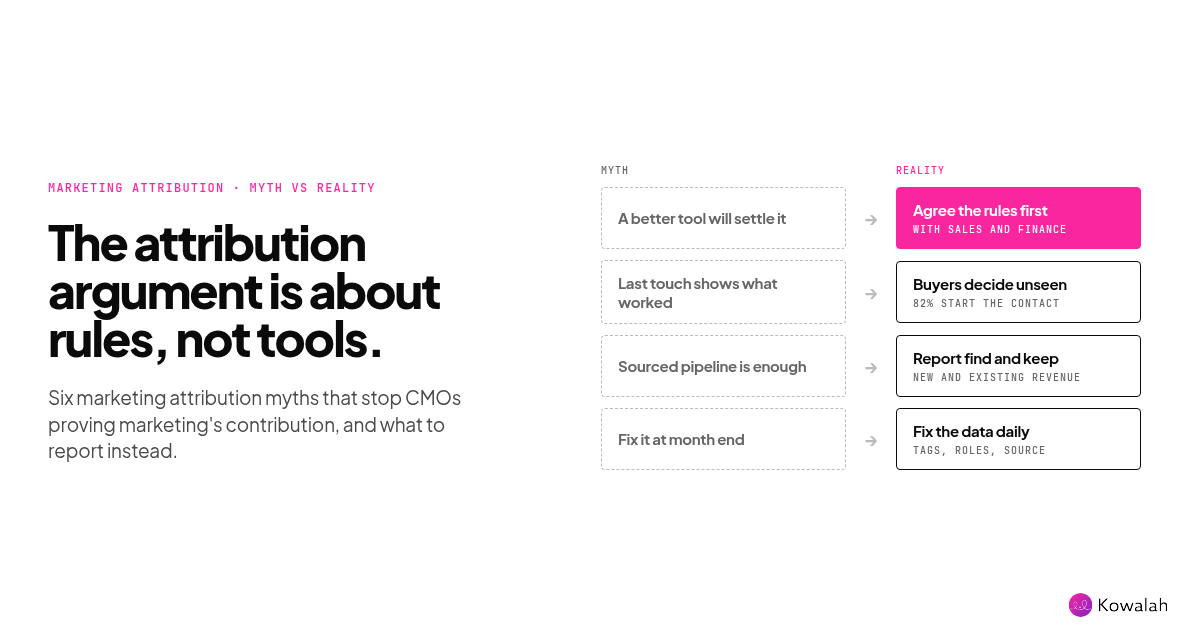
Your CEO and CFO want to know what marketing added to revenue this year. Attribution is how most teams answer, and it's where the argument starts: whose touch counts, which model, which report. Better software won't end that argument. Agreed rules, clean daily data and three reads side by side will. Here are six marketing attribution myths CMOs hear, what's true, and what to report instead.
This is for CMOs, VPs and Heads of Marketing at UK enterprises of 1,000 to 10,000 people, in tech, financial services and retail, who are judged on pipeline and revenue and asked to prove marketing's part in both.
Why this keeps coming up
Proving contribution is hard for everyone. In Gartner's 2024 survey of 378 senior marketing leaders, only 52% said they were successful in proving marketing's value and receiving credit for it. They ranked CFOs (40%) and CEOs (39%) as the executives most sceptical of marketing's value.
Confidence is low too. The ANA's Confident B2B Marketer study, a survey of 200 senior US B2B marketing leaders in May 2025, found only 39% were extremely or very confident they could measure marketing's impact on financial performance.
Both are US or global surveys, so read them as direction, not a UK benchmark. The pattern matches what we hear from UK marketing leaders: the board asks a simple question, and the answer takes a week and a spreadsheet.
Myth 1: A better attribution tool will settle the argument
Reality: the argument is about rules, not software. Every tool applies a rule: which touches count, over what window, and how credit is split. If marketing, sales and finance haven't agreed those rules, a new tool gives you a new number to argue about.
The gaps sit in the data as well as the model. In Anteriad and Ascend2's 2026 B2B Marketing Edge report, a survey of 631 marketing decision-makers in the US, UK and APAC, 33% named connecting marketing activity to closed revenue as one of their biggest analytics challenges. 28% named a lack of confidence in the accuracy or completeness of their data.
Before you buy anything, write the rules on one page and ask the CRO and CFO to sign it: what counts as marketing-sourced, what counts as influenced, the lookback window, and which touches are in scope. Then any tool you already own can apply them.
Myth 2: Last touch shows what worked
Reality: by the last touch, the buyer has decided. 6sense's 2026 B2B Buyer Experience Report found buyers first engage sellers roughly 59% of the way through an average 10.3-month cycle, after 91.4% have already ranked their shortlist. The buyer's team initiated 82% of first vendor contacts, and only 35.2% of buyers used their own contact information on a form.
So the last touch records the buyer arriving, not the reason they came. First touch has the opposite problem: it credits whatever you happened to track first, months after the buyer started reading, asking peers and forming a view.
Keep first and last touch in the CRM. They're useful facts. Just don't present either one as the answer to "what worked?"
Myth 3: Multi-touch attribution gives you the true answer
Reality: multi-touch shares credit among the touches you can see. It can't say whether the deal would have happened without them, and it can't see the peer conversation, the podcast or the AI answer that put you on the shortlist.
Use it as one of three reads:
- An attribution model from your CRM, for which tracked touches came before the deal.
- Self-reported attribution: a free-text "How did you hear about us?" field on every form, and the same question in the first call.
- Channel tests: switch a channel off, or double it, in one region or segment for a set period, and compare pipeline with the rest.
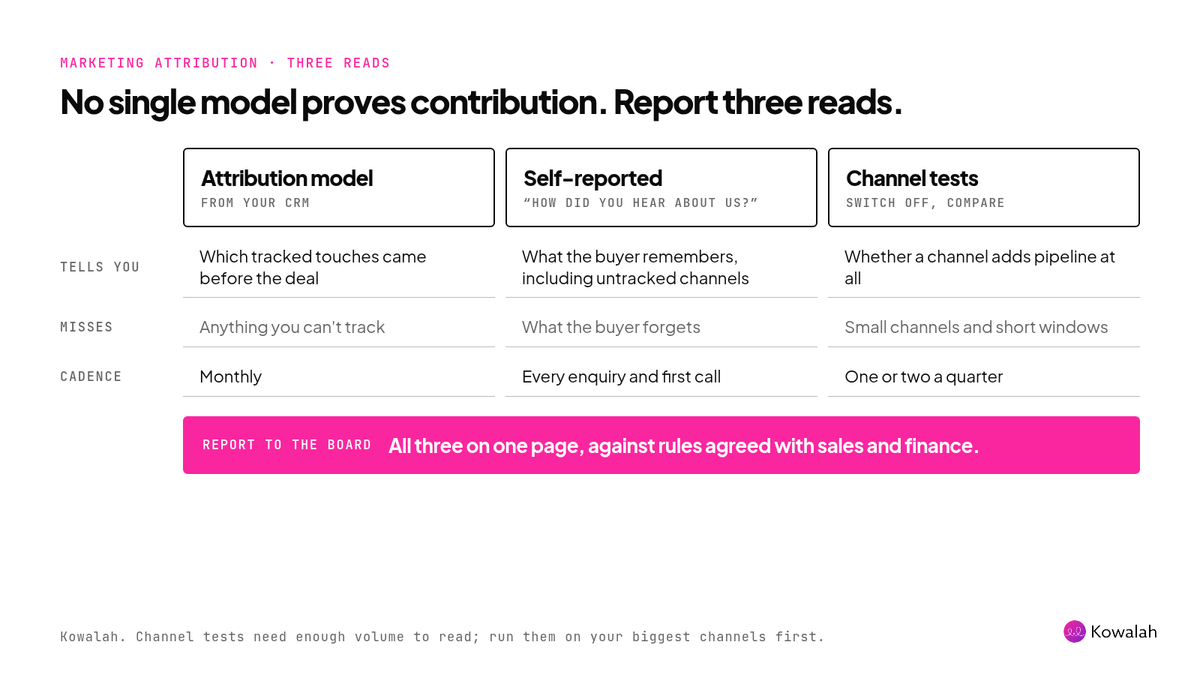
When the three agree, you have a story the CFO can test. When they disagree, you've found the question worth an hour of the leadership team's time.
Myth 4: Marketing-sourced pipeline is the number that proves contribution
Reality: sourced pipeline is a KPI. The number you're judged on is revenue, from finding new customers and from keeping and growing the ones you have. Emily Kramer of MKT1 counts increasing the value of customers (upsell, expansion and pricing) as one of the four revenue levers marketing can pull, alongside two ways to grow the top of the funnel and improving efficiency. A report that stops at new pipeline leaves one of the four out.
Gartner's survey points the same way. Leaders who used two or more "high complexity" metric types, such as customer lifetime value, CAC and the ratio between them, were up to 1.8 times more likely to prove value and get credit than those who used none.
Report sourced and influenced pipeline side by side, with the definitions from your one-page rules. Add CAC and cost per opportunity. Where marketing runs onboarding or customer programmes, add adoption and expansion from those accounts.
Myth 5: Attribution is a month-end reporting job
Reality: attribution is decided every day, at the moment data enters the CRM. By month end it's too late to fix. The leaks are dull and predictable: campaign links without tracking tags, an original source overwritten by a later touch, event attendees loaded a week late or never, and opportunities with no contacts attached, so marketing's touches never connect to the deal.
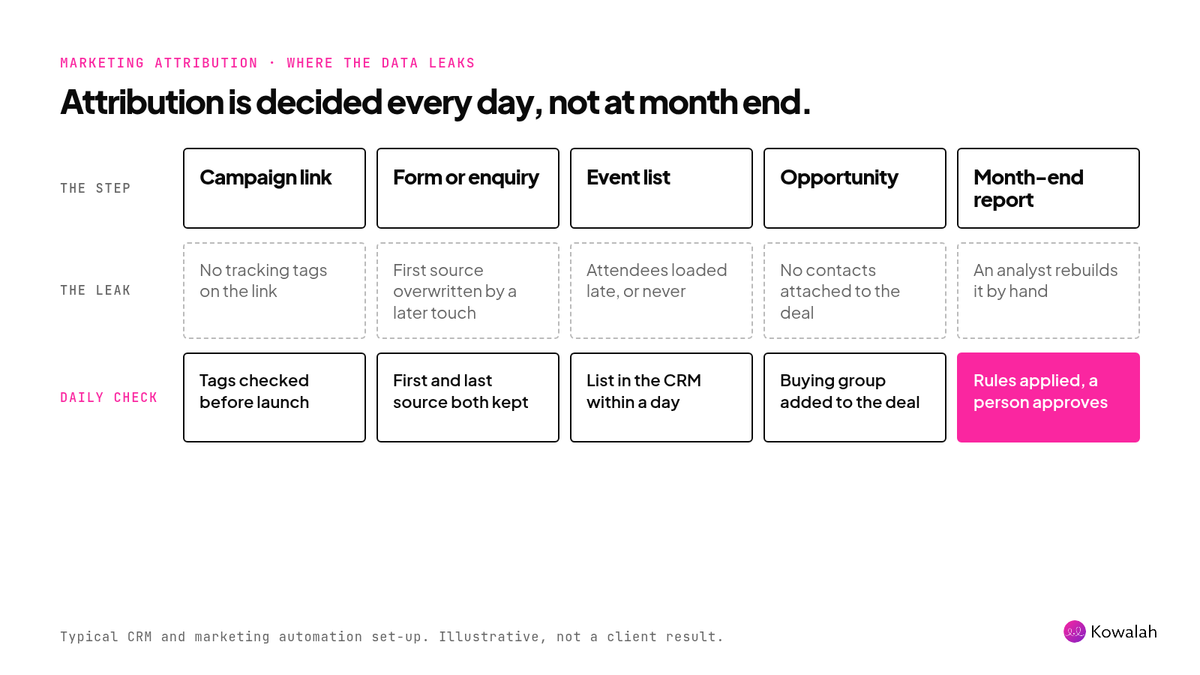
Then someone in marketing ops rebuilds it by hand. We took that process apart in our monthly marketing report teardown: the days go on fixing data, not reading it. Move the checks to the day the data arrives, and the month-end report applies your rules instead of rebuilding them.
Myth 6: AI search makes attribution impossible, so stop trying
Reality: AI answers add a touch you can't track, but they aren't the main one yet. In the same 6sense report, 81% of buyers used LLMs, yet only 17% to 21% cited them as an influential source during their decision process. Buyers ranked their own knowledge and conversations with colleagues higher.
Treat visibility in AI answers as its own KPI: how Claude, ChatGPT and Perplexity describe you when buyers ask. Confirm it with the self-reported field, where buyers will write "ChatGPT" if that's where they found you. Our AI search visibility myths post covers how to measure it.
AI is also good at the grind behind attribution. An agent can code every free-text answer into your channel list, check campaign tags before launch, flag opportunities with no contacts attached, and draft the monthly narrative for a person to approve.
What to report instead
One page, each month, judged against the rules you agreed:
- The rules: sourced and influenced definitions, the lookback window and what's in scope, signed by marketing, sales and finance.
- Pipeline: sourced and influenced, by channel, from your attribution model.
- What buyers say: self-reported answers, coded into the same channel list.
- What the tests show: any channel test that finished this quarter.
- Efficiency and keep: CAC, cost per opportunity, and adoption and expansion where marketing runs customer programmes.
- Data health: the share of opportunities with contacts attached, and the share of campaign touches with tracking tags.
Record data health before you change anything, then track it monthly. It's the leading indicator for every other line on the page.
Where Kowalah fits
Kowalah is a UK Anthropic Implementation Specialist. On our page for CMOs, channel planning and attribution is one of the six processes behind a marketing team's number, measured on CAC and cost per opportunity.
We don't sell an attribution tool. HubSpot, Salesforce and your analytics own the data. We build agents with your team, on your own Claude, for the daily checks above: coding self-reported answers, checking tags and contacts, and drafting the monthly report. They start read-only, a person approves what reaches the leadership team, and each one is measured on the KPI it moves. You own them and see what they cost.
If you'd like a second pair of eyes, book a free 45-minute planning session. Bring your pipeline target and how you report marketing's contribution today, and leave with a one-page plan for the first three processes to change. Our free Monthly Marketing Report Template gives you a one-page structure to start from.
Frequently asked questions
What is marketing attribution?
The rules and data that connect marketing activity to pipeline and revenue. It assigns credit for a deal to the touches that came before it, using a model such as first touch, last touch or multi-touch.
What's the difference between marketing-sourced and marketing-influenced pipeline?
Sourced pipeline is where marketing created the first qualifying touch, by the definition you agree. Influenced pipeline is any opportunity with a marketing touch before or during the deal. Report both, with the definitions on the page.
Which attribution model is best for B2B?
No single model. B2B buyers decide before they're visible, so every model misses part of the journey. Pair a model from your CRM with self-reported attribution and channel tests, and judge all three against rules agreed with sales and finance.
How do you prove marketing's value to a CFO?
Agree the rules with finance first. Then report pipeline, CAC and cost per opportunity, and revenue from existing customers where marketing runs programmes, all against those rules. A CFO trusts a number they helped define.
Can AI improve marketing attribution?
Yes, on the inputs. Agents can code free-text self-reported answers, check tracking tags and contacts on deals every day, and draft the monthly report for a person to approve. They don't replace the rules; they apply them the same way every time.
Enjoyed this?
Weekly insights for executives navigating enterprise AI. A five-minute read.