Insights
Claude for marketing teams: 10 questions marketing leaders ask, answered
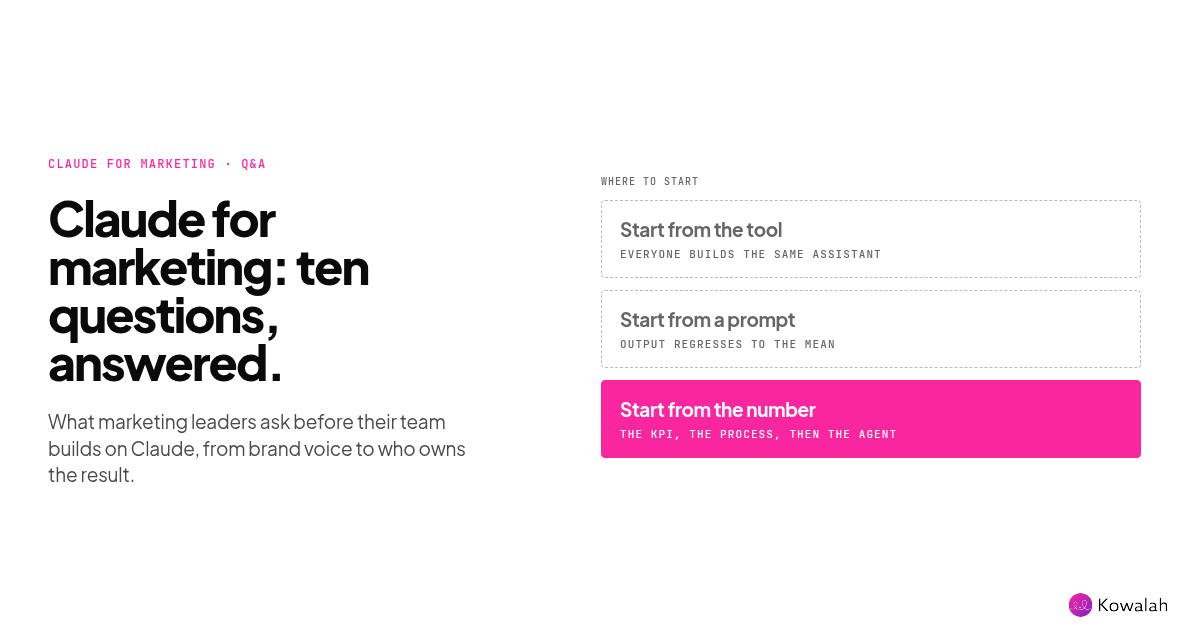
Claude for marketing works when it starts from the number you're judged on, not from the tool. Start from the tool and every team builds the same assistant while the pipeline target stays where it was.
These are the ten questions marketing leaders have put to us in recent calls and training sessions, anonymised and tidied, each with a direct answer.
The short version: pick the KPI, find the process that fills your team's week, write your brand into a skill, connect Claude to your data read-only, and keep a person on every judgement call.
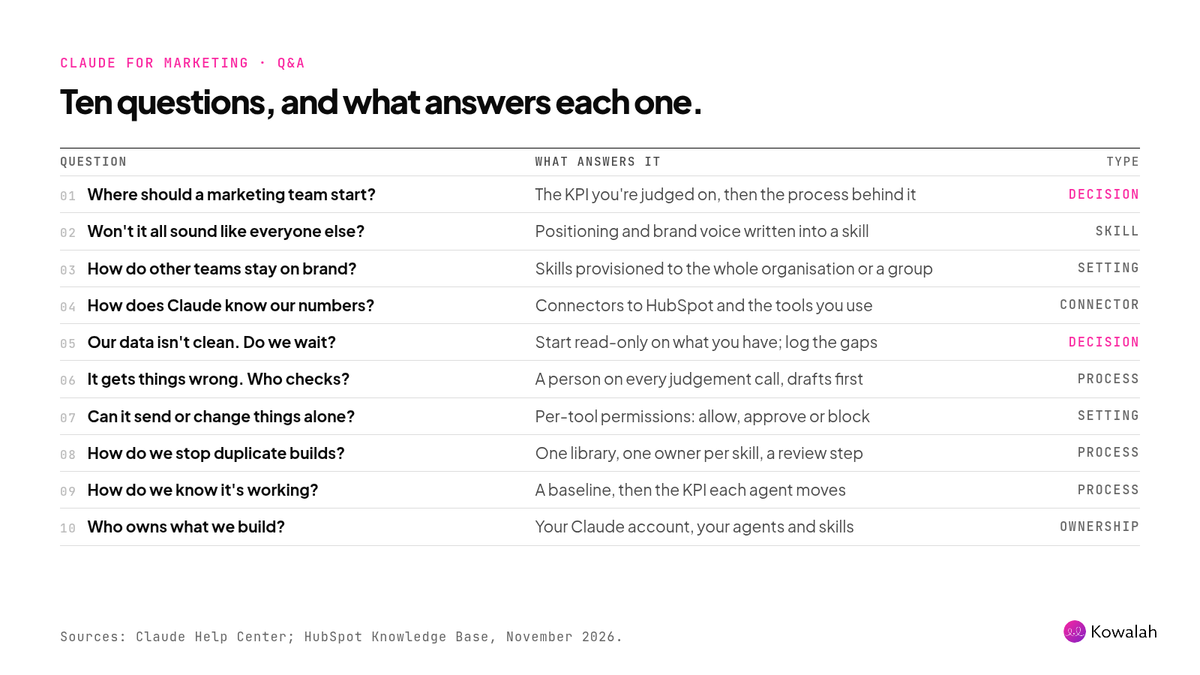
1. Where should a marketing team start with Claude?
Start from the number. Name the pipeline or revenue target you're judged on, then the KPI beneath it that's furthest off: speed to lead, MQL to SQL conversion, cost per opportunity, or new customers using what they bought before the renewal.
Emily Kramer of MKT1 gives CMOs a useful way to choose: the four revenue levers. Grow the funnel with your existing audience, grow it with a new audience, increase revenue per customer, or improve efficiency through conversion and acquisition cost. Rank them, then pick the process behind your top lever. That's where Claude goes first.
We set out the full planning steps in how to write an AI marketing plan your CEO will read.
2. Won't everything we produce sound like everyone else's?
It will if you prompt from a blank page. Ask for a post about your launch and you get the average of everything Claude has read. One marketing leader described it to us as regressing to the mean.
The answer is to put your taste in writing. Write your positioning, audiences, proof points and tone of voice into a skill, Claude's format for a repeatable workflow. Anthropic lists applying brand guidelines as a typical custom skill. Every draft then starts from your positioning, not from nothing.
The judgement stays with your team: what to say, what to cut and what's worth publishing.
3. How do demand gen, field and customer teams stay on brand?
Share the skill, not the brand guidelines PDF. On Claude Team and Enterprise plans, an owner can provision a skill to the whole organisation from one place, and it's switched on for everyone by default. Enterprise plans can also bundle skills into a plugin and give it to one group, such as marketing, so only that group sees them.
Your brand team owns the skill and everyone else uses it. Change it once and every team's next draft changes with it. Worth knowing: from 30 November 2026, Enterprise organisations manage plugins, skills and connectors from one Plugins page.
4. How does Claude know our numbers if it isn't connected to the CRM?
It doesn't. Without a connection to your systems, Claude answers from what you paste in. Connectors close that gap. The HubSpot connector for Claude is Anthropic-verified and lets Claude read contacts, deals and campaigns, analyse marketing email performance and, on Marketing Hub Professional or Enterprise, report campaign attribution.
A connector works with the permissions of the person using it. If someone can't see a record in HubSpot, Claude can't see it for them either. The same pattern applies to the other systems in Claude's connector directory.
5. Our data isn't clean. Should we wait for the data team?
No. Waiting for perfect data is how a quarter disappears. Connect read-only to the systems you have and ask the questions you'd ask anyway: which segments converted last quarter, which event leads never got a follow-up, which campaigns produced opportunities rather than clicks.
The answers that come back wrong are useful too. They show the data team which fields and definitions to fix first, ranked by the questions marketing actually asks.
6. It gets things wrong. How much checking do we need?
Claude (like humans) makes mistakes, so design for them. Decide where the person sits before you build: Claude does the pulling, matching and first draft, and a person makes the judgement call and approves anything a customer will see.
Check the output against the KPI, not only the prose. A well-written follow-up that goes to the wrong segment still costs you pipeline. Our event follow-up teardown shows that split step by step.
7. Can Claude send emails or change records on its own?
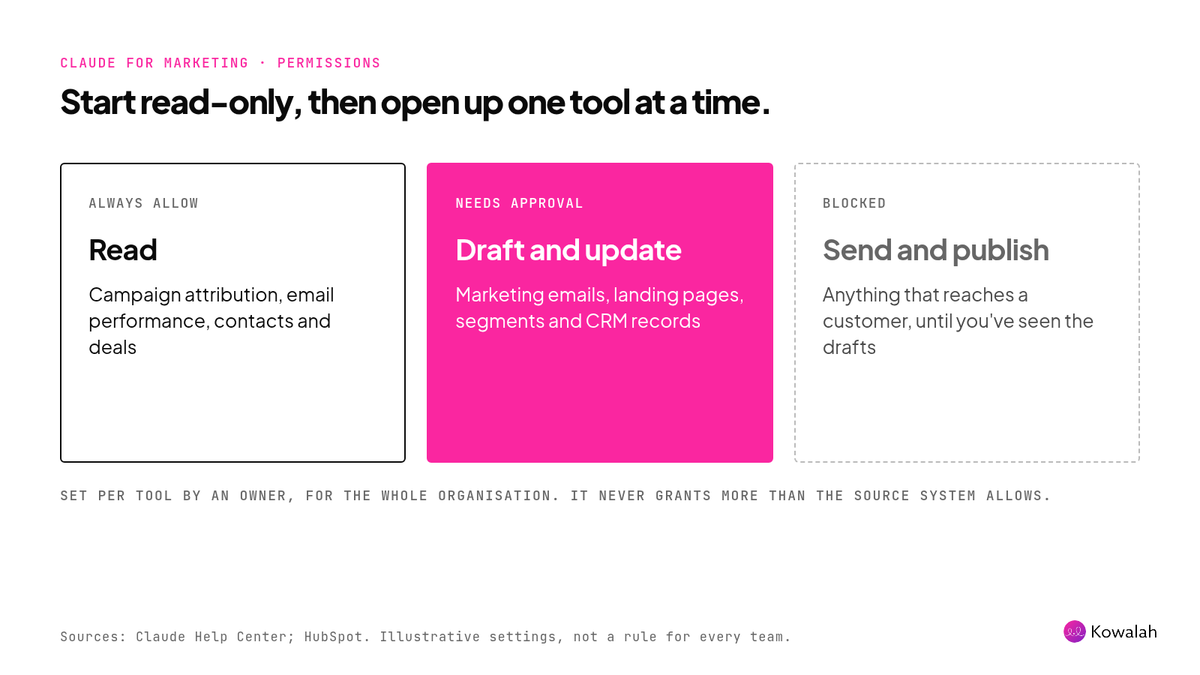
Only if you let it. On Team and Enterprise plans, an owner sets each connector tool to Always allow, Needs approval or Blocked for the whole organisation, and individual users can't override it. The setting only narrows access. It never grants more than the source system allows.
This matters in marketing because the HubSpot connector can create and update campaigns, landing pages, blog posts, marketing emails and segments. A sensible start: let Claude read freely, require approval for anything it drafts or changes, and block sending and publishing until the drafts have earned your trust.
8. How do we stop everyone building the same thing?
Give every skill one home and one owner. Team members can submit a skill they've built to the organisation's library, and where the organisation requires review, an owner approves each submission and every later version before it's published.
Then keep a short register: what each skill does, who owns it and which KPI it serves. A skill with no owner falls behind the first time your positioning or your process changes.
9. How do we know it's working?
Measure before you build. Ask each person in the team to log one normal week, with the hours on content, event follow-up, enquiries and reporting counted separately. Multiply by 52 and you have a baseline.
Time saved is a useful key result, but it isn't the headline. The headline is the KPI the agent was built to move: enquiries answered within minutes, event leads followed up the same day, more MQLs accepted by sales. Record the reading before the agent goes live and every month after.
10. Who owns what we build?
You should. Build on your own Claude account and the agents, the skills and the record of what they did are yours. When the person who built them leaves, they stay.
That's the risk in handing it all to one new hire: the automations live in one person's head unless someone writes them down. We set out the trade-off in should you hire a GTM engineer?
What to do next
Pick one KPI, one process and one skill. You'll learn more from one agent measured on a real number than from ten clever prompts.
If you'd like a second pair of eyes, book a free 45-minute planning session. Bring your pipeline target and leave with a one-page plan: the first three processes to change, the agents and skills for each, and how your team changes. Or see how we work with CMOs.
Prefer to start on your own? Use the free AI marketing plan template, or bring your team to a Claude for Marketing morning and build your 2027 plan on your own numbers.
Enjoyed this?
Weekly insights for executives navigating enterprise AI. A five-minute read.